Science of baby sleep
0 min read
How to reduce SIDS risk: A guide for parents and caregivers

Medically Reviewed Dr. Hormuz Nicolwala, Director of the Infant Apnea Program at Stony Brook Children's Hospital, NY
Written by Cradlewise Staff
Sudden Infant Death Syndrome (SIDS) is one of the most frightening things a new parent can think about. It’s natural to search for “how to prevent SIDS” and want to know everything you can do to keep your baby safe. While SIDS cannot be prevented 100%, the good news is that there are steps you can take to lower your baby’s risk.
Safe sleep practices can make a meaningful difference, and knowing what they are can help you and your baby’s caregivers feel more confident about your baby’s sleep environment.
In this guide, we’ll walk you through ways to reduce SIDS risk, from how to set up your baby’s sleep space to everyday habits that support safer sleep.
We spoke with Dr. Hormuz Nicolwala, Director of the Infant Apnea Program at Stony Brook Children’s Hospital, NY, and Joanna Kreyling, CPNP-PC, IBCLC at 1 Natural Way, to break down what’s actually known how to reduce SIDS risk, and how to talk about it with everyone who cares for your baby.
Cradlewise Note: If you’re reading this after losing a baby to SIDS, we’re deeply sorry for your loss. SIDS is sudden and often unexplained, and you deserve support as you navigate your grief. Organizations like First Candle and the CJ Foundation for SIDS offer grief support and resources for families who have experienced infant loss.
What is SIDS?
Sudden Infant Death Syndrome is the sudden, unexplained death of an otherwise healthy baby under one year old, most often during sleep. It’s rare. It’s also the leading cause of death for babies between one month and one year, which is why the guidance around it is so specific. For a deeper look at what researchers believe contributes to SIDS, see our guide on what causes SIDS.
Much of what we know about SIDS today traces back to decades of research, including the work of Dr. Hannah C. Kinney. Her studies helped establish that SIDS has a biological basis rooted in the brainstem, the part of the brain that helps regulate breathing and arousal from sleep. That discovery helped us to know SIDS a little – from an unexplained tragedy into a condition we could actually study, understand, and act on.

Did you know?
In the US, about 1,300 babies are lost to SIDS each year.
When does SIDS risk start?
According to the Triple Risk Model, SIDS tends to occur when three factors overlap:
- An underlying vulnerability in the brainstem, the part of the brain that helps regulate breathing, heart rate, blood pressure, and arousal from sleep. These abnormalities are not apparent and are often undetectable in a healthy-looking baby.
- A critical window of nervous system development. An infant’s autonomic nervous system, which controls many of the body’s automatic functions, is still maturing during the first few months of life.
- An environmental stressor like unsafe sleep conditions, including sleeping on the stomach, overheating, soft bedding, pillows, or other unsafe sleep environments.
When these overlap, the risk of SIDS is highest.
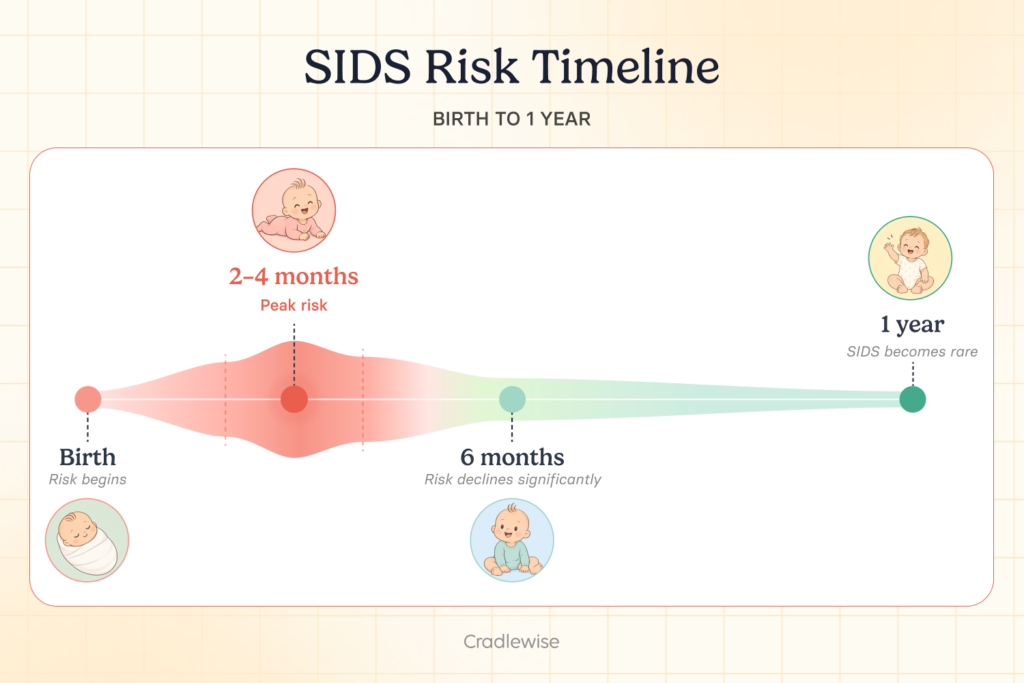
When does SIDS risk end?
SIDS risk declines significantly after 6 months as your baby’s nervous system matures, and by their first birthday, SIDS becomes rare.
Joanna Kreyling explains the reason behind it: Between 2 and 4 months, infant brains undergo rapid development that impacts their heart rate, breathing, sleep cycles and ability to wake themselves up. They also do not have great control and strength over muscles and airways. By 6 months, these are more developed and the risk of SIDS lessens.
How to prevent SIDS
SIDS is not completely preventable. But, the American Academy of Pediatrics (AAP) has a well-researched set of guidelines that, together, help lower SIDS risk.
1. Always place your baby on their back to sleep
This is the single most protective step. Babies clear spit-up and reflux more easily on their backs, since the windpipe sits above the esophagus.
2. Use a firm, flat sleep surface
A firm crib or bassinet mattress with a fitted sheet, nothing else, is the safest setup for every sleep.
3. Room sharing without bed-sharing
Having your baby sleep in the same room, but not sharing a bed, for the first 6 to 12 months is one of the more protective habits you can build. See our full guide to safe sleep practices for setup tips.
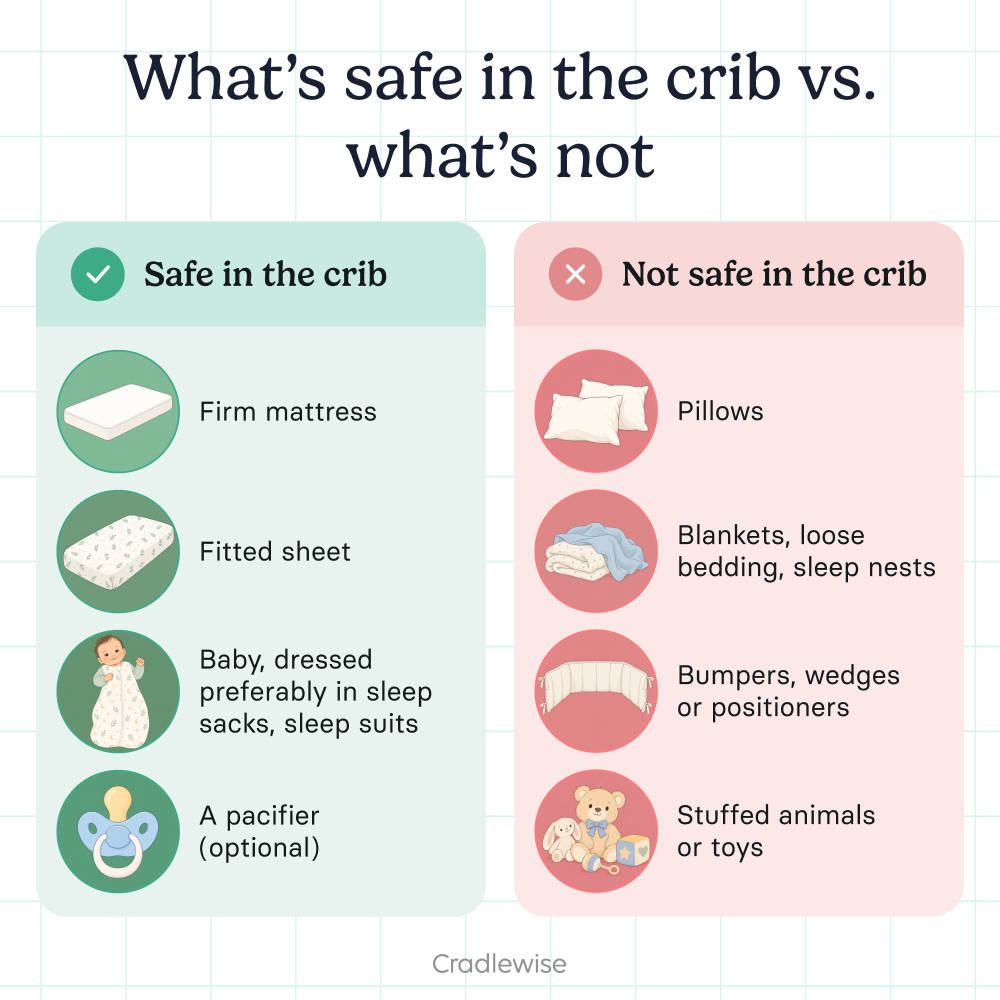
4. Keep the sleep space bare
While these products may sound reassuring, most have not been shown to reduce the risk of SIDS and are not recommended by the American Academy of Pediatrics.
Our safe sleep checklist walks through exactly what belongs, and what doesn’t, in your baby’s crib.
Consider a pacifier at sleep times
Offering a pacifier at naps and bedtime is associated with a lower SIDS risk, even if it falls out after your baby falls asleep.
Breastfeed if you’re able to
Research suggests that breastfeeding lowers the risk of SIDS by 50%.
However, if breastfeeding isn’t possible for you, please know that you are not putting your baby’s safety in your hands by not breastfeeding. Breastfeeding is only one factor associated with SIDS risk, and there are many other things you can do to create a safer sleep environment for your baby.
7. Avoid smoke exposure
Keep your home, car, and car seat free of cigarette and nicotine smoke, both during pregnancy and after birth.
8. Avoid overheating
It’s natural to worry about a baby being cold. What’s less well known is that overheating raises SIDS risk.
9. Keep up with well-baby visits and vaccinations
Decades of high-quality research have found no evidence that vaccines cause SIDS. In fact, the opposite appears to be true.
To give you some context, SIDS risk has been, and continues to be attributed to vaccines. Read along to know that myth busted by Dr. Nicolwala.
Did you know?
It’s not a coincidence that vaccine appointments and SIDS risk both cluster around 2 to 4 months. Immunizations protect against illnesses that make breathing harder, which is part of why vaccinated infants show a lower SIDS risk.
See our full guide to your baby’s vaccine and immunization schedule.
10. Every sleep counts, not just nighttime
Every nap and every nighttime sleep should follow the same safe sleep recommendations. However, make a note that even families who follow every guideline can still experience SIDS.
11. If you’re too exhausted to stay awake while feeding
Joanna adds: If you are exhausted, the safest place might be lying on the bed with pillows and blankets removed and away from the edges. Should you fall asleep, you can move your baby to their crib upon awakening.
How to talk to caregivers about safe sleep
This is one of the most common, and understandable challenges new parents face.
Following safe sleep practices yourself is only half the picture. Anyone who cares for your baby needs to be on the same page, including grandparents, babysitters, friends, and family members who may have raised their own kids differently.
Dr. Nicolwala and Joanna Kreyling have an interesting approach to talk to caregivers:
- A respectful approach works best. Acknowledge that recommendations have changed over time and recognize the experience of grandparents and caregivers.
- Ask them about their past experiences with infant feeding, sleeping and care practices.
- If they did any risk reduction techniques such as not smoking or breastfeeding back then, pat them on the back
- Instead of suggesting they ‘did it wrong,’ explain that today’s recommendations are based on decades of new research.
- Keep the discussion focused on current medical evidence rather than personal opinions.
- When unsafe practices are discussed, simply say how times have changed and that thankfully we have reduced the risks of SIDS through research.
A simple way to remember the fundamentals when briefing a new caregiver is the ABCs: Alone (no bed-sharing), Back (always the sleep position), Crib (a bare, firm sleep space).
The rule caregivers push back on most
“However,” Dr. Nicolwala explains, “infants have relatively large heads, weak neck muscles, and limited ability to move away if their nose or mouth becomes pressed against a soft object. What looks cozy to an adult can create a dangerous environment for a baby.”
Conclusion
The cause of SIDS is still not fully understood, but you can follow the above-mentioned safe sleep guidelines to lower the risk of SIDS. Back to sleep, a bare crib, and a caregiver team that’s all on the same page go a long way. Babies don’t need much anyways, least of all a special product to keep themselves safe.
However, you need consistency, and a village that’s informed enough to help you keep it.
FAQs
Q: What is Sudden Infant Death Syndrome?
A: SIDS is the sudden, unexplained death of an otherwise healthy baby under one year old, usually during sleep. Its exact cause isn’t known, but research points to overlapping factors in brain development, sleep environment, and a vulnerable developmental window.
Q: How can I reduce the risk of SIDS?
A: Place your baby on their back for every sleep, use a firm and bare sleep surface, room sharing without bed-sharing, avoid smoke exposure and overheating, breastfeed if you’re able to, and keep up with well-baby visits and vaccinations.
Q: When does SIDS risk end?
A: Risk is highest between 2 and 4 months, declines significantly after 6 months as your baby’s nervous system matures, and becomes rare by their first birthday.
Q: Do pacifiers really help reduce SIDS risk?
A: Yes. Offering a pacifier at naps and bedtime is associated with a lower SIDS risk, even if your baby spits it out after falling asleep.
Q: Does breastfeeding lower the risk of SIDS?
A: Yes. Breastfeeding, even partially, has been linked to roughly a 50% reduction in SIDS risk.
Q: Are there signs of SIDS before it happens?
A: Unfortunately, no. And while it can feel scary, it also means you’re not expected to constantly watch for signs or worry that you might miss something. The most helpful thing you can do is create a safe sleep space for your baby. Once you’ve done that, you’ve taken an important step to lower the risk and you can let yourself rest, too.
You may also like:
- Fever after vaccines in babies: What’s normal and when to worry.
- 15 sweet things to put in your baby’s time capsule.
- Rediscovering intimacy and sex after birth: A guide for new parents.
Sources:
- 1,300 babies die annually from SIDS. CDC. 2026. Data and Statistics for SUID and SIDS.
- Breastfeeding has been linked to lower the risk of SIDS by 50%. AAP. 2017. Breastfeeding for at least 2 months decreases risk of SIDS.
- Vaccinations and SIDS. AAP. 2022. Sleep-Related Infant Deaths: Updated 2022 Recommendations for Reducing Infant Deaths in the Sleep Environment.
You may also like


