Parenting
0 min read
Toddler Bedtime Routine: How to Handle Bedtime Battles

Medically Reviewed Dr. Saema Tahir, a quadruple board-certified physician & , Kim Schaf, M.A.T., founder of Sleep Training Solutions and a pediatric sleep consultant.
Written by Cradlewise Staff
It’s 8:45 p.m., and your toddler is still awake. The pajamas are on. Teeth are brushed. You’ve read the bedtime story twice. You’ve found the missing stuffed animal, filled the water cup, and answered a very serious question about why the moon is following the car. And somehow, they are still going.
How are they not tired? They’ve been running around all day, playing, climbing, asking questions, changing their minds, and generally being a tiny ball of energy. You, on the other hand, are ready to fall asleep pretty much anywhere. The couch is looking very inviting right now. Your toddler has other plans..
To understand why bedtime can get so tricky, we spoke with two experts:
- Dr. Saema Tahir, a quadruple board-certified physician specializing in pulmonary, critical care, and sleep medicine, including pediatric sleep disorders
- Kim Schaf, M.A.T., founder of Sleep Training Solutions and a pediatric sleep consultant who works with children from newborns through age 6
They shared why toddlers resist bedtime, how to build a routine, when to adjust the sleep schedule, and when it may be time to talk to your pediatrician.
A familiar bedtime routine can help your child know what is coming next as the day winds down. But what does a toddler bedtime routine actually look like? And what are you supposed to do when your child keeps finding reasons to stay awake?
How much sleep does a toddler need?
Before you start moving bedtime around, it helps to look at how much sleep your toddler is getting over the whole day. According to the CDC, children ages 1 to 2 need 11–14 hours of sleep in 24 hours, including naps. Children ages 3 to 5 need 10–13 hours, also including naps.
Dr. Tahir explains, “Parents can tell whether bedtime resistance is schedule related by tracking total sleep against the American Academy of Sleep Medicine guideline of 11 to 14 hours in 24 hours for ages 1 to 2 and 10 to 13 hours for ages 3 to 5.”
Look at your toddler’s sleep across several days rather than judging by one difficult night. Consider when they wake up, whether they nap, how long the nap lasts, and when they actually fall asleep at night.
If your toddler regularly lies awake for a long time, their bedtime or nap schedule may need adjusting. If they’re melting down every evening, they may need an earlier bedtime or more opportunities to rest.
What does a good toddler bedtime routine look like?
A toddler’s bedtime routine doesn’t have to be a whole production. The American Academy of Pediatrics recommends having a predictable bedtime routine, which could include things like brushing teeth, reading, and going to bed around the same time each night.
Dr. Tahir adds, “An age-appropriate toddler bedtime routine is a consistent, calm sequence of the same few activities, such as a bath, pajamas, brushing teeth, and a book, done in the same order each night.”
Keep the bedtime routine to about 30 minutes, from the first activity to lights out, as Kim recommends. You can start winding down earlier by dimming the lights and switching off screens an hour before bed, as Dr. Tahir suggests. This gives your toddler time to settle before the routine begins, without making bedtime feel endless.
Your routine might be pajamas, teeth, two books, a cuddle, and lights out. Maybe you add a bath. Maybe you don’t. Maybe some nights you skip the bath because everyone is tired and nobody needs that kind of drama at 7:30 p.m. The exact routine matters less than your toddler beginning to recognize the pattern: we do these things, and then it’s time to sleep.
Why is my toddler fighting bedtime?
Sometimes your toddler simply doesn’t want the day to end. They’ve spent hours playing and exploring, and now you’re telling them to stop. Of course they have questions. Of course they suddenly remember something important. And if they’re at the age where they are discovering just how much they can do on their own, bedtime can become one more thing a 2-year-old wants a say in.
Kim says, “There’s usually a reason for that sudden burst of energy! They may be overtired, not tired enough, testing boundaries, or needing a little more one-on-one attention to fill their “attention bucket.” But one of the biggest reasons I see is that they haven’t learned how to fall asleep on their own.”
Then come the requests. Water. Another book. The bathroom. A different stuffed animal. Another hug. One more question. Some of those requests are completely genuine. But toddlers are also pretty quick to notice what happens when they ask for “one more thing.” You come back into the room. You talk to them. Bedtime gets pushed a little further away. Before long, you’ve both fallen into a routine you didn’t exactly plan.
Dr. Tahir adds, “Toddlers often resist bedtime even when tired because this stage brings a strong drive for independence, normal separation anxiety, and a growing awareness that fun continues after they leave the room. Research also shows that an overtired child can become more alert and harder to settle, so a long, busy day can actually make falling asleep more difficult rather than easier.”
Should you move bedtime earlier if your toddler fights sleep?
If your toddler regularly takes a long time to fall asleep, bedtime may be landing at the wrong point in their day. The American Academy of Pediatrics recommends setting a regular bedtime rather than waiting for obvious signs of sleepiness, such as yawning or rubbing their eyes. If your toddler is struggling to settle, try moving bedtime 15–20 minutes earlier and see whether it helps.
Maybe. An earlier bedtime can help if your toddler is overtired, but moving bedtime earlier won’t solve every sleep struggle. Kim explains, “If your toddler is bouncing off the walls at bedtime, don’t automatically assume they’re not tired. That second wind can actually mean they’re overtired!”
The American Academy of Pediatrics (AAP) recommends consistent bedtime routines to help children settle down for sleep. If bedtime is regularly turning into a battle, look at your toddler’s sleep schedule and cues to see whether an earlier bedtime might help.
Watch for other signs, too, such as whining, tears, or unusually big reactions to small frustrations. These may be clues that your toddler needs more sleep. On the other hand, a toddler who lies happily awake for a long time may not be sleepy enough when you put them to bed. A late or long nap can also affect how quickly they fall asleep.
Dr. Tahir says, “A child who lies awake for more than 30 minutes may have a bedtime that is too early or a nap that ends too close to bedtime, while a child who melts down, rubs their eyes, or falls asleep instantly is often going to bed too late.”
If you suspect bedtime is too early or too late, try adjusting it in small increments rather than making a dramatic change overnight. Keep track of your toddler’s wake-up time, nap, and actual sleep time for several days so you can look for patterns. MedlinePlus notes that many toddlers move to one nap around 18 months, and a nap too close to bedtime can make it harder to fall asleep.
What should you do when your toddler keeps getting out of bed?
This is where bedtime can really start testing your patience.
You put your toddler to bed. They get up. You take them back. They get up again. Suddenly, you’re standing in the hallway having a serious conversation about whether dinosaurs could live in your backyard.
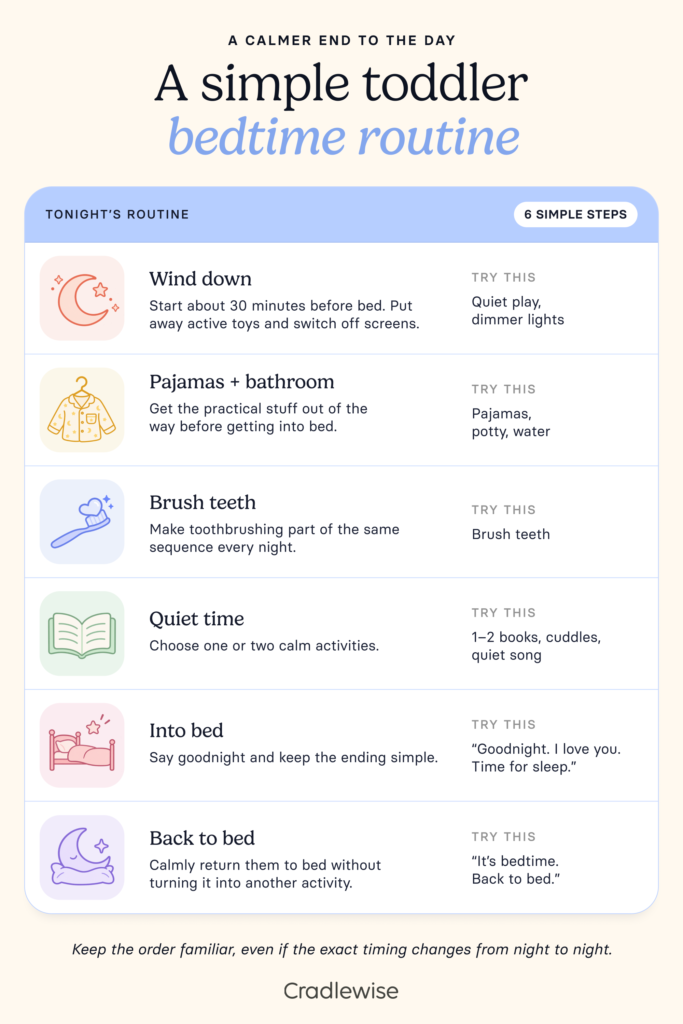
“ A simple toddler bedtime routine parents can use each night starts with dimming the lights and turning off screens about an hour before bed, followed by a bath, pajamas, and brushing teeth. Next comes a final drink and bathroom trip, one or two books in bed, a song or cuddle with a consistent goodnight phrase, and then leaving the room while the child is drowsy but still awake.”
Before bedtime, try to deal with the things you already know they’re likely to ask for. Water? Get it. Bathroom? Go. Favorite stuffed animal? Find it. One last book? Fine. Once all of that is done, keep things pretty boring when they get back up. The AAP recommends responding consistently to bedtime resistance, making it clear that bedtime means staying in the bedroom. Dr. Saema Tahir advises, “When a toddler repeatedly gets out of bed or asks for one more drink, book, hug, or bathroom trip, parents should build those requests into the routine beforehand and then calmly and quietly return the child to bed each time with minimal attention.”
You may have to repeat yourself. A lot. “It’s bedtime. Back to bed” is enough. You don’t need to explain it again every time, especially if the explanation turns into a five-minute conversation about something completely unrelated to sleep.
What if my toddler wants me to stay until they fall asleep?
Maybe you started staying beside your toddler because they were sick. Or there was a big change at home. Or they were having a clingy phase and sitting beside them was the only way anyone was getting to sleep. Fair enough. But now it’s weeks later, and you’re still sitting on the bedroom floor every night, wondering when this became part of your job description.
Kim notes, “If they’ve always needed Mom or Dad to rock them to sleep or lie beside them until they’re out, of course they’re going to protest when that parent tries to leave! Once they’re confident falling asleep independently, there’s often a lot less reason to drag bedtime out.”
If you want to change the habit, you can do it slowly. Sit beside the bed for a while, then move your chair a little farther away every few nights until you’re closer to the door. Let your toddler know what’s happening so they aren’t surprised when you suddenly stop sitting right next to them. And if staying in the room works for you and your child and everyone is sleeping well, you don’t necessarily need to change it. There isn’t a prize for having the shortest bedtime routine in the neighborhood.
What if bedtime turns into a tantrum?
Sometimes bedtime resistance is just a little complaining. Other nights, it is a full meltdown because the blue pajamas are in the laundry and the green ones are apparently unacceptable.
Before deciding that your toddler is simply fighting sleep, check what’s going on. Are they hungry? Uncomfortable? Sick? Too hot? Did something change recently? A new bed, a new daycare schedule, travel, potty training, or a big change at home can all make bedtime feel different.
If they are upset because they don’t want the day to end, you can acknowledge that without changing the plan. “I know you want to keep playing. It’s bedtime now.” You don’t have to convince them that bedtime is wonderful. And if you can keep your own voice calm, it can stop the whole thing from turning into a showdown between two very tired people.
Should toddlers have screens before bed?
Screens can make it harder for some children to settle down, especially if they’re watching something exciting right before bed. The American Academy of Pediatrics recommends keeping digital devices out of children’s sleep spaces and creating an environment that supports sleep.
Try switching off screens about an hour before bed and replacing them with quieter activities, such as looking at books, drawing, listening to a familiar song, or playing calmly together. Keep phones, tablets, and televisions out of your toddler’s sleep space where possible.
You don’t need a complicated evening activity to replace screen time. Often, a familiar book and a few quiet minutes together are enough to help your toddler shift gears.

Did you know?
For children ages 2 to 5, the AAP recommends limiting screen use to no more than one hour a day of high-quality programming, ideally watched together with a parent.
What if my toddler suddenly starts fighting bedtime?
This can be especially confusing when your toddler used to go to bed without much fuss and suddenly decides they absolutely will not.
Before assuming you’ve somehow created a bad habit, think about what has changed. Maybe your toddler is dropping a nap. Maybe they’ve moved into a big-kid bed. Maybe daycare has changed. Maybe you’ve been traveling. Or maybe they’re simply in a phase where they have discovered that they have opinions, and they’d like everyone to hear them.
You don’t have to throw out the whole bedtime routine because of it. Go back to the familiar parts for a few nights. Keep the order roughly the same, look at whether the nap is affecting bedtime, and give your child some warning before you ask them to stop playing. Sometimes that little bit of predictability is what helps the evening settle back down.
When should you talk to your pediatrician about bedtime problems?
A difficult bedtime every now and then is one thing. If your child is regularly struggling to fall asleep or stay asleep, or you’re worried that they aren’t getting enough sleep, it’s worth bringing it up with their pediatrician. The CDC recommends talking with a healthcare provider when you have concerns about sleep.
Dr. Tahir stressed, “Bedtime resistance becomes worth discussing with a pediatrician when it persists for weeks despite a consistent routine, significantly disrupts family life, or comes with daytime sleepiness, irritability, hyperactivity, or attention problems.”
Dr. Tahir also advises parents to watch for “loud nightly snoring, gasping or pauses in breathing, very restless sleep, frequent night terrors, or leg discomfort, since these can signal sleep apnea or another medical sleep disorder.”
If you notice these signs, or you’re concerned that your toddler isn’t getting enough sleep, contact your pediatrician. You don’t have to wait until bedtime becomes unmanageable to ask for help.
Conclusion
So, back to that 8:45 p.m. toddler who somehow has enough energy left to negotiate another glass of water. Some nights, bedtime will go exactly as planned. Other nights, your child will need another story, a different stuffed animal, and an urgent answer about whether penguins have knees just when you thought you were finally done.
That’s where having a familiar routine helps. You know what’s coming next, your toddler knows what’s coming next, and there are fewer opportunities for bedtime to turn into a completely new activity every night. Keep an eye on the whole sleep schedule too, especially naps and bedtime timing, and keep your response as calm and predictable as you can when your child tests the limits.
And as your toddler grows, the routine will probably change. The bedtime that worked at 18 months may not make much sense at 3. That’s okay. You may just find that one day, after all those evenings of wondering How are you still awake?, you look at the clock and realize your toddler has been asleep for an hour.
Enjoy the quiet while it lasts.
FAQs
Q: How much sleep does a toddler need?
A: Children ages 1–2 need 11–14 hours of sleep per 24 hours, including naps. Children ages 3–5 need 10–13 hours.
Q: What is a good bedtime routine for a toddler?
A: Start winding down about 30 minutes before bed. Move through pajamas, bathroom, brushing teeth, one or two quiet activities, and a consistent goodnight.
Q: Why is my toddler suddenly fighting bedtime?
A: Changes in naps, daycare schedules, travel, a new bed, or a growing desire for independence can contribute to bedtime resistance.
Q: Should I move my toddler's bedtime earlier if they won't sleep?
A: It may help if bedtime is falling at the wrong point in their day. Try moving it earlier by smaller increments and check whether their nap is too close to bedtime.
Q: What should I do when my toddler keeps getting out of bed?
A: Take them back calmly and consistently, keeping the interaction brief. Try to meet basic needs, such as water or a bathroom trip, before bedtime so there are fewer reasons to get up.
Sources:
- Recommended sleep duration and healthy sleep habits. Centers for Disease Control and Prevention (CDC). 2024.
- Building a consistent bedtime routine with brushing, reading, and sleep. American Academy of Pediatrics (HealthyChildren.org). 2024.
- Managing bedtime struggles and helping children settle to sleep. American Academy of Pediatrics (HealthyChildren.org).
- How sleep affects children’s mental and physical health. American Academy of Pediatrics (HealthyChildren.org). 2026.
You may also like