Parenting
0 min read
What is second night syndrome? A guide for exhausted new parents

Medically Reviewed Juliana Parker, RN, a 21-year Labor & Delivery nurse and founder of Nurse Core Triage
Written by Cradlewise Staff
You finally have your beautiful baby in your arms. After months of waiting, you’re exhausted, sore, emotional, and probably running on very little sleep, but you’re also relieved. And then comes the first night. Maybe your baby slept for a few stretches between feeds. You got to cuddle, stare at their tiny face, and perhaps even close your eyes for a little while yourself. By morning, you might have thought, Okay, this is doable.
Then night two arrives. Your baby suddenly wants to feed again. And again. They fall asleep in your arms but wake as soon as you put them down. They want to be held, they fuss when you try to settle them, and you’re wondering what happened. This is what many parents and healthcare professionals refer to as second night syndrome.
We spoke to Juliana Parker, RN, a 21-year Labor & Delivery nurse and founder of Nurse Core Triage, about what parents can expect during this stage. She describes a common pattern where a newborn becomes more awake, fussy, and eager to feed after a sleepier first day.
While these behaviors can feel overwhelming for exhausted new parents, they can be normal during the early newborn period. The term describes a pattern of newborn behavior that can include frequent feeding, wakefulness, fussiness, and wanting lots of physical contact during the second night after birth.
What is second night syndrome?
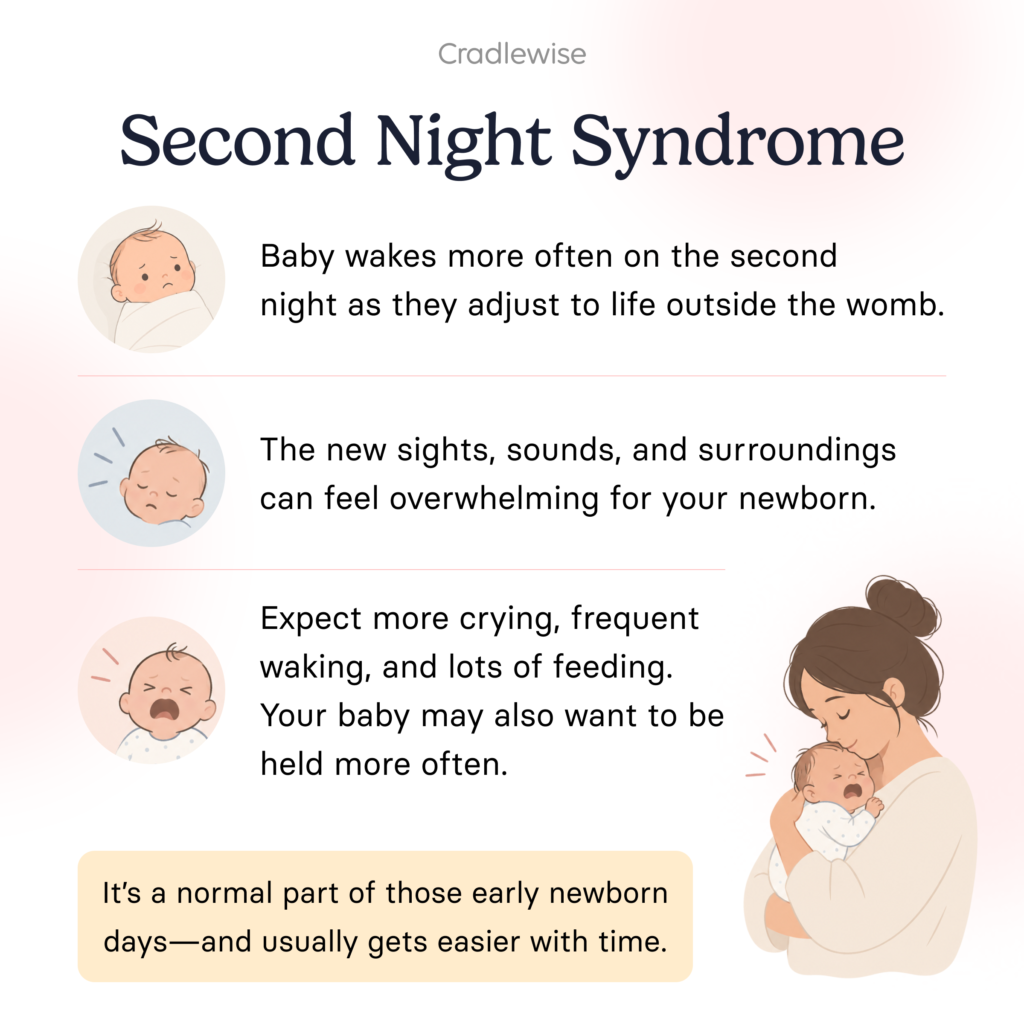
Second night syndrome is a term used to describe a newborn who seems much more unsettled on their second night than they did during their first day or night.
Parker explains it this way: “Second night syndrome isn’t really a medical diagnosis. It’s a term used to describe something we commonly see during a baby’s second night of life.”
She further explains that on the first day, babies can be pretty sleepy. Then the second night comes and suddenly that sleepy little newborn wants to eat constantly, doesn’t want to be put down, wakes up as soon as you place them in the bassinet, and seems much fussier than they were the day before.
Your baby may:
- Want to breastfeed very frequently
- Wake soon after being put down
- Want to be held or have skin-to-skin contact
- Fuss or cry more than they did on the first day
- Sleep only in short stretches
Frequent feeding is common during the first few days. If your newborn seems to want to feed constantly on the second night, you may be seeing cluster feeding, periods when a baby wants to feed repeatedly over a short period. USDA WIC Breastfeeding Support notes that cluster feeding can happen during growth spurts and other periods of increased feeding.
Parker adds, “This can be really overwhelming for new parents, especially because mom is also exhausted and recovering from delivery. But for many babies, this is completely normal newborn behavior.”
Why do newborns act differently on the second night?
There isn’t one proven explanation for second night syndrome. The term describes a pattern of behavior rather than a condition with one specific cause.
- Frequent feeding can be normal in the first days: Newborns have small stomachs and may want to breastfeed frequently. The CDC notes that babies may want to eat every 1–3 hours in the first days, and some may feed as often as every hour at times, which is often called cluster feeding. Early hunger cues can include putting their hands to their mouth, turning toward the breast, or smacking or licking their lips.
- Your baby may also want to be close to you: After spending months inside the womb, being held and having skin-to-skin contact can be comforting during those first days. The AAP recommends skin-to-skin care for healthy newborns and notes benefits such as supporting breastfeeding and helping regulate a newborn’s temperature and blood glucose.
As Parker puts it, “I always remind parents to think about what their baby has just experienced. For nine months, they were warm, constantly fed, surrounded by sound and movement, and never separated from mom. Then suddenly we expect them to sleep quietly in a bassinet by themselves!”

Did you know?
Your newborn has a built-in rooting reflex that helps them turn toward your touch and find the breast when they’re ready to feed.
Second night syndrome vs. cluster feeding
These terms are related, but they aren’t interchangeable.
Second night syndrome refers to a broader pattern of newborn behavior that may occur during the second night, including frequent feeding, wakefulness, fussiness, and a desire to be held.
Cluster feeding specifically refers to frequent feeding over a short period. It can happen during the second night, but it can also happen at other times during the newborn period. USDA WIC describes cluster feeding as a normal pattern that can occur during growth spurts.
Parker recommends looking at how your baby is actually feeding: “This is where I tell parents not to focus only on how often the baby wants to eat. A baby wanting to nurse frequently doesn’t automatically mean they aren’t getting enough.”
How long does second night syndrome last?
Second night syndrome doesn’t necessarily end when night two is over. There isn’t an established timeline for how long these behaviors last, and some babies may continue to wake frequently, want to feed often, or need more help settling on nights 3–5.
What parents can expect is that the early newborn days may continue to feel unpredictable. A difficult second night doesn’t mean every night that follows will be the same, and it doesn’t predict your baby’s longer-term sleep patterns.
What can help during the second night?
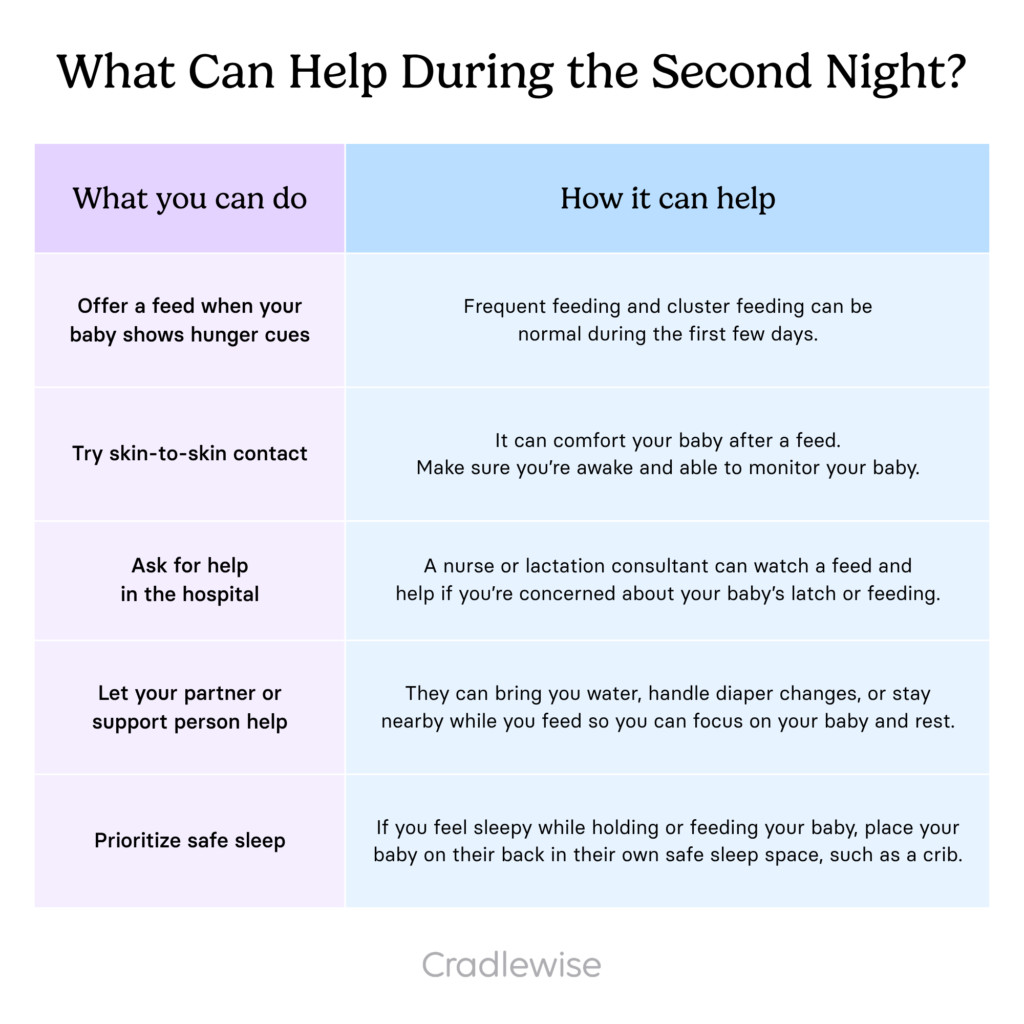
If your baby is showing hunger cues, offer a feed using the feeding method that works for your family. Frequent feeds can be normal during the early days, whether your baby is breastfed, formula-fed, or combination-fed. If your baby has just fed but still wants to be close, skin-to-skin contact can be comforting. Just make sure you’re awake and able to monitor your baby while doing it.
We asked Parker, what she recommends for getting through the second night. “Probably the biggest thing is knowing ahead of time that it might happen.” Knowing this ahead of time can make the night feel less surprising. If you’re still in the hospital, don’t hesitate to ask your nurse or lactation consultant for help if you’re unsure about feeding or your baby’s latch.
Parker also recommends keeping your baby close and following their feeding cues: “Keep your baby close, feed based on their cues, and use skin-to-skin.”
Skin-to-skin can be comforting for newborns, but make sure you’re awake and able to monitor your baby while doing it. And don’t try to handle everything yourself. The National Academies’ review of breastfeeding in the United States emphasizes the importance of supporting families during the breastfeeding period. Parker encourages parents to accept help with the tasks around feeding.
At home, keep water, snacks, diapers, and anything else you need within reach. If you have a partner or support person, let them handle diaper changes and other tasks when they can. If you’re formula-feeding or combination-feeding, your healthcare provider can also help with questions about feeding amounts or frequency.
Keep safe sleep in mind
The second night can be particularly exhausting, which makes safe sleep even more important. If you feel yourself getting sleepy while holding or feeding your baby, move them to their own safe sleep space and place them on their back. The AAP recommends moving your baby to a safe sleep surface, such as a crib, when you’re no longer awake and able to monitor them.
Parker emphasizes the same concern, “The other thing I really emphasize is safe sleep. The second night can be exhausting, and falling asleep while holding a baby on a couch or recliner can be dangerous. If you feel yourself getting so tired that you can’t safely stay awake, put the baby on their back in their own safe sleep space or ask another awake adult for help.”
When should you contact your pediatrician?
Contact your baby’s healthcare provider if your newborn:
- Is difficult to wake for feeds
- Isn’t feeding well
- Seems unusually unwell or lethargic
- Or you’re worried they’re not getting enough milk
If you’re breastfeeding and concerned about feeding, ask your pediatrician, lactation consultant, or other healthcare professional to assess what’s happening.
Don’t assume that every change in your baby’s behavior is second night syndrome. Parker also recommends calling if you notice other concerning changes: “I would also call the pediatrician for concerns about increasing jaundice, repeated vomiting, an abnormal temperature, or if the baby seems unusually sleepy, weak, or just isn’t acting right.”
And remember, asking is okay. As Parker puts it, “I always tell parents that they know their baby better than anyone else. Even though they’ve only known them for a day or two, if something doesn’t seem right, call. You are never bothering us by asking about a newborn.”
Conclusion
The second night can be a rough one, but it doesn’t tell you what every night with your newborn will look like. If your baby is feeding well and otherwise seems okay, a fussy or wakeful night can be part of those early days. But if something about your baby’s feeding, alertness, diapers, or behavior concerns you, check in with your healthcare provider rather than assuming it’s second night syndrome.
FAQs
Q: Is second night syndrome normal?
A: It can be. The term describes a common pattern of increased feeding, wakefulness, and fussiness that some newborns experience around their second night.
Q: Is it the same as cluster feeding?
A: No. Cluster feeding means feeding repeatedly over a short period. It can happen during the second night but isn’t limited to it.
Q: How long does it last?
A: There’s no set timeline. Some babies settle after the second night, while others continue to feed and wake frequently during the first few days.
Q: Can skin-to-skin help?
A: Yes. Skin-to-skin can comfort newborns and support breastfeeding. Practice it while you’re awake and able to monitor your baby.
Q: When should I call the pediatrician?
A: Call if your baby is difficult to wake for feeds, isn’t feeding well, seems unwell, or you’re worried they’re not getting enough milk.
Sources:
- Breastfeeding, feeding patterns, and maternal experiences. Journal of Human Lactation. 2022. “Feeding Patterns of Healthy Term Newborns in the First 5 Days—The Glucose in Well Babies Study (GLOW).”
- Cluster feeding and infant growth spurts. USDA WIC Breastfeeding Support. n.d. “Cluster Feeding and Growth Spurts.”
- Newborn reflexes and normal infant development. American Academy of Pediatrics (HealthyChildren.org). n.d. “Newborn Reflexes.”
- Safe sleep and skin-to-skin care for newborns. Pediatrics. 2016. “Safe Sleep and Skin-to-Skin Care in the Neonatal Period for Healthy Newborns.”
- Hunger and fullness cues in babies and young children. Centers for Disease Control and Prevention (CDC). 2026. “Signs Your Child Is Hungry or Full
- Newborn care and breastfeeding guidance. StatPearls Publishing / NCBI Bookshelf. 2025. “The Importance of Breastfeeding Across the Life Course.”
You may also like:
You may also like


