Parenting
0 min read
How to massage a baby safely: A simple guide for parents


Cradlewise Staff
Baby massage sounds lovely in theory. Then you put your tiny, wiggly baby in front of you and suddenly you’re wondering: How much pressure is too much? Should I use oil? Can I massage their tummy? What if they start crying?
Take a breath. Baby massage doesn’t have to be complicated. It can be as simple as gently stroking your baby’s legs after a bath, rubbing their little feet before bed, or spending a few quiet minutes touching their back while they lie comfortably in front of you. The American Academy of Pediatrics (AAP) describes baby massage as one way parents can connect with their babies, learn their cues, and provide comforting touch.
There’s also some research on massage as part of a bedtime routine. A 2018 randomized study found that mothers who introduced a massage-based bedtime routine for their 3- to 18-month-old babies reported fewer night wakings and better maternal sleep. The study didn’t find improvements in every measure of infant sleep, including total sleep duration.
So, if you’d like to try baby massage, you don’t need to think of it as another thing to get “right.” Start gently, watch your baby’s reactions, and let them tell you when they’ve had enough.
What are the benefits of baby massage?
Touch is already part of your baby’s everyday life. You hold them, feed them, change their diaper, carry them around, and probably rub their back without even thinking about it.
Baby massage simply gives you a little more time to be intentional about that touch. The AAP says massage can help parents learn what their baby likes and dislikes while creating opportunities for closeness and connection.
There is also some evidence that massage may be useful as part of a bedtime routine. In the 2018 study by Mindell and colleagues, a massage-based bedtime routine was associated with fewer night wakings for infants and mothers, along with improvements in maternal sleep quality and perceptions of the child’s sleep.
The research doesn’t support promising broad health benefits for every healthy, full-term baby, though. The National Center for Complementary and Integrative Health (NCCIH), part of the NIH, says that no benefits of massage for healthy, full-term infants have been clearly demonstrated. Research in premature infants has found evidence of improved weight gain, but that evidence applies to a different group of babies.
For parents, that means you can enjoy massage for what it is: a few quiet minutes of touch and connection, without expecting it to solve every sleep or baby-care problem.
When can you start baby massage?
For a healthy baby, gentle massage can be introduced early. If your baby was born prematurely, has a medical condition, has a skin condition, or has recently had a medical procedure, check with your pediatrician before starting. You also don’t need to wait for a particular age or milestone. Choose a time when your baby is awake, calm, and comfortable.
A newborn who is hungry and ready to eat probably isn’t going to appreciate a foot massage. Neither is a baby who is already overtired and crying.
When is the best time to massage a baby?
Look for your baby’s quiet, alert moments.
This might be:
- After a bath
- Right after a feed
- During a calm diaper change
- Before pajamas and bedtime
- After your baby has had time to settle following a feed
- During a relaxed part of the day when your baby is awake
If you’re using massage as part of a bedtime routine, you can place it alongside things you already do before sleep.
For example:
Bath → massage → pajamas → feed → bedtime
You don’t have to follow that exact order. The idea is to make massage part of a familiar, calming routine if your baby enjoys it. Research on bedtime routines more broadly suggests that consistent bedtime routines can support sleep in infants and young children.
When should you skip baby massage?
There are days when massage just isn’t a good idea.
Wait until another time if your baby:
- Has a fever or is sick
- Has irritated, broken, or painful skin
- Is very hungry
- Is extremely tired
- Is crying and difficult to settle
- Seems uncomfortable with being touched
The AAP recommends following your baby’s cues during massage and stopping if they seem uncomfortable. And if your baby starts out happy but changes their mind halfway through, that’s okay too.
How to prepare for a baby massage
You don’t need much. Choose a warm, comfortable room and place your baby somewhere safe where you can reach them easily. Have everything you need nearby before you start.
Wash your hands and remove rings or anything else that could scratch your baby’s skin. You can place a towel underneath your baby in case you use oil. Keep the room warm enough that your baby is comfortable while some of their clothing is removed.
And one small but important thing: don’t turn away from your baby to grab something you forgot. Have the oil, towel, diaper, and anything else you need within reach.
Do you need oil for baby massage?
No. You can massage your baby with clean, warm hands.
If you do use oil, choose a product that’s appropriate for infant skin and use only a small amount. If your baby has eczema, very sensitive skin, or has reacted to skincare products before, ask your pediatrician before introducing something new.
The AAP notes that oil can help your hands move smoothly over your baby’s skin and specifically advises against adult massage oils, hand lotion, and nut-based oils because of potential allergic reactions. Avoid getting oil near your baby’s eyes, nose, or mouth.
How to massage a baby: A simple step-by-step guide
There’s no single “correct” baby massage routine. You can work your way from your baby’s legs to their feet, arms, tummy, and back, or spend the whole session on one area your baby particularly enjoys.
If you’d like hands-on guidance, you can learn baby massage from a Certified Educator of Infant Massage (CEIM). Classes are offered in locations across the United States. The International Association of Infant Massage’s website can help you find a class near you.
The movements should be slow, gentle, and comfortable. If you’re looking for a structured routine, the American Academy of Pediatrics recommends the Colic Relief Routine developed by Vimala McClure, author and founder of the International Association of Infant Massage (IAIM). AAP notes that you can try this routine at least 30 minutes after your baby eats, as long as your baby is quiet and alert. If your baby becomes fussier, stop the massage and try again another time. You can also watch a demonstration of the routine here: Baby massage and colic relief routine
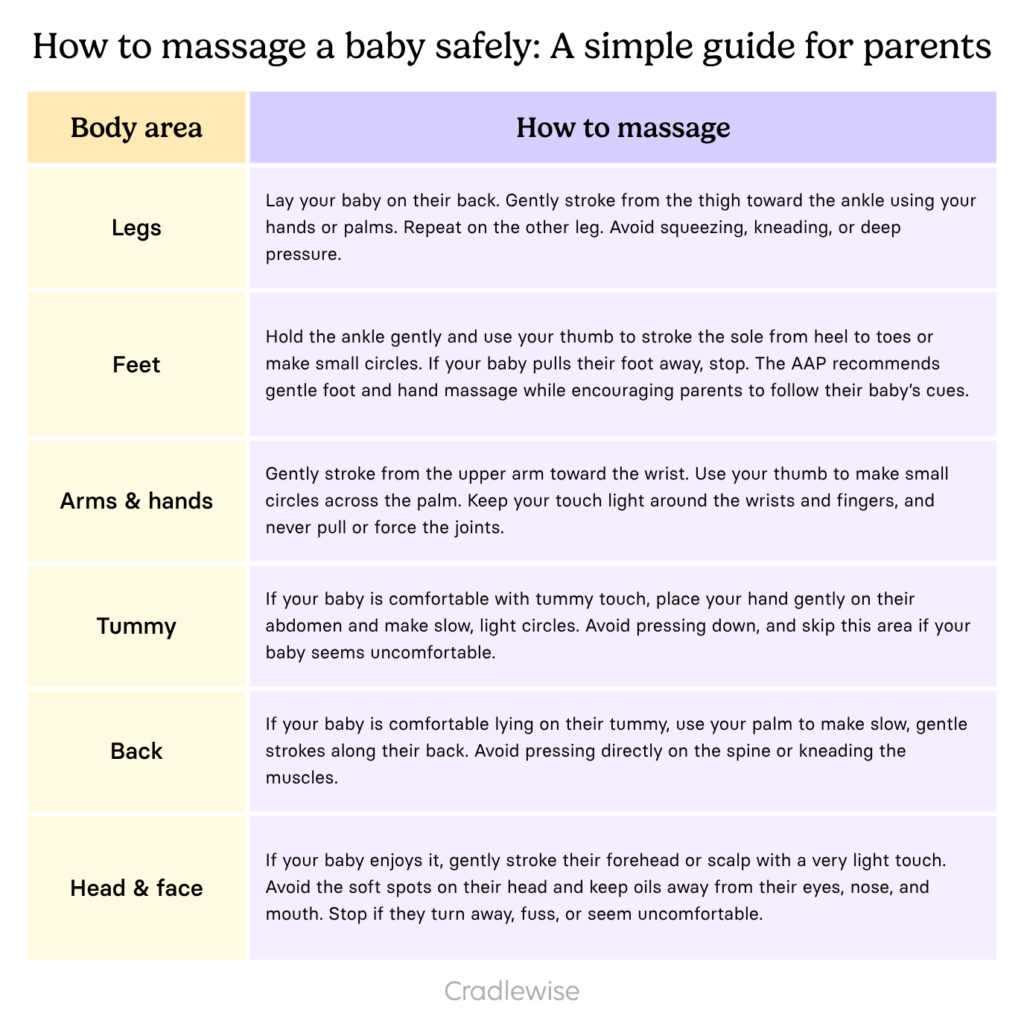
1. Start with the legs
Lay your baby comfortably on their back.
Place your hands around one thigh and gently stroke down toward the ankle.
Repeat the same movement on the other leg.
You can also gently rub the length of the leg using your palms.
There’s no need to squeeze, knead, or press deeply.
2. Give those little feet some attention
Baby feet are tiny, but they can be a nice place to start if your baby enjoys having their feet touched.
Hold your baby’s ankle gently and use your thumb to stroke the sole of their foot.
You can make small circles across the sole or gently move from the heel toward the toes.
If your baby pulls their foot away, leave it alone.
The AAP includes gentle foot and hand massage among the areas parents can try, while emphasizing that parents should watch how their baby responds.
3. Move to the arms
Gently stroke from your baby’s upper arm toward their wrist.
You can then use your thumb to make small circles across their palm.
Keep your movements light around the wrists and fingers. Don’t pull, stretch, or force their joints into a particular position.
4. Try the tummy
If your baby is comfortable with tummy touch, place your hand gently on their abdomen.
Use slow, light circular movements.
You don’t need to press down to massage the tummy effectively.
If your baby seems uncomfortable, skip this part.
5. Gently massage the back
If your baby is comfortable being on their tummy, you can try some gentle strokes along their back.
Use the palm of your hand and move slowly.
There’s no need to press directly over the spine or knead the muscles.
If your baby doesn’t like being on their tummy, don’t force it. You can simply leave the back massage for another day.
6. Be extra gentle around the head and face
Some babies enjoy having their forehead or scalp gently stroked. Others don’t.
If your baby seems comfortable, use a very light touch.
Avoid pressing on the soft spots on your baby’s head, and keep oils and other products away from their eyes, nose, and mouth.
The AAP also notes that babies can respond differently to touch around the head and recommends following your baby’s reaction.
If your baby turns their head away, fusses, or seems uncomfortable, stop.
How much pressure should you use during baby massage?
This is where many parents get nervous. You don’t need to press hard. The AAP describes baby massage as using gentle, consistent pressure, while also emphasizing that parents should watch their baby’s cues and stop if their baby seems uncomfortable.
Start gently and pay attention. If your baby looks relaxed and comfortable, you can continue. If they stiffen their body, pull away, turn their head away, cry, or become increasingly fussy, stop the massage. Your baby’s reaction matters more than following a particular technique perfectly.
How long should a baby massage last?
Start with just a few minutes. You may find that your newborn is happy with a quick foot and leg massage and then decides they’re done. As your baby gets older, you can spend longer if they’re still enjoying it.
There’s no magic number of minutes that every baby needs. Research studies have used different massage routines and schedules, and the evidence doesn’t establish one ideal duration or frequency for healthy, full-term babies.
So if your five-minute massage ends with a happy baby, there’s no need to stretch it into 15 minutes just because you planned to.
Can baby massage help with sleep?
This is probably one of the biggest reasons parents become interested in baby massage.
The research is promising in one particular area: massage as part of a bedtime routine.
In a randomized 2018 study, 123 mothers and their 3- to 18-month-old babies were assigned either a massage-based bedtime routine or their usual bedtime routine. Families using the massage routine reported fewer night wakings for both mothers and babies. Mothers also reported better sleep quality and more positive perceptions of their child’s sleep.
But the study didn’t find improvements in every sleep measure. Total infant sleep duration, sleep-onset latency, duration of night wakings, and the longest sleep stretch did not change significantly.
So massage can be part of a calming bedtime routine, but it shouldn’t be treated as a guaranteed way to make your baby sleep longer. If your baby enjoys a few minutes of massage before bed, it can become one of the familiar signals that the day is winding down.
Can baby massage help with bonding?
This is one of the simplest reasons to try it. When you’re massaging your baby, you’re paying attention to them. You’re noticing when they relax, when they pull away, and which kind of touch they seem to enjoy.
The AAP says baby massage can help parents learn their baby’s cues and build closeness through touch. Research on infant touch has also explored the role of physical contact in early emotion regulation. Weller and Feldman’s review discusses the relationship between maternal proximity, handling, touch, and infant emotion regulation, although the review includes both human and animal research.
You don’t need to think of massage as a developmental exercise. Sometimes it’s simply a few minutes when your baby is awake, you’re both calm, and you’re paying attention to each other.
What if my baby doesn’t like massage?
Some babies love having their feet rubbed. Others pull their legs up and complain. Both are normal, and if yours is the second kind, you just stop.
The AAP recommends following your baby’s cues and stopping when they show signs of discomfort. You can try again later, shorten the session, massage just their feet, or skip massage altogether. Holding your baby, stroking their back, or cuddling them are also ways to give them a comforting touch.
Baby massage safety tips parents should know
Before you start, keep these safety points in mind:
- Don’t massage a sick baby. If your baby has a fever or isn’t feeling well, wait until they’re better or ask your pediatrician what they recommend.
- Avoid irritated or broken skin. Don’t massage over wounds, burns, significant rashes, or areas that seem painful.
- Don’t use deep pressure. Baby massage should feel comfortable. Avoid forceful kneading or pressing.
- Don’t force a position. If your baby doesn’t want to be on their tummy, don’t turn massage into a wrestling match.
- Watch your baby’s cues. Fussing, stiffening, turning away, or pulling away can all mean your baby has had enough.
- Be particularly careful with premature or medically fragile babies. Ask your pediatrician about massage before trying it. Research on massage in premature infants is a separate area of study and shouldn’t automatically be applied to healthy, full-term babies.
- Never leave your baby unattended. Keep everything you need within arm’s reach before you begin.
A simple baby massage routine for bedtime
Want to try massage before bed? You don’t need a complicated routine.
- Start with your baby’s legs and feet.
- Move to their arms and hands if they’re still enjoying the touch.
- Then try their tummy or back if those areas seem comfortable.
- Keep the movements slow and gentle.
- Once your baby starts looking tired or unsettled, you’re done.
- You can then continue with the rest of your usual bedtime routine, perhaps pajamas, feeding, a quiet cuddle, and sleep.
The 2018 Mindell study suggests that incorporating massage into a consistent bedtime routine may reduce night wakings, although it did not increase every measure of infant sleep.
Conclusion
Baby massage doesn’t need to become another item on your parenting checklist. If your baby enjoys it, a few minutes of gentle touch can be a lovely part of your day. It gives you time to notice their cues, respond to what they like, and simply be close.
And if you want to make it part of bedtime, research suggests that a massage-based routine may help reduce night wakings for some babies and their mothers. Just keep your expectations realistic. Start with your baby’s feet. See how they respond. If they enjoy it, keep going. If they decide they’d rather be picked up and cuddled, the massage can wait.
FAQs
Q: How do you massage a baby safely?
A: Use slow, gentle strokes with light pressure, and follow your baby’s cues. Avoid squeezing, kneading, or pressing deeply.
Q: What areas can you massage on a baby?
A: You can gently massage your baby’s legs, feet, arms, tummy, and back. The head and face can also be touched very lightly if your baby is comfortable.
Q: Can you massage a newborn’s head?
A: Yes, but use an extremely light touch. Avoid pressing on the soft spots on your baby’s head and keep oils away from their eyes, nose, and mouth.
Q: What should you do if your baby doesn’t like massage?
A: Stop the massage if your baby turns away, pulls a body part away, fusses, or seems uncomfortable. You can try again another time or skip that area.
Q: How much pressure should you use when massaging a baby?
A: Keep the pressure light and gentle. There is no need to squeeze, knead, or press deeply for a baby massage.
Sources:
- Benefits and techniques of baby massage. HealthyChildren.org, American Academy of Pediatrics. 2024. “The Benefits of Baby Massage.”
- Massage-based bedtime routines and infant sleep. Sleep Medicine. 2018. “Massage-based bedtime routine: impact on sleep and mood in infants and mothers.”
- What research says about massage therapy and infant health. National Center for Complementary and Integrative Health (NCCIH). “Massage Therapy: What You Need To Know.”
- Infant massage education and resources. International Association of Infant Massage (IAIM). “International Association of Infant Massage.”
- Baby massage techniques for soothing colic. American Academy of Pediatrics. “5 Baby Massage Strokes to Soothe Colic in Newborns and Infants.”
- Touch, infant emotion regulation, and bonding. Peptides. 2003. “Emotion regulation and touch in infants: the role of cholecystokinin and opioids.”
You may also like