Science of baby sleep
0 min read
1-month-old baby sleep schedule: Your ultimate guide to naps, wake windows and sleep tips

Medically Reviewed Dr. Hormuz Nicolwala, Director of the Infant Apnea Program at Stony Brook Children's Hospital, NY
Written by Cradlewise Staff

Night sleep
8-9.5 hours

Daytime naps
6-7.5 hours

Total sleep
16-17 hours
Congratulations! You’ve made it through the newest, blurriest weeks of parenthood. If you’re searching for a 1-month-old baby sleep schedule right now, here’s the first thing worth knowing: there isn’t really one yet.
At four weeks old, your baby still doesn’t have organized sleep patterns. Your baby’s internal clock hasn’t switched on, their stomach is still tiny, and long stretches of sleep aren’t developed yet. We know you’d want a routine, but at best what you can plan around is a rhythm, which gets a little more predictable with every passing week.
With the help of Dr. Hormuz Nicolwala, Director of the Infant Apnea Program at Stony Brook Children’s Hospital, NY, we have compiled this guide that walks you through how much sleep is typical at one month, what a sample day might look like with feeding and sleeping schedules and wake windows, and gentle newborn settling tips.
1-month-baby sleep schedule at a glance:
- Night sleep: 8-9 hours, in 1-2 hour stretches (not one continuous block)
- Daytime naps: 6-7.5 hours, across 4-6+ short naps
- Total sleep: 16-17 hours in 24 hours
One-month-old baby milestones for sleep
At one month, sleep and development are closely linked, and there isn’t a long list of milestones to check off yet. As Dr. Nicolwala puts it:
However, as per Dr. Nicolwala, you may still observe the following developments:
- Your baby may start to become more interested in faces and voices.
- They may briefly follow a face or object with their eyes.
- They become more alert when they hear a familiar voice.
- You might hear some early cooing sounds.
- When your baby is on their stomach and awake (always supervised), they may briefly lift their head or chin.
- You may notice that your baby is staying awake and alert for slightly longer stretches than in the first couple of weeks.
For premature babies, Dr. Nicolwala adds: For babies who were born prematurely, we generally look at development based on corrected age rather than simply their chronological age.
Development becomes more obvious over the next couple of months. By around two months, expect more responsive smiling, more sounds, and better head control from your baby.

Cradlewise Smart Crib
Smarter Sleep for Your Baby
An award-winning crib—loved by parents, approved by experts.
0 to 24 months of use
Automatic soothing
Built-in video & sound machine
AI-powered sleep insights
Customizable soundtracks
Get 2 extra hours of sleep nightly
Day-night confusion, and what actually helps
It’s one of the most common questions parents ask in the first month: why does my baby seem to have day and night mixed up?
The only answer is that their internal clock hasn’t developed yet. Melatonin production doesn’t really ramp up until closer to 8-12 weeks, so for now, day and night look the same to them.
We asked Dr. Nicolwala whether parents should just wait this period out or actively help move things along.
What Dr. Nicolwala recommends to build consistent routine for their 1-month-old baby:
- During the day, keep the house reasonably bright and allow normal household activity and noise.
- Talk to the baby and interact with them when they are awake. At night, do the opposite.
- Keep the lights low, keep things quiet and limit stimulation.
- Feed the baby, change them if necessary, burp them and get them back to sleep rather than turning nighttime feedings into a social event.
Those environmental cues won’t produce an overnight transformation, but they do help lay the groundwork for your baby’s circadian rhythm to develop.
As Dr. Nicolwala puts it, “parents should not expect a one-month-old to suddenly start sleeping through the night. That comes with maturation.”
What’s going on in your baby’s brain?
When your baby is born, the lower part of the nervous system: the spinal cord and brain stem is well-developed. These areas control essential early behaviors such as kicking, grasping, crying, sleeping, and feeding. The brain regions tied to higher-level thinking, memory, and emotion develop much more slowly, over months and years.
During these early weeks, you may observe that your baby’s movements are reflexive, rather than purposeful. These newborn reflexes are instinctive and facilitate neonatal survival and early development; they also help your doctor assess how well their nervous system is developing. One example is the Moro reflex, where an infant will splay out their arms in response to a loud sound or the feeling of falling, like when you put them down in the crib on their back. In some cases, your baby might startle themselves awake. The Moro reflex usually disappears by four months of age.

Did you know?
Cradlewise smart crib can identify Moro reflex? It automatically starts bouncing as soon as your baby wakes up and before they start crying.

Crib Notes
Did you know that Cradlewise can identify Moro reflex? It automatically starts bouncing as soon as your baby wakes up and before they start crying.
How much should a 1-month-old baby sleep?
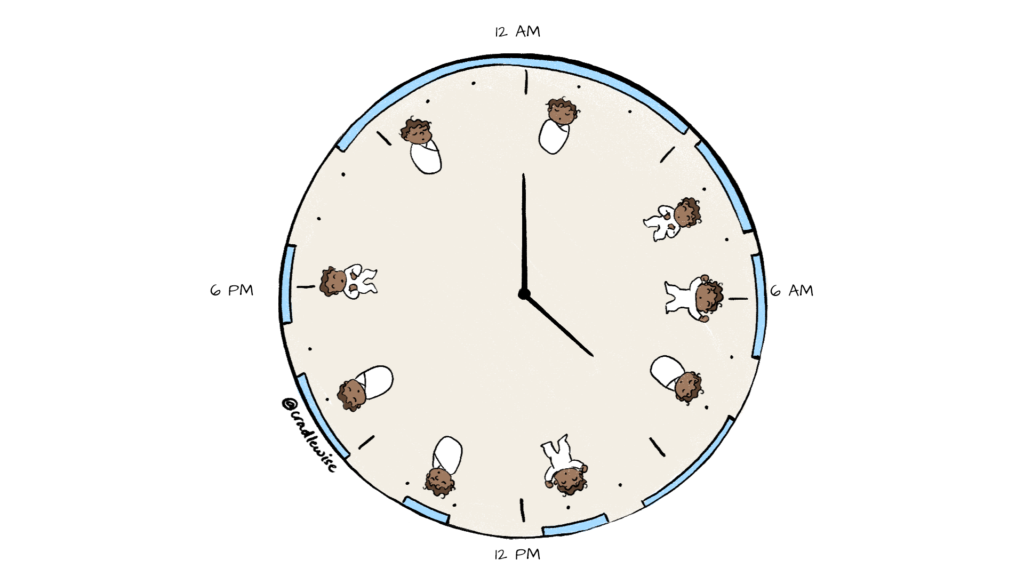
- Total hours of sleep: Most 1 month-olds sleep about 16 to 17 hours across a 24-hour day. What makes this stage feel so disorienting is that this sleep almost never comes in one long stretch, instead, it’s broken into short chunks of one to two hours, or three if you’re lucky, all day and night.
- Wake windows: A “wake window” is simply how long your baby stays awake between sleep periods. At one month, that’s typically 30 to 90 minutes, which, once you factor in a feeding and a diaper change, doesn’t leave a lot of extra time. This window stretches out gradually as your baby grows.
- Number of naps: Rather than 4-5 long naps, most 1 month olds take four to six (or more) short naps across the day. This number can shift from one day to the next, but it’s nothing to worry.
We asked Dr. Nicolwala whether one nap pattern is “healthier” than another at this age:
Dr. Nicolwala recommends that rather than counting naps, observe your baby and ask yourself:
- If your baby is feeding well?
- Are they having an appropriate number of wet diapers?
- Are they gaining weight?
- Do they have periods where they are awake and appropriately alert?
Those things are much more meaningful than whether a baby takes five naps or seven naps.
The most common misconception Dr. Nicolwala hears from new parents is that a newborn should already have a predictable sleep schedule.
As he puts it, “the first month is really not about teaching a baby to sleep. It’s about making sure they’re fed, growing, comfortable and sleeping safely.” The longer, more consolidated stretches of nighttime sleep come later, as your baby’s nervous system matures.
Newborn safe sleep basics
These safe sleep guidelines are worth keeping in mind for every nap, not just bedtime:
- Alone: Your baby sleeps best in their own sleep space (a crib, bassinet, or play yard), not in your bed or on a couch or chair.
- On the back: Always place your baby on their back to sleep, for naps and at night.
- Clear crib: No pillows, loose blankets, bumpers, or stuffed animals in the sleep space, even though it’s tempting to make it cozy.
- Room-sharing (not bed-sharing): Is recommended for at least the first six months.
For the full breakdown, see our complete safe sleep guide for babies.
Sample 1-month-old sleep and feeding schedule
Keep in mind that this is just one example, and every baby has their own rhythm. Yours might sleep a longer stretch earlier in the evening, or take a shorter morning nap than the one shown here.
| Time | What’s happening |
| 7:00 AM | Wake + feed |
| 8:00 – 9:30 AM | Nap |
| 9:30 AM | Feed |
| 10:30 – 11:15 AM | Nap |
| 11:15 AM | Feed |
| 12:00 – 1:30 PM | Nap |
| 1:30 PM | Feed |
| 2:15 – 3:30 PM | Nap |
| 3:30 PM | Feed |
| 4:15 – 5:00 PM | Short, often fussier nap |
| 5:00 – 7:30 PM | Witching hour stretch – fussiness, possible cluster feeding |
| 7:30 – 8:30 PM | Feed + bedtime routine |
| 8:30 – 10:30 PM | First sleep stretch of the night |
| 10:30 PM | Feed |
| Overnight | Wake to feed roughly every 2-4 hours |
Newborn feeding guidance
During the first month, you’ll want to be sure your baby is feeding frequently and gaining weight, which your pediatrician will help you track. Babies lose weight after they’re born, but by two weeks of age, they should have regained their birth weight.
Until your baby regains their birth weight, pediatricians recommend you should wake them to eat if they sleep longer than four hours.
How often should a 1-month-old eat?
Babies at this age typically eat every two to four hours that is 8-12 times a day, timed from when the last feed started. If you begin feeding at 10:30 am, expect the next feed anywhere from noon to 1:30 pm. at the latest, usually sooner. Logging feeds for the first few weeks can help, since sleep deprivation makes everyone a little forgetful.
How much should a 1-month-old eat?
We asked Dr. Nicolwala, and this is what we learned. This is only an approximation, and it is always advisable to check with your pediatrician if you feel your baby is not eating well.
- Breast fed babies at 1 month consume 60-90 ml or on an average 3-4 ounces in a single feeding
- Formula feed 120 ml (4 ounces) in a single feeding.
- Premature baby may have different feeding requirements, but for stable premature baby 50-90 ml (2-3 ounces) in a single feeding
Burping can ease discomfort. If breastfeeding, burp when switching sides; if bottle-feeding, burp after every two to three ounces.
How to help support your baby’s sleep during the first month
The only “must” of the first month is to try and go with the flow, but a few things can help guide your baby toward better sleep.
Look out for your baby’s cues
Telling hunger and tiredness cues apart is one of the trickier parts of the newborn stage, especially for first-time parents. Dr. Nicolwala breaks it down:
Dr. Nicolwala adds: Tired babies can also become fussy and may bring their hands to their mouth, which is one reason the two can be confused. Other signs of tiredness include looking away, staring off, yawning, becoming less interactive or simply becoming more irritable.
His practical tip: Think about what happened right before. If your baby just had a good feeding and is now looking away, becoming fussy or less engaged, they may simply be tired. If it has been a while since the last feeding and they’re rooting and actively looking to suck, hunger is more likely.” And if you’re genuinely unsure? It’s okay to offer a feeding.
Support circadian rhythms
Beyond the day/night basics covered above, a few small habits reinforce your baby’s developing internal clock: dim the lights in your home before bedtime, and keep your baby away from the blue light of phones and screens in the evening. If you need to feed or change a diaper overnight, use only a soft, low light.
Start with sound habits
It’s never too soon to start a soothing bedtime routine: a bath, a massage, a short story, repeated consistently so your baby begins to associate it with sleep. Aim to put your baby down drowsy but awake so they can start getting used to falling asleep on their own.
Try a swaddle
Swaddling may help encourage longer sleep stretches, but it’s important to do it safely. Always put your baby down on their back, and stop swaddling once they show signs of being able to roll over (around 4 months) since they could become trapped face-down. Swaddling can also cause overheating, so monitor the room temperature (aim for 68-72°F) and your baby’s warmth.
Create custom sleep tracks
Cradlewise smart crib offers a built-in sound machine with white, pink, or brown noise designed to mimic what your baby heard in the womb. You can build custom sleep tracks and mix in heartbeat sounds for extra soothing.
Check out this cool, in-built white noise sound machine by Cradlewise team
Stay flexible
Dr. Nicolwala’s advice for the first month is to establish some consistency without feeling like you have to follow the clock and to keep things flexible:
“I like the idea of having a rhythm rather than a schedule. It’s fine to have some things that happen in roughly the same order every evening — a bath or diaper change, feeding, dimming the lights, swaddling when appropriate and settling the baby down. But I wouldn’t worry about doing these things at exactly 7:00 or 8:00 every night.”
Prioritize your own rest
Sleep deprivation has been linked to higher rates of postpartum depression, so protecting your own rest matters too. You likely won’t get a full eight hours straight, especially if you’re breastfeeding exclusively, but you can enlist help: a partner handling an overnight feeding or diaper change, or a friend running errands. When you do get a spare moment, it’s okay to let the to-do list wait.
How to deal with witching hour in 1-month-old
Around the two-week mark, the hours from roughly 5 pm until bedtime can start to become especially difficult. Your baby may be cranky and want to cluster feed, eating every 30 to 60 minutes. This period is often described as the witching hour.
Your baby cries and is hard to soothe, even if they are fed and dry.
The witching hour is often just the evening part of the broader Purple crying phase. Purple crying is an acronym for: Peak of crying, Unexpected, Resists soothing, Pain-like face, Long lasting (up to five hours), and Evening, describing when it tends to happen.
It’s a real, well-documented phase in an infant’s first few weeks of life.
We asked Dr. Nicolwala when this period typically starts easing, and whether anything shortens it:
While there isn’t a magic solution that makes it go aways, according to Dr. Nicolwala, there are a few things that can help:
- Hold, rock or gently walk around with your baby
- White noise
- A pacifier
- Swaddling when appropriate
- Reducing stimulation
He adds: “Responding to a crying newborn does not mean you’re spoiling them. Holding and comforting your baby is completely appropriate.” At the same time, “if you feel yourself getting frustrated, it is okay to put the baby safely on their back in their crib or bassinet and step away for a few minutes to collect yourself. Never shake a baby.”
Did you know?
The “peak” in PURPLE crying refers to when crying is at its most frequent, generally between six and eight weeks, not a single bad night, but a stretch of weeks that gradually eases as your baby’s nervous system matures.
Cradlewise Tip: Having someone else around during this stretch, whether a partner, sitter, friend, or relative, helps. If you don’t have family nearby, Cradlewise’s caregiver team feature lets grandparents or other loved ones check in on your baby remotely too.
What’s next?
Curious how sleep evolves from here? See our 2-month-old baby sleep guide and 3-month-old baby sleep guide, or browse our full baby sleep schedule guide for every age and stage.
Conclusion
There’s no shortcut through the first month. 1-month-old baby sleep schedule really is this disorganized, but it does get more predictable from here. For now, the most useful thing you can do is exactly what Dr. Nicolwala recommends: keep your baby fed, safe, and comfortable, and let the rest sort itself out with time.
FAQs
Q: What is a good schedule for a 1-month-old?
A: There isn’t a fixed schedule yet. Expect about 16-17 hours of total sleep across 4-6+ short naps, wake windows of 30-90 minutes, and feeds roughly every 2-4 hours, day and night.
Q: How long can a 1-month-old sleep at night without eating?
A: Most 1-month-olds shouldn’t go more than about 4 hours without a feed, and many wake sooner. Until your baby regains their birth weight (usually by 2 weeks), doctors recommend waking them to feed if they sleep longer than 4 hours.
Q: Is there a 1.5-month baby sleep schedule?
A: Sleep at 5-6 weeks looks very similar to 1 month; still no fixed schedule, though wake windows may stretch slightly longer and the witching hour is often near its peak around this time.
Q: How long should a 1-month-old be awake?
A: Wake windows at this age are short, typically 30 to 90 minutes between sleep periods. Watch for tiredness cues like yawning, looking away, or fussiness rather than the clock.
Q: Why does my 1-month-old keep waking up at night crying?
A: Frequent night waking is expected at this age. Babies have tiny stomachs and need to feed every 2-4 hours, and their sleep cycles are still immature. It isn’t a sign that anything is wrong.
Q: Is there a sleep regression at 1 month?
A: Not in the technical sense. A true sleep regression describes a disruption to an established pattern, and at one month, sleep hasn’t settled into a pattern yet to regress from. Sudden changes are more often growth spurts or cluster feeding.
Q: What is the 1-month-old feeding and sleeping schedule?
A: At this age, feeding and sleeping are tightly linked. Most babies eat every 2-4 hours (8-12 times a day) and sleep in between in 1-2 hour stretches. See the sample schedule above for what a full day can look like.
Q: How much breastmilk should a 1-month-old eat?
A: 1-month-old babies eat 60-90 ml or on an average 3-4 ounces of breastmilk in a single feeding.
More posts you might like:
- 12 photos to take during baby’s first year.
- Milk teeth schedule: When babies get (and lose) each tooth, with teeth chart.
- Fever after vaccines in babies: What’s normal and when to worry.
Sources:
- Baby’s movements are reflexive. AAP. 2022. Newborn Reflexes.
- Newborn reflexes are instinctive. StatPearls. 2026. Primitive Reflexes: Comprehensive Neurological Assessment Across the Lifespan.
- Total hours of sleep. AAP. 2026. Sleep.
- How often should a 1-month-old eat. CDC. 2026. How Much and How Often to Breastfeed.
You may also like


