Pregnancy
0 min read
How to induce labor naturally: What the evidence says


Cradlewise Staff
Your hospital bag is packed, every little cramp makes you wonder if today is the day, and everyone you know seems to have their own favorite trick for getting labor started. “Go for a long walk.” “Eat spicy food.” “Have some pineapple.” And they swear one of these methods worked.
The reality is much less straightforward. While a handful of natural methods have some scientific support, many popular suggestions are rooted in tradition rather than evidence. More importantly, no home remedy can safely force labor to begin before your body and your baby are ready.
In this guide, we’ll look at what research actually says about natural ways to induce labor, explain why labor can’t simply be switched on, and discuss which methods are worth considering, which ones to avoid, and when it’s time to involve your healthcare provider.
To help separate fact from fiction, we spoke with the following medical experts to know what works, what doesn’t, and why:
- Dr. David Ghozland, MD, board-certified OB/GYN at Cedars-Sinai Medical Center and UCLA Medical Center, and Founder of Intimate Health Center in Santa Monica.
- Patricia Bartels, RN, Senior Nurse Manager, Labor & Delivery, Mount Sinai South Nassau, Oceanside, NY.
- Sarah LaMothe, Certified Nurse Midwife, LCMC Health.
Before we head any further into the blog, let’s go through this warning.
Word of caution
Do not attempt any of these methods before 39 weeks of pregnancy without discussing with your provider. The American College of Obstetricians and Gynecologists (ACOG) defines full term as 39 weeks for a reason: lung and brain development continue into those final weeks and early delivery, even by a week, carries real risks for your baby.
As per Patricia Bartel: These methods may be contraindicated if:
- Your water has broken.
- You have a high-risk pregnancy.
- You have a history of cesarean birth or uterine surgery.
- Your baby is breech or there are concerns about the baby’s well-being.
Why can’t you just start labor when you’re ready?
“ Labor is a cascade, meaning there are a number of things that must happen before its onset. The cervix needs to soften, hormones need to change, and the uterus needs to be prepared to contract in an orderly manner. Interestingly, the baby is often involved here as well, as its lungs begin to mature and this can signal to trigger the process. Until all these pieces are in place, no natural remedy can force labor to begin.”
Dr. Ghozland adds, “So when patients ask me for a shortcut, I tell them the truth: this is your body’s timeline, not something you can rush.”
Understanding this is actually liberating. It means that trying dates or going for a walk can only work when your body is ready for the next step.

Did you know?
Your Bishop score, a clinical assessment of cervical readiness (dilation, effacement, station, consistency, and position), is the most reliable predictor of whether natural or medical induction is likely to work at any given moment. Ask your OB about yours.
How to induce labor naturally
If you search online, you will come across many suggestions on natural ways to induce labor. Some have been studied in clinical trials, while others are based almost entirely on anecdotes. Here’s what current research tells us.
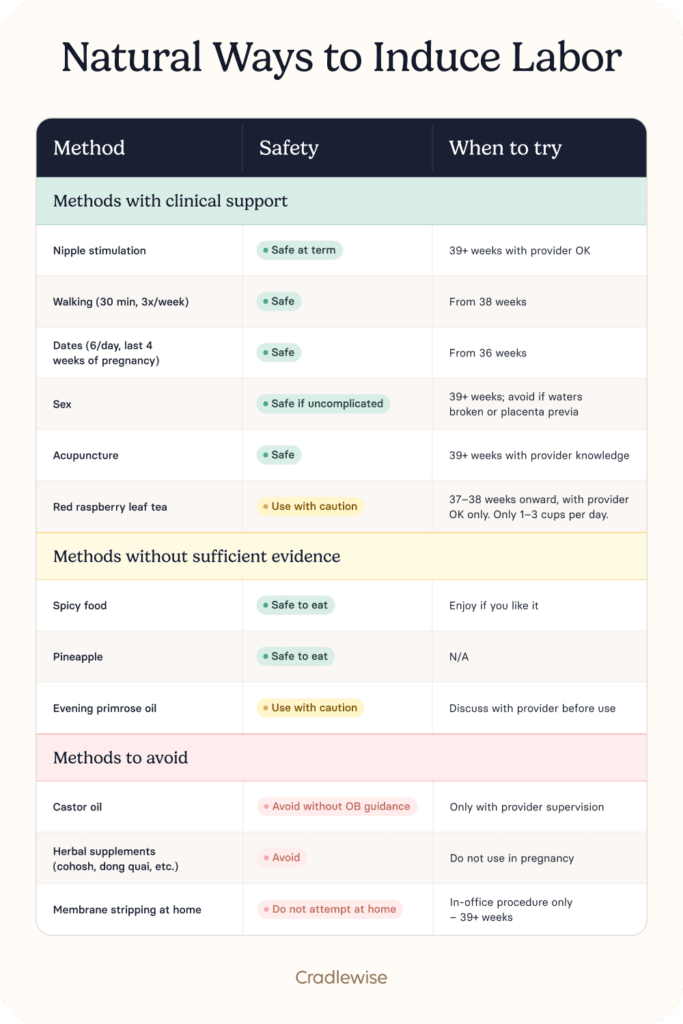
Walking
Walking is the most low risk and most evidence-based option. It encourages the baby to engage in the pelvis, applying gentle pressure to the cervix. It also keeps you fit for the work of labor. Just don’t push through exhaustion or pain.
Eating dates
Dates are one of the few foods with actual clinical evidence. A randomised study found that women who consumed 6 dates per day in the final four weeks of pregnancy had significantly higher cervical ripening scores compared to those who did not.
Cradlewise Note: Dates are high in sugar, so if you have gestational diabetes, check with your provider first.
Nipple stimulation
“ This (nipple stimulation) has the best evidence among non-medical methods. Several randomized trials and systematic reviews have found that nipple stimulation can increase the likelihood of going into labor within a few days in low-risk pregnancies at term. It may also reduce the need for medical induction in some women.”
Nipple stimulation triggers the release of oxytocin, the same hormone responsible for uterine contractions. However, it’s best done gently and only with your provider’s guidance.
Avoid it if you have a high-risk pregnancy, placenta previa, or any condition where premature contractions would be a concern.
Acupuncture
There are only limited observational studies on the effect of acupuncture as one of the natural ways to trigger labor.
Whether it meaningfully accelerates labor onset is not clear, however, it is not known to show adverse fetal effects. If it’s something that appeals to you and your provider approves, it’s a low-risk option worth exploring.
Red raspberry leaf tea
Pregnancy teas including red raspberry leaf tea is a popular beverage during pregnancy, but the research supporting its use as a labor induction method is very limited. In fact, as per a study by Aust Coll Midwives Inc J, it is known to reduce the instances of artificial rupture of the membranes, of cesarean sections, forceps or vacuum births in women who drink red raspberry tea.
Cradlewise Note: It should be avoided before 37 weeks due to its potential uterine stimulant properties. If you want to try it, do so only from 37-38 weeks onward, with your provider’s knowledge, and stick to one to three cups per day.
Sex
“ Semen carries the highest concentration of prostaglandins of any bodily fluid, and it lands right at the cervix during intercourse, the same compounds used in cervical ripening gels. The researchers, however, when they actually examined the results, did not see that sex hastened the onset of labor. I wouldn’t say not to do it, but I wouldn’t say it’s your key to getting into the delivery room.”
Patricia Bartels says, “If your body is already preparing for labor, sex may help nudge things along. If your body isn’t ready, it’s unlikely to have much effect.”
In short, sex is safe as long as you don’t have an uncomplicated pregnancy with placenta previa or ruptured membranes.
Are there sleeping positions that induce labor?
Would you like to know if sleeping positions can really turn a breech baby? Read how.
Natural ways to induce labor that don’t work and to avoid
Some suggestions are harmless but unlikely to work. Others carry real risks that outweigh any potential benefit.
Spicy food
Spicy food may cause heartburn, indigestion, or stomach upset without any cervical effect. If you enjoy it, eat it, just don’t expect results.
Eating pineapple
Pineapple contains an enzyme called bromelain, which is claimed to soften the cervix. However, that bromelain is largely destroyed by your stomach acid before reaching your uterus. There is currently no clinical evidence that supports that eating pineapple starts labor.
Evening primrose oil
Patricia Bartels explains: Most obstetric organizations do not recommend evening primrose oil as an evidence-based method of inducing labor. Evening primrose oil is thought to provide gamma-linolenic acid (GLA), which the body can convert into substances involved in prostaglandin production. Prostaglandins help soften and ripen the cervix. There is no strong evidence it works to induce labor.
Cradlewise Note: Evening primrose oil’s evidence for cervical ripening is poor and inconclusive. It should not be used vaginally without provider guidance, and oral use should also be discussed first.
Natural induction methods you should avoid at home
These below methods must never be carried out at home with or without medical supervision.
Castor oil
“ Castor Oil works as a strong laxative, stimulating the intestines. Because the intestines and uterus share some nerve pathways, this intestinal stimulation can be associated with the onset of contractions. It does not help to “ripen” the cervix and does not appear to work if the cervix and body are not already preparing for labor.”
She further adds, “Patients should be cautioned that using castor oil can induce diarrhea, nausea, vomiting, abdominal cramps, dehydration.”
Dr. David Ghozland says, “I rarely recommend castor oil as a first option, and never without checking in with your OB beforehand. If you’re set on trying it, know that the side effects can be rough, and the benefit isn’t guaranteed.”
Membrane stripping at home
Patricia Bartels explains the process of membrane stripping: “A membrane sweep is a procedure performed by a trained healthcare professional during a cervical exam. They insert a gloved finger through the cervix (if it is already open enough) and gently separate the amniotic sac from the lower part of the uterus. This separation releases prostaglandins, which may help stimulate labor.”
However, trying to do it yourself at home without training is not recommended as it can lead to infection or may accidentally rupture your membranes.
The same caution applies to any herbal supplement marketed as a labor stimulant including blue or black cohosh, dong quai, and pennyroyal as they have all been associated with serious complications and should be completely avoided.
What happens if labor doesn’t start naturally?
Many parents reach their due date (or even go past it) without labor starting on its own. It is not a sign that something has gone wrong.
If your baby is taking their time, your doctor may discuss different options to induce labor. ACOG recommends that uncomplicated pregnancies be offered induction between 41 and 42 weeks if labor has not started spontaneously.
When medical induction is needed, your provider can go for a membrane sweep (performed in the office), cervical ripening with prostaglandin gel, an amniotomy (breaking the waters in a monitored setting), or Pitocin to stimulate contractions. These are safe, closely monitored, and can be adjusted based on how your cervix and baby responds.
When to call your provider
Whether you’re trying natural methods or simply waiting for labor to start, keep your healthcare provider informed. Call your provider or maternity unit if you notice:
- Regular contractions coming every 5 minutes, lasting 1 minute, for at least 1 hour (the 5-1-1 rule)
- Your water breaks, even if contractions haven’t started
- Green or brown fluid, that has an unusual smell, which may indicate your baby has passed meconium
- Significant decrease in your baby’s movements
- Heavy vaginal bleeding (more than light spotting)
- Severe headache, vision changes, or significant swelling of your face or hands (possible signs of preeclampsia)
- Severe upper abdominal pain or a fever
If you’re worried, it’s always appropriate to call your healthcare team. They would much rather answer a question than have you stay home wondering.
Trust the process: Your baby will come when it’s time
By the end of pregnancy, it can feel like everyone around you is waiting, checking in, asking when the baby is coming. And all that well-meaning attention can make the final stretch feel even longer.
And while you may wonder about how to induce labor naturally, hold those methods lightly, as support for a process that’s already underway. Your body already knows how to begin this process and is working towards it, even when it doesn’t feel like it.
As Dr. David Ghozland puts it in the beginning: This is your body’s timeline, not something you can rush.
Your provider is there to guide you when the moment calls for medical help. Until then, focus on staying comfortable and listening to your body. Your baby will be here soon.
FAQs
Q: What is the quickest way to go into labor?
A: There isn’t a method that’s proven to make labor start immediately if your body isn’t already ready. Labor begins when a complex series of hormonal and physical changes occur between the baby, placenta, uterus, and cervix. Until those changes are underway, even medical induction can fail, says Patricia Bartels.
Q: Does sex induce labor?
A: In theory, yes. Semen contains prostaglandins, the same compounds used in cervical ripening gels, and orgasm releases oxytocin. In practice, research has not shown that sex reliably starts labor. If your pregnancy is healthy and your provider hasn’t advised pelvic rest, it’s generally safe, but it shouldn’t be viewed as a guaranteed labor trigger.
Q: How can I open my cervix naturally for labor?
A: Unfortunately, there isn’t a reliable home method to open the cervix. Staying active, walking, and eating dates during the last few weeks of pregnancy may support cervical ripening, but your cervix still follows its own biological timeline.
Q: Are there any sleeping positions to induce labor?
A: No. There isn’t any sleeping position that’s been shown to induce labor. Labor begins when a complex combination of hormonal signals from the baby, placenta, uterus, and your body all line up, and changing your sleeping position can’t trigger that process.
Q: How to induce labor naturally at 38 weeks?
A: At 38 weeks, your baby is not yet considered full term by ACOG standards (39 weeks is the threshold). The gentle options like walking and eating dates can be started with your provider’s knowledge, but nothing more aggressive is appropriate at this stage.
Q: What to drink for quick labor?
A: No drink has been proven to reliably start labor. Staying well-hydrated with water is important. Red raspberry leaf tea is sometimes used during the final weeks of pregnancy, but is not a reliable induction method, and it should only be used after discussing it with your healthcare provider.
You may also like:
- Hospital bag checklist: What to pack for mom, baby, and partner.
- Ask the expert: What are the early signs of preterm labor, and when should you call your doctor?
- Does oxytocin make you sleepy? What parents should know.
Sources:
- Full term as 39 weeks. ACOG. Obstetrics Data Definitions.
- Eating dates. Medical Archives. 2025. The Effects of Date Consumption on Labor and Vaginal Birth.
- Nipple stimulation. Cochrane Library. 2005. Breast stimulation for cervical ripening and induction of labor.
- Acupuncture. Cochrane Database Syst Rev. 2013. Acupuncture for induction of labour.
- Red raspberry leaf tea. Aust Coll Midwives Inc J. 1999. https://pubmed.ncbi.nlm.nih.gov/10754818/
- Reach their due date (or even go past it). National Library of Medicine. Birth: Learn More – When your baby’s due date has passed.
- What happens if labor doesn’t start naturally. ACOG. 8 Questions to Ask Your Doctor Before Labor Induction.
You may also like


