Pregnancy
0 min read
The Dirty Dozen during pregnancy: How to think about produce, pesticides, and what to wash


Cradlewise Staff
Pregnancy can turn grocery shopping into a full-blown research project. One minute you’re happily eating strawberries straight out of the carton. The next? You’re deep into a rabbit hole about pesticides, produce washing hacks, and something called the “Dirty Dozen.”
If you’ve found yourself wondering:
- Should I only buy organic now?
- Is regular produce safe during pregnancy?
- Am I washing fruits the “right” way?
…you are most definitely not alone.
The good news: experts still agree that eating fruits and vegetables during pregnancy is incredibly important for both you and your growing baby. The goal isn’t perfection; it’s making informed, realistic choices without spiraling every time you enter the produce aisle.
So, what is the Dirty Dozen?
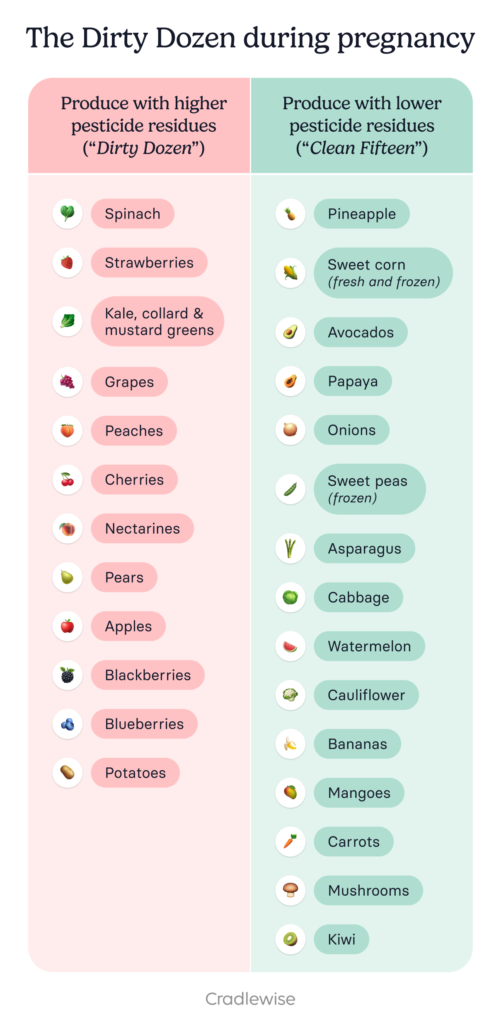
The “Dirty Dozen” is a yearly list published by the Environmental Working Group (EWG) that highlights produce found to have higher pesticide residues after washing. The list is based on testing data from the USDA Pesticide Data Program, which monitors pesticide residues on fruits and vegetables sold in the U.S.
The idea behind the list is simple: help consumers identify produce where choosing organic might reduce pesticide exposure.
The 2026 Dirty Dozen list includes:
- Spinach
Spinach has more pesticide residues by weight than any other type of produce. - Kale, collard, and mustard greens
More than half of kale samples were found to contain residues of a pesticide considered a possible carcinogen. - Strawberries
The average American eats about eight pounds of fresh strawberries a year — along with traces of dozens of pesticides. - Grapes
Grapes frequently appear on high-residue produce lists because of multiple pesticide residues detected during testing. - Nectarines
Nectarines continue to rank among fruits with higher detected pesticide residues. - Peaches
Peaches consistently show high levels of pesticide contamination due to their delicate skin and farming practices. - Cherries
Cherries are often treated with multiple pesticides to protect against insects and fungal diseases. - Apples
Apples may be treated with chemicals even after harvest to help extend shelf life and maintain appearance. - Blackberries
Blackberries were added to the Dirty Dozen after the USDA tested them in 2023 and found multiple pesticide residues on sampled fruit. - Pears
Pears rank among the more pesticide-contaminated fruits on the list. - Potatoes
One of the most commonly eaten vegetables in the U.S., returned to this year’s Dirty Dozen list. - Blueberries
Blueberries reappeared on the Dirty Dozen with traces of several pesticide residues detected during testing.
Important:
- If your budget allows, consider buying organic versions of higher-residue produce more often.
- Lower-residue produce is generally considered a good conventional option.
- Wash all produce thoroughly, organic included.
But it’s also important to understand that the Dirty Dozen is not without controversy.
Some scientists and nutrition experts argue that the list can unintentionally create fear around eating fruits and vegetables, even though the pesticide levels found on produce are typically still within EPA safety limits. It is important to point out that the USDA consistently finds the vast majority of produce samples to be compliant with federal safety standards.
In fact, according to USDA testing data, more than 99% of tested food samples had pesticide residues below EPA safety thresholds. That’s why many OB-GYNs and dietitians encourage a balanced approach: wash produce thoroughly, buy organic strategically if it works for your budget, and most importantly, continue eating a wide variety of fruits and vegetables during pregnancy. Because ultimately, the nutritional benefits of produce are very well established, and skipping fruits and vegetables altogether out of fear would likely do far more harm than good.
Why pregnancy makes this feel extra stressful
Pregnancy has a way of making every tiny decision feel enormous.
You’re already thinking about:
- caffeine
- deli meat
- sushi
- sleep positions
- prenatals
- ingredient labels
So hearing the words “pesticides” and “pregnancy” in the same sentence? Understandably unsettling. Some studies have looked at whether repeated high exposure to certain pesticides could affect fetal development or hormone systems. But experts at the American College of Obstetricians and Gynecologists ACOG also stress that avoiding fruits and vegetables altogether out of fear would likely do more harm than good.
Produce contains nutrients that pregnancy desperately needs:
- folate
- fiber
- vitamin C
- potassium
- antioxidants
Translation? Your apple is still your friend.
Do you need to buy organic during pregnancy?
Short answer: not necessarily. If buying organic works for your budget, prioritizing organic versions of higher-residue produce like strawberries, spinach, grapes, and apples. But if organic groceries aren’t realistic right now? Conventional produce is still nutritious and worth eating.
A practical pregnancy approach:
Prioritize organic if possible for these:
- berries
- leafy greens
- apples
- grapes
- peaches
Conventional is generally lower-residue for these:
- avocados
- bananas
- onions
- cabbage
- sweet corn
- Pineapple
What washing produce actually helps with
Washing fruits and vegetables absolutely matters during pregnancy, but maybe not in the way TikTok says it does. According to the FDA’s produce safety guidelines, rinsing produce under running water helps reduce:
- dirt
- bacteria
- germs
- some pesticide residues
But washing does not remove every trace of pesticides. Some pesticides are “systemic,” meaning they’re absorbed into the plant itself. Still, washing produce is one of the easiest and most effective ways to reduce surface residue exposure.
If your grocery budget is limited, then…
- “Worth prioritizing organic”
- “Usually okay conventional”
- “Always wash thoroughly”
The best way to wash fruits and vegetables during pregnancy
Here’s the surprisingly boring answer experts keep giving:
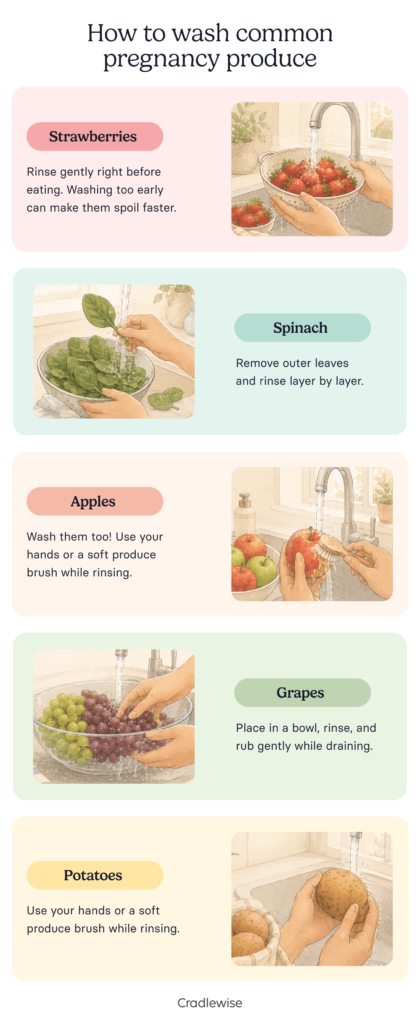
Plain running water works really well. The FDA and CDC both recommend washing produce under clean running water, not soap, bleach, or commercial produce cleaners. According to the FDA, produce is porous and can absorb soaps or detergents, which may make you sick
Wait, what about vinegar or baking soda?
This is where pregnancy internet gets creative.
You’ve probably seen:
- vinegar soaks
- baking soda baths
- produce sprays
- “detox washes”
Some research suggests baking soda solutions may help reduce certain surface pesticide residues on produce like apples. One small study published in the Journal of Agricultural and Food Chemistry found that soaking apples in a baking soda solution removed more surface pesticide residue than plain water alone, although it still didn’t remove everything, especially pesticides that had already penetrated the skin of the fruit.
Vinegar, meanwhile, is better known for helping reduce some bacteria and germs rather than dramatically removing pesticides. That’s why many experts see it as more of a produce-cleaning method than a true “detox” solution.
But federal agencies still say plain running water works well for most people. The FDA specifically advises against washing produce with soap or detergent because fruits and vegetables are porous and can absorb those substances, potentially leaving behind residues you actually don’t want to eat.
So no, your strawberries do not need a bubble bath. If using a vinegar or baking soda soak makes you feel better, it’s generally fine in moderation, but it’s not something you need to do to have a healthy pregnancy diet. Thorough rinsing, gentle scrubbing, and eating a wide variety of produce matter far more than creating the perfect produce-cleaning routine.
The bigger picture: don’t let produce anxiety take over
This part matters most.
Pregnancy already comes with a lot of “don’t eat this” messaging. It’s easy to start feeling like every food choice carries massive consequences. But experts consistently emphasize that eating fruits and vegetables, even conventionally grown ones, is healthier than avoiding produce altogether because of pesticide fears.
That means:
- Frozen fruit is okay
- Non-organic spinach is okay
- Grocery store apples are okay
- Doing your best is okay
The goal is to be aware and lower exposure where practical, not just achieving perfect “clean eating.” Because realistically? Most pregnant people are just trying to survive nausea while remembering where they left their water bottle.
Conclusion
The Dirty Dozen can be a helpful tool, not a reason to fear your produce drawer. Wash your fruits and vegetables. Buy organic strategically if it fits your budget. Focus on variety instead of perfection. And remember: a bowl of regular grocery store strawberries is still a nourishing pregnancy snack.
You may also like
- Prenatal genetic testing: What should parents know
- Pregnant and dealing with a head cold? What’s safe, what works, and what to avoid
- Ask the expert: How to choose the right prenatal vitamins during pregnancy
Sources:
- Consumer guide to pesticide residues in produce. Environmental Working Group (EWG). 2024. “EWG’s 2024 Shopper’s Guide to Pesticides in Produce.”
- USDA testing data on pesticide residues in food. United States Department of Agriculture (USDA). Ongoing dataset. “Pesticide Data Program (PDP).”
- Research on endocrine disruption and human health. United States Environmental Protection Agency (EPA).Ongoing research overview. “Endocrine Disruption and Human Health Research.”
- Guidelines for healthy eating during pregnancy. American College of Obstetricians and Gynecologists (ACOG).2023. “Healthy Eating During Pregnancy.”
- FDA recommendations for choosing and washing produce safely. U.S. Food and Drug Administration (FDA).2024. “Selecting and Serving Produce Safely.”
- Food safety advice for fruits, vegetables, and juices during pregnancy. U.S. Food and Drug Administration (FDA). 2024. “Fruits, Veggies and Juices: Food Safety for Moms-to-Be.”
- CDC guidance on preventing foodborne illness from fresh produce. Centers for Disease Control and Prevention (CDC). 2024. “Preventing Cyclosporiasis.”
You may also like


