Parenting
0 min read
A breastfeeding and pumping schedule that works in real newborn life


Cradlewise Staff
At some point during the newborn stage, many parents begin to realise that feeding a baby can feel like a full-day event. You nurse. You burp. You change a diaper. Your baby falls asleep in your arms. Life suddenly seems to run on this feed, burp, diaper change, and sleep routine, and you begin to wonder when things will feel a little less repetitive. Somewhere along the way, someone asks if you’ve started pumping yet.
You may have heard other parents talk about pumping but aren’t quite sure when, or how, to introduce it into an already packed day. For some families, pumping becomes part of the routine because work is on the horizon, while others begin earlier because of latch concerns, weight gain, or time apart from their baby. Adding a pump to the mix can make the early weeks feel even more scheduled, but a breastfeeding and pumping routine doesn’t have to revolve around the clock.
Let’s walk you through this and show you that a breastfeeding and pumping schedule doesn’t have to run with military precision. During the first few months, it’s often less about following a clock and more about understanding when your baby tends to eat, how your milk supply responds, and where pumping fits into your day.
How milk supply works
Breast milk production is driven by supply and demand. Every time milk is removed, whether by nursing or pumping, your body receives a signal to continue making milk.
Research published in MCN: The American Journal of Maternal/Child Nursing suggests that frequent and effective milk removal—either through breastfeeding or pumping, is essential for establishing and maintaining milk supply. Current guidance recommends aiming for 8–12 feedings or milk expressions over 24 hours during the early postpartum weeks.
According to the Centers for Disease Control and Prevention (CDC), newborns typically feed eight or more times over a 24-hour period. Some days may feel like an endless loop of feeding, especially during growth spurts or periods of cluster feeding.
This is why many lactation professionals encourage parents to focus on overall feeding patterns rather than exact times on a schedule during the newborn stage.
When should you start pumping?
If breastfeeding is going smoothly and your baby is gaining weight appropriately, many parents wait until feeding is established before introducing regular pumping sessions.
The American Academy of Pediatrics (AAP) recommends establishing breastfeeding before introducing bottles or other artificial nipples. For many families, that happens during the first few weeks after birth, making the one-month mark a common time to begin offering expressed milk.
There are situations where pumping may begin much earlier, including:
- Premature birth.
- Difficulty latching.
- Time spent apart after delivery.
- Concerns about milk transfer or weight gain.
- Recommendations from your pediatrician or lactation consultant.
Parents preparing to return to work may choose to begin pumping a few weeks before their first day back. Building a small supply of expressed milk can help ease the transition, though many families find they don’t need an entire freezer full of milk before returning to work.
A sample breastfeeding and pumping schedule (0–6 weeks)
The first month with a newborn rarely follows a predictable pattern.
Many parents find that morning pumping sessions yield more milk than sessions later in the day. Overnight milk production continues while you sleep, and breasts may feel fuller after longer stretches between feeds.
If your baby spends an entire evening cluster feeding, that’s normal, too. Cluster feeding is common in young infants and does not necessarily mean that your supply is low.
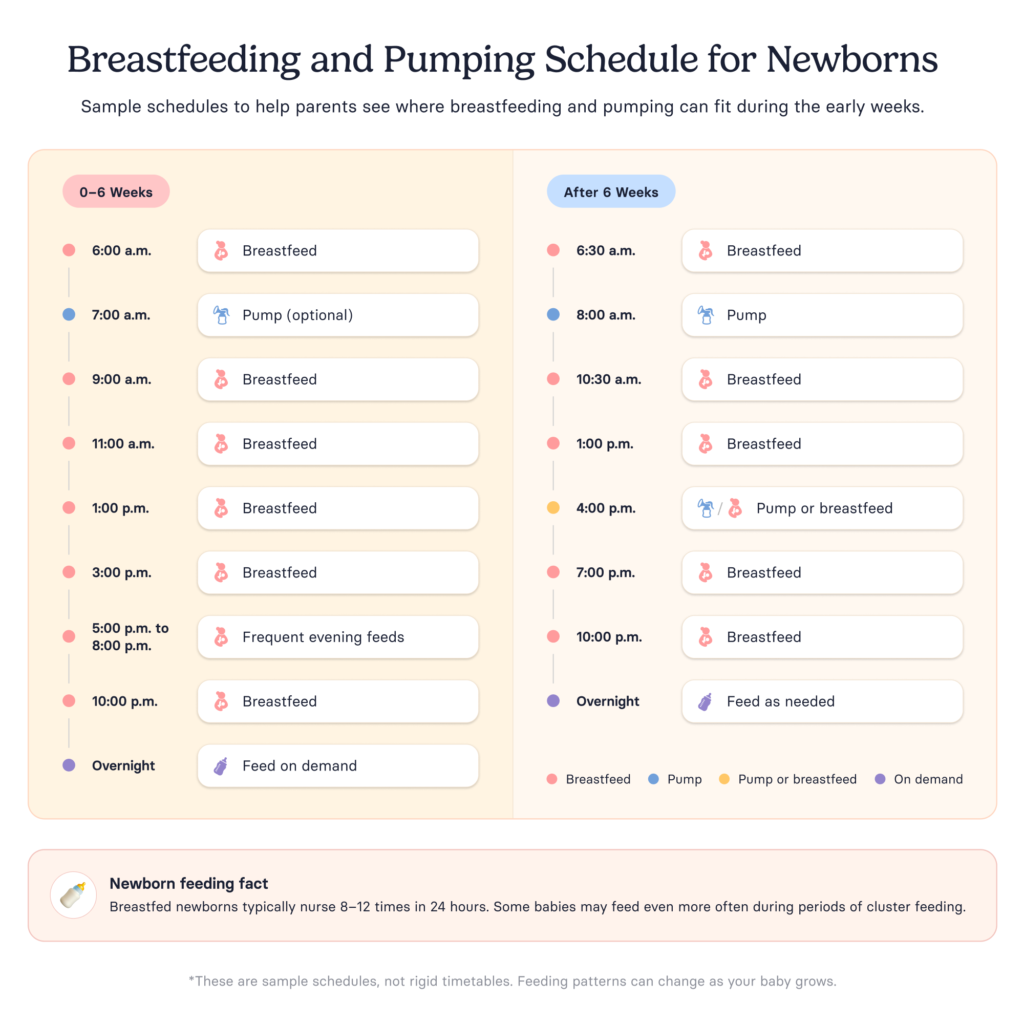
A sample schedule after 6 weeks
Around six to eight weeks, some babies become more efficient feeders, and families begin to notice a bit more predictability.
If your baby receives a bottle while you’re away, it’s generally recommended to pump around that same time to continue removing milk regularly.
What about exclusive pumping?
Exclusive pumping means that all milk removal happens through a breast pump rather than direct nursing.
According to CDC breastfeeding recommendations, infants should receive only breast milk for about the first six months when possible. Families reach that goal in different ways, and exclusive pumping is one of them.
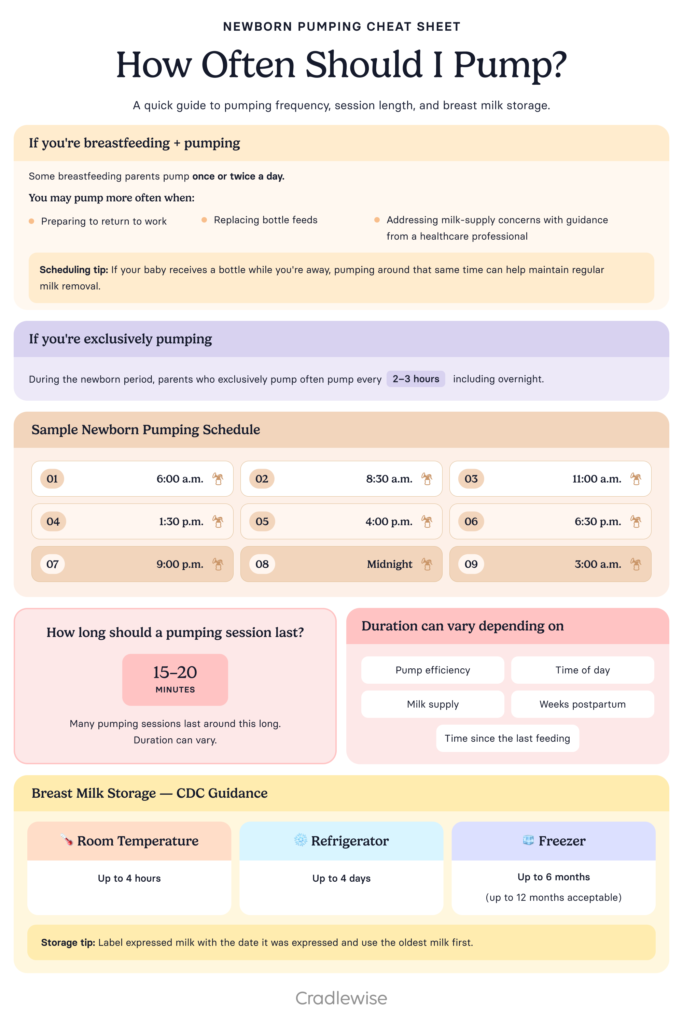
During the newborn period, parents who exclusively pump often pump every two to three hours, including overnight.
An example schedule may include:
- 6:00 a.m.
- 8:30 a.m.
- 11:00 a.m.
- 1:30 p.m.
- 4:00 p.m.
- 6:30 p.m.
- 9:00 p.m.
- Midnight
- 3:00 a.m.
Maintaining that frequency helps establish milk supply during the early postpartum period. As babies grow and milk production becomes more established, some parents are able to reduce the number of daily pumping sessions with guidance from their healthcare provider.

Did you know?
In a recent U.S. survey, 72% of people who pumped breast milk reported having a pumping schedule. Among them, the median was four pumping sessions a day.
How long should pumping sessions last?
Most pumping sessions last between 15 and 20 minutes, although there is considerable variation from one parent to another.
Several factors influence pumping output, including:
- Time of day.
- Time since the last feeding.
- Pump efficiency.
- Milk supply.
- Weeks postpartum.
Parents are often surprised by how different pumping output can be throughout the day. Collecting one ounce after nursing does not automatically indicate a supply problem. If your baby has just finished a full feeding, there may simply be less milk available for the pump to collect.
What if my baby wants to nurse immediately after I pump?
This is a common question in the early weeks. Because breast milk production is ongoing. Pumping does not completely “empty” the breast, and your body continues making milk throughout the day.
So, if your baby wants to feed shortly after you’ve pumped, you can still nurse them. Many parents find that they spend less time watching the clock as they become more familiar with their baby’s feeding habits. Over time, it’s easier to recognize whether your baby is hungry, comfort nursing, or simply looking for a familiar place to settle before sleep.
Signs your feeding routine is working
It’s easy to focus on the number of ounces in a bottle or the amount collected during a pumping session.
Pediatricians typically look at a broader picture:
- Consistent weight gain.
- Regular wet and dirty diapers.
- Appropriate growth over time.
- Baby appears satisfied after many feeds.
- Milk supply remains stable.
The AAP considers weight gain and diaper output among the most reliable indicators that a baby is receiving enough milk.
Storing pumped milk safely
If you’re pumping regularly, you’ll quickly discover that breast milk storage bags can take over an entire shelf of your refrigerator.
The CDC currently recommends:
- Freshly expressed milk can remain at room temperature for up to four hours.
- Breast milk can be stored in the refrigerator for up to four days.
- Breast milk can be stored in a standard freezer for up to six months, with up to twelve months being acceptable in some circumstances.
Always label stored milk with the date it was expressed and use the oldest milk first.
Conclusion
A breastfeeding and pumping schedule usually starts as a rough plan and changes several times during the first few months. The routine that develops in your home, with your baby may not resemble the examples you see online, and that’s often because newborns have a way of rearranging even the best intentions.
Some days will include one pumping session, others three. Some nights will bring longer stretches of sleep, while others will revolve around frequent feeds. What tends to matter most over time is regular milk removal, appropriate weight gain, and finding a rhythm that supports both parent and baby as those newborn weeks gradually give way to something a little more predictable.
FAQs
Q: How many times should a newborn breastfeed in 24 hours?
A: Breastfed newborns typically nurse about 8 to 12 times in a 24-hour period. Some babies may feed more frequently during periods of cluster feeding.
Q: When should I start pumping while breastfeeding?
A: If breastfeeding is going well, many parents wait until breastfeeding is established before introducing regular pumping. You may need to start earlier if your baby has difficulty latching, isn’t gaining weight well, or you’re separated from your baby.
Q: How often should I pump if I'm breastfeeding?
A: It depends on why you’re pumping. Some breastfeeding parents pump once or twice a day, while others pump more often when preparing for work, replacing bottle feeds, or addressing milk-supply concerns.
Q: How often should I pump if I'm exclusively pumping?
A: During the newborn period, parents who exclusively pump often pump every two to three hours, including overnight, to establish and maintain milk supply.
Q: How long should a pumping session last?
A: Many pumping sessions last around 15 to 20 minutes, although the ideal duration varies based on your pump, milk supply, time postpartum, and individual milk flow.
Sources:
- Guidance on establishing and protecting milk supply. MCN: The American Journal of Maternal/Child Nursing.2025. “Guidelines for Primary Pediatric Care Professionals to Help Patients Establish and Protect Milk Supply.”
- Breastfeeding frequency and feeding amounts. Centers for Disease Control and Prevention (CDC). 2026. “How Much and How Often to Breastfeed.”
- AAP recommendations and benefits of breastfeeding. American Academy of Pediatrics (HealthyChildren.org). 2026. “Why We Support Breastfeeding for Your Baby’s Health.”
- Evidence-based breastfeeding recommendations and guidance. Centers for Disease Control and Prevention (CDC).2026. “Breastfeeding Recommendations and Guidance.”
- Signs that a breastfed baby is getting enough milk. American Academy of Pediatrics (HealthyChildren.org). 2025. “How to Tell if Your Breastfed Baby is Getting Enough Milk.”
- Safe storage and preparation of expressed breast milk. Centers for Disease Control and Prevention (CDC). 2026. “Storage and Preparation of Breast Milk.”
- Trends in postpartum pumping practices in the U.S. Breastfeeding Medicine. 2025. “A National Survey: Trends in U.S. Postpartum Pumping Practices After Term Deliveries
You may also like