Parenting
0 min read
170+ Russian baby names with meanings and pronunciation


Cradlewise Staff
Picking a baby name sounds simple enough, until you actually have to pick one. Suddenly, every name feels like it needs to be beautiful, meaningful, easy to say, and somehow just right for your baby.
That’s where Russian baby names can be so much fun to explore. They have a certain character to them. Some are soft and sweet, while others have a bold, almost storybook feel. And then there are the names you may not have heard before but can’t stop saying once you find them.
Many Russian names also have fascinating histories, with roots in Slavic, Greek, Hebrew, Latin, and Old Norse languages. Some have strong meanings, some have adorable nickname options, and plenty have that distinctive Russian sound that makes them memorable.
So, if you’re looking for a baby name that feels classic, charming, strong, or a little unexpected, you’re in the right place. We’ve rounded up 170+ Russian baby names, complete with meanings and pronunciations, to help you find a name you’ll love saying for years to come
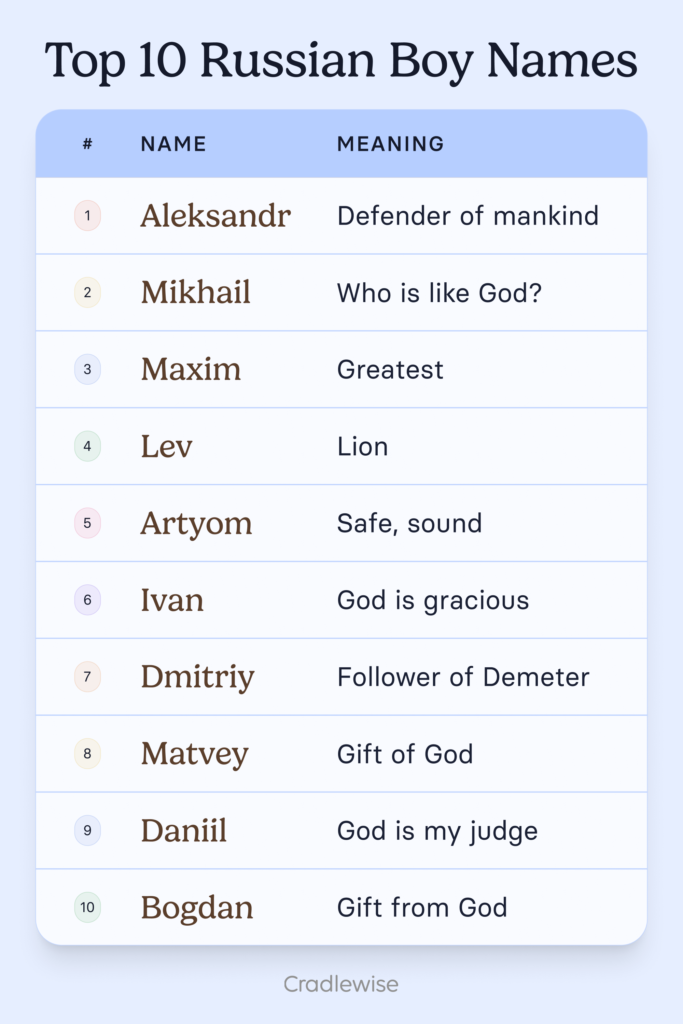
Popular Russian girl names
1. Alina
Meaning: Bright; beautiful
Pronunciation: ah-LEE-nah
Alina is used across Eastern Europe and has several possible linguistic roots. In Russian-speaking communities, it has become a familiar, feminine choice with a simple two-syllable rhythm.
2. Mila
Meaning: Gracious; dear
Pronunciation: MEE-lah
Mila has Slavic roots and is associated with meanings such as “dear” and “gracious.” Its short form and gentle sound have also made it familiar well beyond Russia.
3. Svetlana
Meaning: Light
Pronunciation: sveht-LAH-nah
Svetlana comes from the Slavic word svet, meaning “light.” The name was popularized in Russian literary and cultural circles and carries a bright, distinctly Slavic character.
4. Irina
Meaning: Peace
Pronunciation: ee-REE-nah
Irina is the Russian form of Irene, from the Greek word for “peace.” It has been used for centuries across Eastern Europe and has a particularly classic Russian feel.
5. Yulia
Meaning: Youthful
Pronunciation: YOO-lee-ah
Yulia is the Russian form of Julia, tracing back to the ancient Roman family name Julius. Its connection with youth gives the name a light, timeless quality.
6. Vera
Meaning: Faith
Pronunciation: VEH-rah
Vera comes directly from the Slavic word for “faith.” It is traditionally grouped with the Russian names Nadezhda, meaning hope, and Lyubov, meaning love.
7. Zoya
Meaning: Life
Pronunciation: ZOH-yah
Zoya is the Russian form of the Greek Zoe, meaning “life.” Short and distinctive, it has been used in Russia for generations while retaining its ancient Greek roots.
8. Tatiana
Meaning: From the Roman family name Tatius
Pronunciation: tah-tee-AH-nah
Tatiana comes from the ancient Roman name Tatius and became strongly associated with Russian culture through literature. One of its most famous appearances is as the heroine Tatiana Larina in Pushkin’s Eugene Onegin.
9. Yekaterina
Meaning: Pure
Pronunciation: yeh-kah-teh-REE-nah
Yekaterina is the Russian form of Catherine, traditionally associated with the meaning “pure.” The name has a regal Russian history, most famously through Catherine the Great.
10. Yelizaveta
Meaning: God is my oath
Pronunciation: yeh-lee-zah-VEH-tah
Yelizaveta is the Russian form of Elizabeth, a name with Hebrew roots. Its long history across Russian royalty and religious tradition gives this elegant name plenty of historical weight.
11. Polina
Meaning: Small; humble
Pronunciation: poh-LEE-nah
Polina is widely used in Russia and is related to names such as Paulina and Pauline. Its compact sound makes it feel modern while its roots reach back to Latin naming traditions.
12. Anastasiya
Meaning: Resurrection
Pronunciation: ah-nah-stah-SEE-yah
Anastasiya is the Russian form of Anastasia, a name with ancient Greek roots meaning “resurrection.” It has a long connection with Christian saints and remains one of the most recognizable Russian girl names.

Did you know?
Anastasiya is closely tied to one of Russia’s most famous historical mysteries: Grand Duchess Anastasia Romanov. Her story has inspired books, movies, and the animated film Anastasia.
13. Alyona
Meaning: Bright; shining
Pronunciation: ah-LYOH-nah
Alyona is a Russian form related to Elena and Helen. Its connection to the idea of brightness gives the name a warm meaning, while its use in Russian folklore and literature adds cultural character.
14. Oksana
Meaning: Hospitality; praise
Pronunciation: ok-SAH-nah
Oksana is especially associated with Ukrainian and Russian-speaking naming traditions and is related to the name Xenia. It has a long literary and folk tradition in the region.
15. Larisa
Meaning: Citadel
Pronunciation: lah-REE-sah
Larisa is the Russian form of Larissa, a name connected with ancient Greek tradition. It is also associated with an ancient city and early Christian saint.
16. Marina
Meaning: Of the sea
Pronunciation: mah-REE-nah
Marina comes from the Latin marinus, meaning “of the sea.” The name has traveled easily across European languages and has long been familiar in Russia.
17. Margarita
Meaning: Pearl
Pronunciation: mar-gah-REE-tah
Margarita is the Russian form of Margaret, ultimately from a Greek word meaning “pearl.” The name also has a major place in Russian literature through Bulgakov’s The Master and Margarita.
18. Raisa
Meaning: Easygoing; relaxed
Pronunciation: RAH-ee-sah
Raisa is an established Russian and Eastern European name with ancient Greek associations. Its distinctive pronunciation helps it stand apart from more familiar Russian choices.
Classic Russian Girl Names
19. Galina
Meaning: Calm; peaceful
Pronunciation: gah-LEE-nah
Galina is the Russian form of the Greek Galene, associated with calmness and tranquility. It has been a familiar name throughout Russian-speaking communities for generations.
20. Karina
Meaning: Beloved; pure
Pronunciation: kah-REE-nah
Karina is used across Russia and Europe and has several possible origins. It shares connections with names such as Carina and Katherine, giving it a long multicultural history.
21. Kira
Meaning: Lady; ruler
Pronunciation: KEE-rah
Kira is a short Russian name with several possible roots, including links to Cyrus and Greek naming traditions. Its compact form gives it a crisp, modern feel.
22. Klara
Meaning: Bright; clear
Pronunciation: KLAH-rah
Klara is the Russian and European form of Clara, from Latin clarus, meaning “bright” or “clear.” It has a long history in Christian Europe and remains instantly recognizable.
23. Lada
Meaning: Love; harmony
Pronunciation: LAH-dah
Lada is associated with Slavic mythology and folklore. The name is traditionally linked with ideas of love, beauty, and harmony, giving this short name a distinctly Slavic history.
24. Lyubov
Meaning: Love
Pronunciation: lyoo-BOHF
Lyubov comes directly from the Russian word for “love.” It is one of the traditional Russian virtue names, alongside Vera, meaning faith, and Nadezhda, meaning hope.
25. Natalya
Meaning: Christmas; born at Christmas
Pronunciation: nah-TAHL-yah
Natalya is the Russian form of Natalia, derived from the Latin phrase associated with Christmas. It has been used throughout Russia and other Eastern European countries for centuries.
26. Nadezhda
Meaning: Hope
Pronunciation: nah-DEHZH-dah
Nadezhda literally means “hope” in Russian. Along with Vera and Lyubov, it belongs to the famous trio of Russian virtue names.
27. Olesya
Meaning: Defender
Pronunciation: oh-LEH-syah
Olesya is used in Russian and Ukrainian naming traditions and is sometimes treated as a form of Alexandra or Lesya. Its connection with the idea of protection gives the name an appealing strength.
28. Sonya
Meaning: Wisdom
Pronunciation: SOHN-yah
Sonya is a Russian diminutive of Sofiya, the Russian form of Sophia. The name ultimately comes from Greek sophia, meaning “wisdom,” and has deep literary associations in Russian culture.
29. Sofiya
Meaning: Wisdom
Pronunciation: soh-FEE-yah
Sofiya is the Russian spelling of Sophia, from the Greek word for “wisdom.” It has a long religious history and remains one of the most internationally recognizable names with Russian roots.
30. Taisiya
Meaning: Belonging to Isis
Pronunciation: tie-SEE-yah
Taisiya is the Russian form of the Greek Thais. The name appears in early Christian history and has remained part of the Russian naming tradition.
31. Ulyana
Meaning: Youthful
Pronunciation: oo-LYAH-nah
Ulyana is a Russian form related to Juliana, ultimately connected to the Roman family name Julius. Its meaning is often associated with youthfulness.
32. Yana
Meaning: God is gracious
Pronunciation: YAH-nah
Yana is used in Russia and other Slavic countries and is related to names such as Jana and Joanna. Its roots ultimately connect to the Hebrew name John.
33. Yevgeniya
Meaning: Well-born; noble
Pronunciation: yehv-GEH-nee-yah
Yevgeniya is the feminine form of Yevgeniy, the Russian version of Eugene. Its Greek roots connect it with the idea of being well-born or noble.
34. Yevdokiya
Meaning: Good will
Pronunciation: yehv-doh-KEE-yah
Yevdokiya is the Russian form of Eudokia, an ancient Greek name associated with good will and favor. It also appears in Russian Orthodox history.
35. Zinaida
Meaning: Of Zeus
Pronunciation: zee-nah-EE-dah
Zinaida comes from the Greek name Zenais and is connected with Zeus. The name has a distinctly old-world Russian feel and has been used in Russian literary and cultural circles.
36. Varvara
Meaning: Foreign; stranger
Pronunciation: var-VAH-rah
Varvara is the Russian form of Barbara, from a Greek word historically used for a foreigner or non-Greek speaker. Saint Barbara helped establish the name in Christian naming traditions.
Unique Russian Girl Names
37. Vasilisa
Meaning: Queen
Pronunciation: vah-see-LEE-sah
Vasilisa comes from the Greek Basilissa, meaning “queen.” The name also appears in Russian fairy tales, most famously in stories about Vasilisa the Beautiful.
38. Valeria
Meaning: Strong; healthy
Pronunciation: vah-LEH-ree-ah
Valeria is the feminine form of the Roman family name Valerius. Its Latin roots connect it with strength and health, and the name has long been used throughout Eastern Europe.
39. Elena
Meaning: Bright; shining light
Pronunciation: eh-LEH-nah
Elena is the Russian form of Helen, a name of ancient Greek origin. Its traditional association with light and brightness has helped make it enduring across Europe.
40. Agata
Meaning: Good; virtuous
Pronunciation: ah-GAH-tah
Agata is the Russian and Eastern European form of Agatha, from the Greek word meaning “good.” Saint Agatha helped carry the name into Christian tradition.
41. Agasha
Meaning: Good; virtuous
Pronunciation: ah-GAH-shah
Agasha is a Russian form related to Agata and Agatha. It has a softer, more diminutive feel while retaining the older Greek association with goodness.
42. Aglaya
Meaning: Splendor; beauty
Pronunciation: ah-GLAH-yah
Aglaya comes from the Greek name Aglaia, meaning “splendor” or “beauty.” In Greek mythology, Aglaia was one of the three Graces.
43. Agrafena
Meaning: Wild horse; uncertain origin
Pronunciation: ah-grah-FYEH-nah
Agrafena is an old Russian form associated with Agrippina. It has a distinctly traditional sound and belongs to the older generation of Russian names.
44. Annika
Meaning: Grace
Pronunciation: ah-NEE-kah
Annika is used in Russian naming lists and is related to Anna, ultimately from Hebrew roots associated with grace. Its diminutive shape makes it short and easy to use internationally.
45. Dariya
Meaning: Kingly; sea
Pronunciation: dah-REE-yah
Dariya is a Russian form related to Daria and Darya. It has Persian roots and is associated with the meanings “kingly” and, in some interpretations, “sea.”
46. Evva
Meaning: Life
Pronunciation: EH-vah
Evva is a Russian spelling of Eve, whose Hebrew roots are connected with “life” or “living.” The double-v spelling gives this ancient name a distinctly Russian look.
47. Fanya
Meaning: Free; from France
Pronunciation: FAHN-yah
Fanya is a Russian diminutive-style name with more than one traditional interpretation, including “free man” and “from France.” It has the same friendly, nickname-like quality found in many Russian names.
48. Gala
Meaning: Festive; joyful
Pronunciation: GAH-lah
Gala is used in Russian and other European naming traditions and can function as a short form of longer names. Its association with celebration makes it especially lively.
49. Nadia
Meaning: Hope
Pronunciation: NAH-dee-ah
Nadia is an internationally familiar form of Nadezhda, the Russian name meaning “hope.” It carries the meaning of the longer name in a much shorter form.
51. Rina
Meaning: Joy; peace
Pronunciation: REE-nah
Rina appears as a short form in several naming traditions, including Russian usage. Depending on its source name, it can carry associations with joy or peace.
52. Sabina
Meaning: Sabine woman
Pronunciation: sah-BEE-nah
Sabina comes from the ancient Roman name Sabinus, referring to the Sabine people of central Italy. The name later spread widely through Christian Europe and into Russian naming traditions.
53. Sharlotta
Meaning: Free woman
Pronunciation: shar-LOH-tah
Sharlotta is the Russian form of Charlotte, the feminine form of Charles. Its Germanic roots are associated with freedom or a free person.
54. Verina
Meaning: True
Pronunciation: veh-REE-nah
Verina is a rare form associated with Latin and European naming traditions. Its connection with words for truth gives it a simple, meaningful quality.
55. Zhanna
Meaning: God is gracious
Pronunciation: ZHAH-nah
Zhanna is the Russian and French-influenced form of Jeanne, related to John. Its Hebrew roots carry the meaning “God is gracious.”
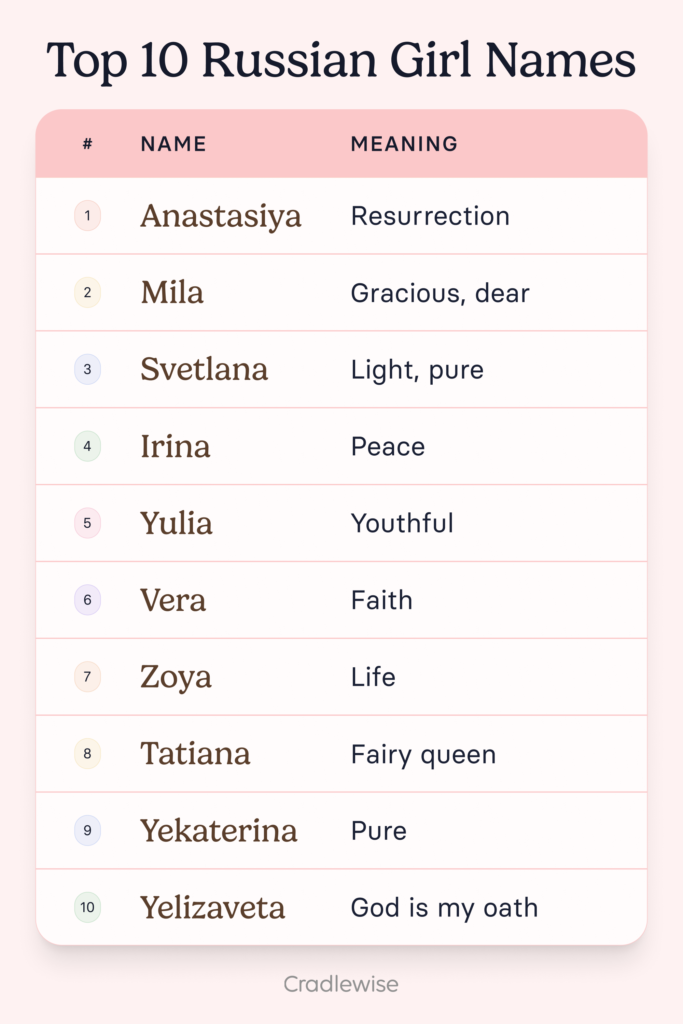
Popular Russian boy names
50. Mechislav
Meaning: Sword and glory
Pronunciation: meh-chee-SLAHF
Mechislav is a traditional Slavic name built around the words for “sword” and “glory.” Like many old Slavic names, its meaning reads almost like a tiny description of the qualities a child might carry.
56. Aleksandr
Meaning: Defender of the people
Pronunciation: ah-lehk-SAHN-dr
Aleksandr is the Russian form of Alexander and comes from ancient Greek. It has been carried by writers, rulers, and military leaders, including the Russian poet Aleksandr Pushkin.
57. Mikhail
Meaning: Who is like God?
Pronunciation: mee-khah-EEL
Mikhail is the Russian form of Michael, a Hebrew name traditionally understood as a rhetorical question: “Who is like God?” Russian poet Mikhail Lermontov and scientist Mikhail Lomonosov are two famous bearers.
58. Maxim
Meaning: Greatest
Pronunciation: MAK-seem
Maxim comes from the Roman name Maximus, meaning “greatest.” It has long been used across Eastern Europe and also offers the familiar nickname Max.
59. Lev
Meaning: Lion
Pronunciation: LYEV
Lev is the Russian form of Leo and means “lion.” It is also the given name of Russian literary giant Lev Tolstoy, giving this compact name a strong literary association.
Did you know?
Lev is the first name of one of the world’s most celebrated novelists, Leo Tolstoy. In Russian, Tolstoy’s name is written Lev Nikolayevich Tolstoy, so the author behind “War and Peace”, and “Anna Karenina” actually had the Russian form of “Leo.”
60. Artyom
Meaning: Dedicated to Artemis
Pronunciation: ar-TYOM
Artyom is the Russian form of the Greek Artemios and is related to Artemis, the ancient Greek goddess. It is a familiar modern Russian choice despite its ancient roots.
61. Mark
Meaning: Dedicated to Mars
Pronunciation: MARK
Mark is used in Russia as well as many English-speaking countries. Its roots reach back to the Roman name Marcus, traditionally associated with the god Mars.
62. Ivan
Meaning: God is gracious
Pronunciation: ee-VAHN
Ivan is the Russian form of John and has been one of the most recognizable names in Russian history. Russian rulers including Ivan III and Ivan IV helped make the name especially prominent.
63. Dmitriy
Meaning: Earth mother
Pronunciation: dmee-TREE
Dmitriy comes from Demetrius, a Greek name connected with Demeter, the goddess of agriculture. One famous bearer was chemist Dmitriy Mendeleev, creator of the periodic table.
64. Matvey
Meaning: Gift of God
Pronunciation: maht-VYEY
Matvey is the Russian form of Matthew, a biblical name meaning “gift of God.” It gives a familiar biblical choice a distinctly Russian spelling and pronunciation.
65. Daniil
Meaning: God is my judge
Pronunciation: dah-nee-EEL
Daniil is the Russian form of Daniel, the biblical name traditionally translated as “God is my judge.” It is a familiar name in Russia while remaining easy for English-speaking families to recognize.
66. Bogdan
Meaning: God-given
Pronunciation: bohg-DAHN
Bogdan comes from Slavic roots meaning “God-given.” It is used across several Eastern European countries, including Russia, and carries a straightforward meaning for a much-awaited baby.
67. Dariy
Meaning: Possessing goodness
Pronunciation: dah-REE
Dariy is a Russian form of Darius, ultimately from Old Persian. The traditional meaning connects the name with possessing goodness or maintaining what is valuable.
68. Faddey
Meaning: Heart
Pronunciation: fah-DYEY
Faddey is the Russian form of Thaddeus, a biblical name. Its traditional association with “heart” gives this uncommon Russian choice a warm meaning.
69. Ilariy
Meaning: Cheerful
Pronunciation: ee-LAH-ree
Ilariy is the Russian form of the Roman name Hilarius, connected with cheerfulness. Its unusual spelling makes it distinctive while the meaning stays wonderfully upbeat.
70. Nikandr
Meaning: Victory of man
Pronunciation: nee-KAHN-dr
Nikandr comes from the ancient Greek Nikandros. Its meaning combines ideas of victory and humanity, while the shorter Nik makes an easy nickname.
Traditional Russian boy names
71. Radimir
Meaning: Happy; peaceful world
Pronunciation: rah-dee-MEER
Radimir is a Slavic name associated with happiness, fame, and peace. Its elements connect naturally with the Slavic tradition of building names from meaningful words.
72. Rurik
Meaning: Famous ruler
Pronunciation: ROO-rik
Rurik has Old Norse roots and is closely tied to early Russian history. The name is associated with the ninth-century ruler traditionally regarded as the founder of the Rurik dynasty.
73. Vissarion
Meaning: Wooded valley
Pronunciation: vee-sah-ree-OHN
Vissarion is a Russian form of the Greek Bessarion. Its nature-related meaning of “wooded valley” gives a striking image to an otherwise rare traditional name.
Did you know?
Vissarion is the name of Vissarion Belinsky, a famous 19th-century Russian literary critic who strongly influenced how Russian literature was discussed and evaluated in his time. His essays helped shape the reputation of writers including Gogol and Pushkin.
74. Abrasha
Meaning: Father of many
Pronunciation: ah-BRAH-shah
Abrasha is a Russian diminutive related to Abram and Abraham. The biblical root carries the meaning “father of many,” connecting this nickname-style choice with one of the oldest biblical names.
75. Agafon
Meaning: Good
Pronunciation: ah-gah-FON
Agafon comes from the Greek Agathon, associated with goodness. It is an old-fashioned Russian choice with a simple meaning at its center.
76. Aristarkh
Meaning: Best ruler; best master
Pronunciation: ah-ree-STARKH
Aristarkh is the Russian form of Aristarchus, an ancient Greek name. It carries the striking meaning “best master” and has a distinctly classical feel.
77. Benedikt
Meaning: Blessed
Pronunciation: beh-neh-DEEKT
Benedikt is the Russian spelling of Benedict, from Latin Benedictus, meaning “blessed.” The name is closely associated with Saint Benedict and the Benedictine tradition.
78. Dorofey
Meaning: Gift of God
Pronunciation: doh-roh-FYEY
Dorofey is the Russian form of Dorotheus, from Greek roots meaning “gift of God.” Its feminine counterpart, Dorothea, shares the same ancient meaning.
79. Ieronim
Meaning: Sacred name
Pronunciation: yeh-roh-NEEM
Ieronim is the Russian form of Jerome. Its Greek roots combine ideas of holiness and name, while Saint Jerome gives it a strong place in Christian history.
80. Iriney
Meaning: Peaceful
Pronunciation: ee-ree-NEY
Iriney comes from the Greek name Eirene, meaning peace. The Russian form has been used particularly within Christian naming traditions.
81. Karp
Meaning: Fruitful
Pronunciation: KARP
Karp is a traditional Russian form of the Greek Karpos, associated with fruitfulness.
82. Polykarp
Meaning: Fruitful
Pronunciation: poh-lee-KARP
Polykarp comes from the Greek Polykarpos, meaning “very fruitful” or “fruitful.” Saint Polycarp, an early Christian bishop and martyr, is its best-known historical namesake.
83. Rustik
Meaning: Rustic; countryside
Pronunciation: ROOS-teek
Rustik is a Russian form related to the Latin name Rusticus, meaning “rustic” or “of the countryside.”
84. Albert
Meaning: Noble and bright
Pronunciation: AHL-bert
Albert is not exclusively Russian, but it has been used in Russia alongside many European naming traditions. Its Germanic roots combine ideas of nobility and brightness.
85. Anastasiy
Meaning: Resurrection
Pronunciation: ah-nah-STAH-see
Anastasiy is the masculine Russian form of Anastasius. The ancient Greek meaning “resurrection” helped establish the name among early Christian saints and martyrs.
86. Artur
Meaning: Bear king
Pronunciation: ar-TOOR
Artur is the Russian form of Arthur. Its traditional association with “bear” and “king” connects it with the legendary King Arthur and the wider Arthurian tradition.
87. David
Meaning: Beloved
Pronunciation: dah-VEED
David is used in Russia as well as across Europe and North America. The biblical King David gives the name one of its strongest historical associations, while its Hebrew meaning is simply “beloved.”
88. Eduard
Meaning: Wealthy guardian
Pronunciation: eh-doo-AHRD
Eduard is the Russian form of Edward, a Germanic name traditionally interpreted as “wealthy guardian.” Several English kings have borne the name, giving it a long royal history.
Classic Russian Boy Names
89. Georgiy
Meaning: Farmer; earthworker
Pronunciation: geh-OR-gee
Georgiy is the Russian form of George, from the Greek georgos, meaning “farmer” or “earthworker.” Saint George helped spread the name throughout Christian Europe.
90. Ioann
Meaning: God is gracious
Pronunciation: ee-oh-AHN
Ioann is an old Russian form of John. Its Hebrew roots and long association with saints, religious leaders, and rulers make it one of the classic names found across Christian naming traditions.
91. Makari
Meaning: Blessed; happy
Pronunciation: mah-KAH-ree
Makari is an old Russian form related to Macarius. The Greek roots are associated with blessedness and happiness, giving this traditional name a particularly cheerful meaning.
92. Pyotr
Meaning: Stone; rock
Pronunciation: PYOTR
Pyotr is the Russian form of Peter, from the Greek word for “rock” or “stone.” Famous bearers include composer Pyotr Tchaikovsky and Russian emperor Peter the Great.
93. Alex
Meaning: Defender of the people
Pronunciation: ah-LEKS
Alex is a short Russian form connected with Aleksandr. The underlying Greek roots mean “defender of the people,” making this compact name carry a much larger history.
94. Dosifey
Meaning: Giving
Pronunciation: doh-see-FYEY
Dosifey is the Russian form of Dositheus, a Greek name associated with giving or generosity. It belongs to the more traditional and uncommon side of Russian naming.
95. Iosif
Meaning: He will add
Pronunciation: ee-oh-SEEF
Iosif is the Russian form of Joseph. Its Hebrew roots are traditionally interpreted as “he will add,” and the biblical Joseph gives the name a long religious history.
96. Kliment
Meaning: Merciful; gentle
Pronunciation: klee-MYENT
Kliment is the Russian form of Clement, from Latin roots associated with mercy and gentleness. Several early Christian saints carried the name.
97. Lukyan
Meaning: Light
Pronunciation: loo-KYAHN
Lukyan is a Russian form related to Lucian and ultimately the Latin lux, meaning “light.” Its connection to brightness gives an old traditional name a simple modern meaning.
98. Miroslav
Meaning: Peace and glory
Pronunciation: mee-roh-SLAHF
Miroslav is built from Slavic elements associated with peace and glory. It belongs to a family of traditional Slavic names whose meanings were formed from powerful virtues.
99. Moisey
Meaning: Son; deliver
Pronunciation: moh-EE-syey
Moisey is the Russian form of Moses. The name has deep biblical roots and is traditionally associated with the prophet who led the Israelites out of Egypt.
100. Nikita
Meaning: Winner; victor
Pronunciation: nee-KEE-tah
Nikita comes from the Greek Niketas, meaning “winner” or “victor.” Although it is commonly masculine in Russian, the name is also used for girls in some countries.
101. Samuil
Meaning: Name of God
Pronunciation: sah-moo-EEL
Samuil is the Russian form of Samuel, a biblical name with Hebrew roots. Samuel was a prophet and judge in the Old Testament, giving this name a long religious history.
102. Sergey
Meaning: Servant
Pronunciation: SEHR-ghey
Sergey is the Russian form of Sergius, an ancient Roman family name. It became particularly established in Russian and Orthodox Christian naming traditions.
103. Anatoliy
Meaning: Sunrise; eastern
Pronunciation: ah-nah-TOH-lee
Anatoliy comes from the Greek Anatolius, associated with the east and sunrise. That connection gives the name an especially hopeful image of a new day.
104. Andrey
Meaning: Manly; brave
Pronunciation: ahn-DRYEY
Andrey is the Russian form of Andrew, from Greek roots associated with manliness and bravery. Saint Andrew helped make the name prominent throughout Christian Europe.
105. Feliks
Meaning: Lucky; successful
Pronunciation: FEH-leeks
Feliks is the Russian form of Felix, a Latin name meaning “lucky” or “fortunate.” It was used by several early Christian saints and remains recognizable across Europe.
106. Gavriil
Meaning: God is my strength
Pronunciation: gah-vree-EEL
Gavriil is the Russian form of Gabriel, the biblical archangel. The Hebrew roots traditionally translate to “God is my strength,” giving this name a strong religious association.
Unique Russian Boy Names
107. Grigoriy
Meaning: Watchful; alert
Pronunciation: gree-goh-REE
Grigoriy is the Russian form of Gregory, from Greek roots meaning “watchful” or “alert.” It has a long Christian history through numerous saints and church leaders.
108. Ignatiy
Meaning: Fiery
Pronunciation: eeg-NAH-tee
Ignatiy is the Russian form of Ignatius, an ancient Roman name. Its traditional association with fire gives the name an energetic meaning and a strong historical identity.
109. Isaak
Meaning: He will laugh
Pronunciation: ee-SAHK
Isaak is the Russian form of Isaac, a biblical name traditionally connected with laughter and joy. In the Old Testament, Isaac was the son of Abraham and Sarah.
110. Nikolay
Meaning: Victory of the people
Pronunciation: nee-koh-LYE
Nikolay is the Russian form of Nicholas, from Greek roots meaning “victory of the people.” Saint Nicholas, the historical figure behind many Santa Claus traditions, is one of its most famous namesakes.
111. Rafail
Meaning: God heals
Pronunciation: rah-fah-EEL
Rafail is the Russian form of Raphael, a name with Hebrew roots meaning “God heals.” Raphael is also the name of the famous Renaissance artist, giving the name an artistic association.
112. Emil
Meaning: Rival; striving
Pronunciation: eh-MEEL
Emil is used across Europe, including Russia, and comes from the Roman family name Aemilius. It has a long literary history in European culture.
113. Kazimir
Meaning: Destroyer of peace; peace and order
Pronunciation: kah-zee-MEER
Kazimir is a Slavic name with elements connected to peace and command. It has long been used across Eastern Europe and is especially recognizable in Slavic royal and aristocratic history.
Did you know?
Kazimir is famously associated with Kazimir Malevich, the Russian avant-garde artist who created ‘Black Square’ in 1915. The painting became one of the most recognizable, and debated, works of modern art.
114. Khariton
Meaning: Grace; kindness
Pronunciation: khah-ree-TOHN
Khariton is the Russian form of the Greek Chariton, connected with grace and kindness. It belongs to the older layer of names preserved through Russian Christian tradition.
115. Kuzma
Meaning: Order; decency
Pronunciation: KOOZ-mah
Kuzma is the Russian form of Cosmas, a Greek name traditionally associated with order and harmony. Saints Cosmas and Damian helped establish the name in Christian history.
116. Luka
Meaning: From Lucania
Pronunciation: LOO-kah
Luka is a Russian and Slavic form related to Luke. Its traditional origin points to Lucania, an ancient region of southern Italy, while Saint Luke gives it a strong biblical connection.
117. Marlen
Meaning: Modern Soviet-era name
Pronunciation: MAR-len
Marlen is a distinctive name from the Soviet period, formed as an acronym from Marx, Engels, Lenin, and the October Revolution. Its history makes it quite different from traditional Russian names.
118. Nazar
Meaning: From Nazarius
Pronunciation: nah-ZAHR
Nazar is used in Russia and other Eastern European countries and comes from the name Nazarius. It also has a long Christian history through Saint Nazarius.
119. Renat
Meaning: Born again
Pronunciation: reh-NAHT
Renat is associated with the Latin name Renatus, meaning “born again.” The name has been used in Russia and other parts of Eastern Europe.
120. Savva
Meaning: Grandfather; old man
Pronunciation: SAHV-vah
Savva is the Russian form of Sabbas, an ancient name associated with the Aramaic word for “grandfather.” Saint Sabbas was an important early Christian monastic figure.
121. Abram
Meaning: Father of many
Pronunciation: ah-BRAHM
Abram is the shorter biblical form of Abraham. In the Book of Genesis, Abram becomes Abraham, traditionally understood as “father of many.”
122. Boris
Meaning: Wolf; snow leopard
Pronunciation: BOH-rees
Boris is an old Slavic name with several proposed meanings, including “wolf” and “snow leopard.” Russian history gives it another layer through Tsar Boris Godunov.
123. Filipp
Meaning: Lover of horses
Pronunciation: fee-LEEP
Filipp is the Russian form of Philip, from Greek roots meaning “lover of horses.” The name has been used by kings, saints, and other historical figures across Europe.
124. German
Meaning: Brother
Pronunciation: gehr-MAHN
German is a Russian form of the Latin Germanus, traditionally associated with “brother.” It is an especially interesting example of a familiar-looking name taking on a different identity in Russian.
Rare Russian Boy Names
125. Iona
Meaning: Dove
Pronunciation: ee-OH-nah
Iona is a Russian form related to Jonah, whose Hebrew name is associated with a dove. The dove has long been used as a symbol of peace, giving the name an additional layer of meaning.
126. Kir
Meaning: Young; lord
Pronunciation: KEER
Kir is a short Russian form associated with Cyrus. Its ancient Persian and Greek connections give the name a history that reaches far beyond its three-letter simplicity.
127. Pavel
Meaning: Small; humble
Pronunciation: pah-VYEL
Pavel is the Russian form of Paul, from the Latin Paulus, meaning “small” or “humble.” Saint Paul is one of the most influential figures in early Christianity.
128. Taras
Meaning: Of uncertain ancient origin
Pronunciation: tah-RAHS
Taras is a traditional name used in Russian and Ukrainian communities. It is particularly associated with Ukrainian literary history through poet Taras Shevchenko.
129. Adrian
Meaning: From Hadria
Pronunciation: ah-dree-AHN
Adrian comes from the Roman name Hadrianus, meaning someone from Hadria, an ancient town in Italy. The name also connects to Roman emperor Hadrian.
130. Anikita
Meaning: Unconquered
Pronunciation: ah-nee-KEE-tah
Anikita is a Russian form associated with the Greek Aniketos, meaning “unconquered.” Its unusual sound and ancient roots make it one of the rarer traditional choices.
131. Arkadiy
Meaning: From Arcadia
Pronunciation: ar-KAH-dee
Arkadiy is the Russian form of Arcadius, connected with Arcadia, the ancient Greek region. Arcadia later became famous in literature as an idealized pastoral land.
132. Arkhip
Meaning: Master of horses
Pronunciation: ar-KHEEP
Arkhip comes from the Greek Archippos, meaning “master of horses.” The name appears in early Christian history and remains an uncommon traditional Russian choice.
133. Arseniy
Meaning: Strong; virile
Pronunciation: ar-SEH-nee
Arseniy is the Russian form of Arsenius, from a Greek word associated with strength and masculinity. Several early Christian saints bore the name.
134. Bronislav
Meaning: Glory in battle
Pronunciation: broh-nee-SLAHF
Bronislav is a Slavic name built from elements associated with protection or battle and glory. Like many traditional Slavic names, its meaning is woven directly into its structure.
135. Danila
Meaning: God is my judge
Pronunciation: dah-NEE-lah
Danila is a Russian form related to Daniil and Daniel. Its biblical meaning, “God is my judge,” gives it a long religious history.
136. Demyan
Meaning: To tame; subdue
Pronunciation: deh-MYAHN
Demyan is the Russian form of Damian, from Greek roots associated with taming or subduing. Saint Damian, traditionally paired with Cosmas, is a well-known Christian namesake.
137. Denis
Meaning: Of Dionysus
Pronunciation: deh-NEES
Denis is the Russian form of Dennis, ultimately connected to the Greek name Dionysios. Its ancient roots link it to Dionysus, the Greek god of wine and festivity.
138. Feofan
Meaning: Manifestation of God
Pronunciation: feh-oh-FAHN
Feofan is the Russian form of Theophanes, built from Greek elements meaning “God” and “to appear.” It was used by several figures in Eastern Christian history.
139. Feofil
Meaning: Friend of God
Pronunciation: feh-oh-FEEL
Feofil is the Russian form of Theophilus, a Greek name meaning “friend of God” or “loved by God.” The name also appears in the New Testament.
140. Ferapont
Meaning: Servant; attendant
Pronunciation: feh-rah-PONT
Ferapont is a traditional Russian form of the Greek Therapon. Its roots are connected with service or being an attendant, making it an unusually old-fashioned choice.
141. Foma
Meaning: Twin
Pronunciation: FOH-mah
Foma is the Russian form of Thomas, from Aramaic roots meaning “twin.” Saint Thomas the Apostle is the best-known historical bearer.
Old Russian Boy Names
142. Gerasim
Meaning: Elderly; honorable
Pronunciation: geh-rah-SEEM
Gerasim is the Russian form of Gerasimos, a Greek name associated with old age or honor. It has a distinctly traditional sound in Russian.
143. Hedeon
Meaning: Feller; destroyer
Pronunciation: geh-dee-OHN
Hedeon is a Russian form of Gideon, the biblical judge and military leader. Its Hebrew roots are traditionally associated with the idea of cutting down or felling.
144. Iustin
Meaning: Just; fair
Pronunciation: yoo-STIN
Iustin is the Russian form of Justin, derived from Latin roots connected with justice and fairness. Several early Christian saints carried related forms of the name.
145. Nestor
Meaning: Homecoming
Pronunciation: NEHS-tohr
Nestor comes from ancient Greek mythology, where Nestor was a wise king of Pylos and a veteran of the Trojan War. The name later entered Christian and European naming traditions.
146. Timofey
Meaning: Honoring God
Pronunciation: tee-moh-FYEY
Timofey is the Russian form of Timothy, from Greek roots meaning “honoring God.” Saint Timothy was a companion and student of the apostle Paul.
147. Trofim
Meaning: Nourishing; well-fed
Pronunciation: troh-FEEM
Trofim is the Russian form of the Greek Trophimos, associated with nourishment or being well-fed. It appears in early Christian history as the name of a companion of Paul.
148. Yury
Meaning: Farmer; earthworker
Pronunciation: YOO-ree
Yury is the Russian form of George, sharing the same Greek roots meaning “farmer” or “earthworker.” Saint George and Yuri Gagarin give the name two very different historical associations.
149. Zakhar
Meaning: God remembers
Pronunciation: zah-KHAR
Zakhar is the Russian form of Zechariah, a Hebrew name traditionally understood as “God remembers.” It appears in both biblical and Russian religious traditions.
150. Yefrem
Meaning: Fruitful
Pronunciation: yeh-FREM
Yefrem is the Russian form of Ephraim, a biblical name associated with fruitfulness. It is an old name that remains recognizable within Russian Orthodox traditions.
151. Yelisey
Meaning: God is salvation
Pronunciation: yeh-lee-SEY
Yelisey is the Russian form of Elisha, a biblical prophet and successor to Elijah. Its Hebrew roots are traditionally connected with salvation through God.
152. Yulian
Meaning: Youthful
Pronunciation: yoo-lee-AHN
Yulian is the Russian form of Julian, derived from the Roman family name Julius. It carries the traditional association with youthfulness.
153. Vitaliy
Meaning: Life; vital
Pronunciation: vee-TAH-lee
Vitaliy comes from the Latin vitalis, meaning “of life” or “vital.” It has been used across Russia and other Eastern European countries for generations.
154. Yaroslav
Meaning: Fierce; glorious
Pronunciation: yah-roh-SLAHF
Yaroslav is a classic Slavic name built from elements associated with fierceness and glory. One of its most famous historical bearers was Yaroslav the Wise, the eleventh-century grand prince of Kyiv.
155. Svyatoslav
Meaning: Blessed glory
Pronunciation: svyah-toh-SLAHF
Svyatoslav is an old Slavic name combining ideas of holiness and glory. A tenth-century ruler of Kievan Rus bore the name, making it closely connected with early East Slavic history.
156. Rostislav
Meaning: Growth and glory
Pronunciation: roh-stee-SLAHF
Rostislav is built from Slavic elements meaning “growth” and “glory.” It belongs to the same traditional naming style as Svyatoslav and Yaroslav.
157. Vyacheslav
Meaning: More glory
Pronunciation: vyah-cheh-SLAHF
Vyacheslav is a classic Slavic name whose elements refer to greater or increased glory. It has been borne by Russian princes, political figures, artists, and writers.
158. Sevastyan
Meaning: From Sebaste
Pronunciation: seh-vahs-TYAHN
Sevastyan is the Russian form of Sebastian, originally referring to someone from Sebaste. Saint Sebastian helped spread the name through Christian Europe.
159. Valentin
Meaning: Strong; healthy
Pronunciation: vah-lehn-TEEN
Valentin comes from the Roman name Valentinus, related to the Latin word for strength and health. The name has long been used in Russia and throughout Eastern Europe.
Strong Russian Boy Names
160. Ruslan
Meaning: Lion
Pronunciation: roos-LAHN
Ruslan is a familiar name in Russian and other Eastern European cultures. Its association with a lion became especially famous through Alexander Pushkin’s poem Ruslan and Ludmila.
Did you know?
Ruslan is forever linked with one of Russia’s literary classics: Alexander Pushkin’s epic poem “Ruslan and Ludmila”. Ruslan is the heroic knight at the heart of the story, making this baby name a little piece of Russian literary history.
161. Spartak
Meaning: From Sparta
Pronunciation: SPAHR-tahk
Spartak is associated with Spartacus, the famous gladiator and leader of a major slave revolt in ancient Rome. In modern Russia, the name also has a strong sporting association through Spartak Moscow.
162. Valeriy
Meaning: Strong
Pronunciation: vah-LEH-ree
Valeriy comes from the Roman family name Valerius and is connected with strength. It has been a familiar traditional choice across Russian-speaking communities.
163. Vasiliy
Meaning: King
Pronunciation: vah-SEE-lee
Vasiliy is the Russian form of Basil, from the Greek basileus, meaning “king.” Numerous Russian rulers and saints have carried the name, including Grand Prince Vasily III.
164. Leonid
Meaning: Lion
Pronunciation: leh-oh-NEED
Leonid comes from the Greek name Leonidas, built from the word for “lion.” It recalls the famous Spartan king Leonidas while remaining a traditional Russian name.
165. Rodion
Meaning: Song of the hero
Pronunciation: roh-dee-OHN
Rodion is a traditional Russian form with ancient Greek associations. It is also strongly connected with Russian literature through Rodion Raskolnikov, the protagonist of Dostoevsky’s Crime and Punishment.
166. Lazar
Meaning: God has helped
Pronunciation: lah-ZAHR
Lazar is the Russian form of Lazarus, a biblical name traditionally interpreted as “God has helped.” The name is especially familiar through the New Testament story of Lazarus.
167. Konstantin
Meaning: Constant; steadfast
Pronunciation: kohn-stahn-TEEN
Konstantin is the Russian form of Constantine, from Latin roots meaning “constant” or “steadfast.” Roman emperors and Byzantine rulers carried the name, giving it a long imperial history.
168. Gennadiy
Meaning: Noble; generous
Pronunciation: geh-nah-DEE
Gennadiy comes from the Greek Gennadios, associated with nobility and generosity. Its affectionate short form, Gena, is also commonly found in Russian naming traditions.
169. Emmanuil
Meaning: God is with us
Pronunciation: eh-mah-noo-EEL
Emmanuil is the Russian form of Emmanuel, a Hebrew name meaning “God is with us.” The name appears in Christian scripture and has been used across many European traditions.
170. Khristofor
Meaning: Bearing Christ
Pronunciation: khrees-toh-FOR
Khristofor is the Russian form of Christopher. Its Greek roots combine “Christ” with “bearing” or “carrying,” giving the name its traditional meaning.
171. Maksimilian
Meaning: Greatest
Pronunciation: mak-see-mee-lee-AHN
Maksimilian is the Russian form of Maximilian, derived from the Roman name Maximilianus and ultimately connected with Maximus, meaning “greatest.” Its long form also offers the familiar nickname Maks.
172. Varfolomey
Meaning: Son of Talmai
Pronunciation: var-foh-leh-MYEY
Varfolomey is the Russian form of Bartholomew, a biblical name traditionally interpreted as “son of Talmai.” It is a particularly distinctive choice for parents drawn to long, traditional names.
173. Panteley
Meaning: All-compassionate
Pronunciation: pahn-teh-LYEY
Panteley is a Russian form related to Panteleimon and Pantaleon. Its Greek roots connect pan, meaning “all,” with compassion.
You may also like:
You may also like