Parenting
0 min read
Toddler twitching in sleep: Is it normal?

Medically Reviewed Dr. Jonathan Jassey, DO, board-certified by the American Academy of Pediatrics
Written by Cradlewise Staff
You finally get your toddler to sleep, only to notice their arm jerk, a leg twitch, or their whole body suddenly jump for a moment. Or maybe it’s daytime, and you catch a quick eye blink or shoulder shrug that seems to come out of nowhere. Either way, if you’ve seen this, you’re not alone. Toddler twitching is surprisingly common and harmless, but it can look a little alarming if you aren’t expecting it.
These movements are most often linked to a nervous system that’s still developing. As toddlers learn new motor skills and their brains strengthen connections between nerves and muscles, these brief movements can appear during sleep and even while awake.
We spoke with Dr. Jonathan Jassey, DO, board-certified pediatrician and founder of Concierge Pediatrics, and Dr. Chrissie Ott, MD, integrative internist and pediatrician, to break down why this happens, how to tell normal twitching from something worth a closer look, and what actually helps.
What is toddler twitching?
Toddler twitching refers to brief, involuntary muscle movements, whether during sleep or while your child is awake.
These movements may look like:
- Small jerks in the arms and legs
- Facial twitches and eye movements
- Full body startles or jumps
- Repetitive small muscle movements like finger twitching or toe wiggling
In most cases, sleep twitching is a normal part of brain and nervous system development. As toddlers grow and learn new physical skills like walking, running, and climbing, their brains are constantly building new neural connections. Sometimes those changes show up as little twitches.

Did you know?
These movements go by several names depending on when they happen: hypnic jerks, hypnagogic jerks, sleep starts, sleep twitches, myoclonic jerks, and sleep myoclonus, along with the clinical term hypnic myoclonus in children, are all names for versions of the same underlying phenomenon.
Is it normal for toddler to twitch in sleep?
Yes, occasional twitching during sleep is normal in toddlers. These movements, often grouped under the term hypnic myoclonus in children, happen as the body transitions between sleep stages. Because toddlers spend more time in active sleep than adults, brief jerks or twitches can appear during the night.
Some nights you may notice them more than others. This is especially common when your toddler has had a busy day, learned a new skill, or is extra tired. Most of the time, these movements last only a few seconds and do not wake your child up.
Why does my toddler twitch in their sleep?
Toddler sleep twitching usually happens because the brain is still developing and processing new motor skills. These brief muscle jerks often occur during REM sleep or when your child is falling asleep. In most cases, they are harmless and part of normal sleep development in young children.
The following are the causes why you see your toddler twitch in their sleep:
1. Brain development and motor learning
One of the biggest reasons a toddler twitches in sleep is brain development.
When your child learns a new movement, like climbing onto the couch or kicking a ball, their brain creates new pathways to control those muscles. Sleep helps strengthen these pathways.
Some research suggests that these small muscle twitches during sleep help the brain fine-tune how the body moves. In simple terms, your toddler’s brain may be practicing new skills while they sleep.
2. REM sleep and active sleep cycles
Twitching often occurs during REM (Rapid Eye Movement) sleep, a stage when brain activity is similar to being awake. During this phase, the brain processes memories, learning, and emotional experiences from the day.
Even though most muscles are relaxed during REM sleep, small muscle groups can still contract briefly, which can cause twitches in the arms, legs, or face. Because toddlers spend a larger portion of their sleep in REM compared to adults, it is normal for your toddler to show more sleep movements.
3. Hypnic jerks when falling asleep
Sometimes twitching happens right as your toddler is falling asleep. These sudden movements are called hypnic jerks, or sleep starts. They can look like a quick jump or a sudden movement of the arms or legs. Many people experience these jerks, even adults.
70% of the general population experiences sleep starts, with 10% having daily symptoms, as per the Sleep Medicine Clinics.
4. Overtiredness and sleep deprivation
When your toddler is overtired, stressed, or has been keeping irregular sleep schedules, their nervous system may become more sensitive and reactive.
If your toddler has missed a nap or stayed up later than usual, their body may have a harder time settling into sleep. This can sometimes make sleep movements like twitching more noticeable.
5. Growth spurts and new physical skills
You may notice more twitching during growth spurts or big developmental leaps.
For example, when toddlers are learning to run, climb, or jump, their brains are working hard to coordinate those new movements. Sleep helps the brain process these skills.
During these periods, small sleep twitches can become a little more common. However, these episodes usually decrease as your child becomes more comfortable with their new skills.
Is toddler twitching while awake common?
Twitching while your toddler is awake is far less common than sleep twitching, and it’s worth understanding too.
1. Transient tics
The most common cause of awake twitching in young children is a transient (or provisional) tic, quick, repetitive movements like eye blinking, shoulder shrugging, or facial grimacing.
Tics tend to come and go in spurts, often getting more noticeable when a child is tired, stressed, or excited, and easing up with distraction or calm. Most transient tics in young children resolve on their own within weeks to months, without any treatment needed.
2. Awake myoclonus
While less common, brief muscle jerks can happen while a toddler is fully awake. They are separate from tics and sleep-related twitching. This is why the timing and pattern of the movement matters more than the movement itself when deciding whether to check in with your pediatrician.
Cradlewise Note: That one rule from Dr. Jassey is worth remembering: twitching that continues while your toddler is awake, or comes with stiffness, is the clearest signal to get it checked, far more than the twitching itself.
Different types of sleep movements in toddlers
Your toddler can show several kinds of sleep movements depending on the stage of sleep.
- Sleep myoclonus refers to quick muscle jerks in the arms, legs, or even the whole body, that happen during sleep. These movements usually stop right away if the child wakes up.
- Hypnic jerks or sleep starts happen right as your child falls asleep. Your toddler might suddenly jump, stretch their arms, or jerk their legs.
- Rhythmic movements during sleep are repeated movements during sleep, such as body rocking or head rolling. These behaviors are more common in younger children and often decrease as your child grows and their sleep patterns mature.
- Limb or facial twitches during sleep. You may also notice small twitches in your toddler’s hands, legs, or face while they sleep.
- Jaw or facial movements during sleep are typically short. Occasionally, some children may show small jaw movements or brief facial twitches during lighter stages of sleep.
What can toddler twitching be easily mistaken for?
Because the movements can look sudden or repetitive, toddler twitchings is sometimes confused with other conditions. Here’s how to tell them apart:
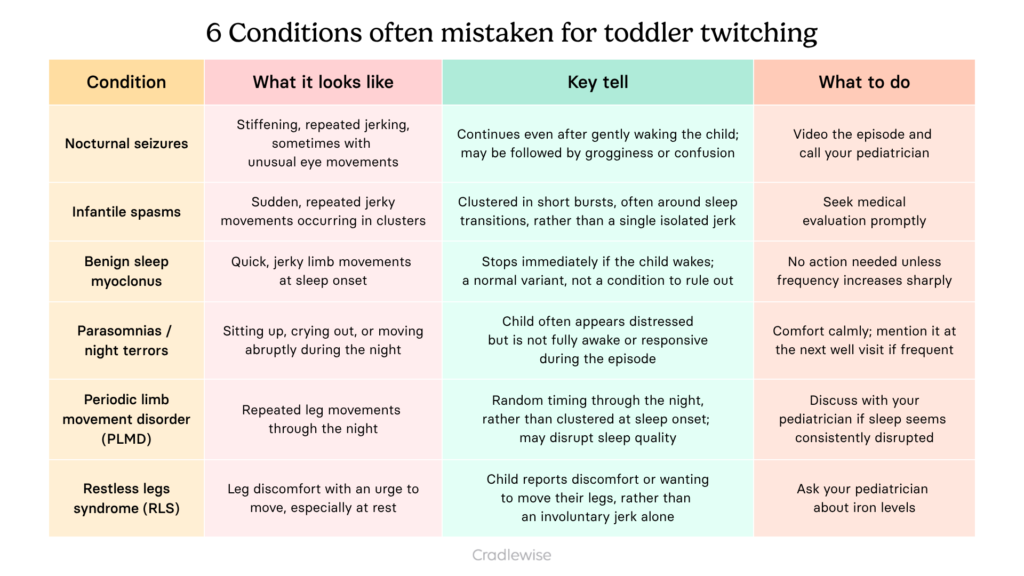
Remember, normal sleep twitching usually stops if you gently wake your child, whereas seizures often continue regardless.
Cradlewise Tip: Record a short video when your toddler experiences twitching. This habit makes it far easier to tell normal twitching apart from something that needs medical attention. It’s useful for your pediatrician too.
Can twitching be related to ADHD, Autism, Parkinsonism, or other neurological disorders in children?
When to talk to a pediatrician
Most of the time, toddler twitching, whether in sleep or while awake, is harmless and simply a normal part of growing up. That said, a few specific patterns are worth a call.
- The twitching continues while your child is awake
- It doesn’t stop once your child wakes up
- The movements are rhythmic or repetitive in a patterned way
- The movements wake your child frequently
- Episodes last longer than 10 to 20 seconds, or are becoming more frequent
- Twitching is accompanied by stiffness, breathing changes, or unusual behavior
- There are any developmental concerns, or changes in behavior after a twitching movement
If you are unsure, it always helps to ask your pediatrician. Record a short video of the movement if it happens again. This can make it easier for doctors to understand what is happening.
How to prevent toddler twitching at night?
“There are no habits or routines to prevent sleep twitching. A child who is extra tired or overstimulated may have more episodes of sleep twitching but again this is not typically an indicator of anything wrong,” says Dr. Chrissie Ott, while Dr. Jassey recommends, “Try to keep your child with a consistent sleep schedule, reducing stimulation before bed, avoid overtiredness, keeping a regular nap schedule; as well as good nutrition.”
Here are a few ways you can help prevent your toddler from twitching whilst asleep; these sleep habits are also recommended by AAP:
- Maintain a consistent, predictable bedtime routine
- Watch for and prevent overtiredness with regular nap and bedtimes
- Limit stimulation, including screens and bright light, before bed
- Avoid caffeine, even small amounts found in chocolate or flavored snacks
- Create a calm, cool, dark sleep environment
- Play white noise or pink noise, or baby sleep music to create a steady sound in your toddler’s room
Nutrition and toddler twitching
Iron deficiency is one of the well-established causes of restless legs and disrupted sleep in the pediatric research, which also supports Dr. Jassey’s guidance. See the NINDS overview of myoclonus for more on how nutrient status and the nervous system interact.
Cradlewise Note: At Cradlewise, we always recommend consulting with your pediatrician before starting any health supplements for your toddler.
Conclusion
Seeing your toddler twitch or jerk can be surprising at first, but in most cases, it is simply a normal part of how children sleep and grow. If the movements are brief, stop when your child wakes, and are not accompanied with stiffness or other changes, they are usually nothing to worry about. But if something feels unusual or the movements happen frequently, a short video and a quick call to your pediatrician can give peace of mind.
Sleep is an important time for your toddler’s growth and development. With a consistent bedtime routine and a calm sleep environment, you can help your little one get the restful sleep they need while their busy brain continues to learn and grow.
FAQs
Q: Can overtiredness cause twitching in toddlers during sleep?
A: Yes, overtiredness can make your toddler’s nervous system more sensitive, which may increase small sleep movements like twitching or jerking while falling asleep.
Q: Do growth spurts cause toddlers to twitch in their sleep?
A: Growth spurts and developmental leaps can sometimes increase sleep twitching. As your toddler learns new physical skills like walking, running, or climbing, their brain may process these movements during sleep.
Q: Are hypnic jerks common in toddlers?
A: Yes, hypnic jerks (sudden movements that occur while falling asleep) are common in both children and adults. They usually happen during the transition from wakefulness to sleep and are typically harmless.
Q: Can certain foods cause sleep twitching in toddlers?
A: Foods containing caffeine, such as chocolate or certain flavored drinks, may make some toddlers more restless during sleep. Avoiding stimulants before bedtime can help support more restful sleep.
Q: Is it possible for my child to get hurt while sleep twitching?
A: No, normal sleep twitching does not harm your child. However, a sudden sleep start may cause your child to bump a limb or foot against the bed, but this is not common and rarely causes real harm.
Q: Should I wake my toddler if they twitch during sleep?
A: No, you usually do not need to wake your toddler if they twitch during sleep. These movements are typically harmless and part of normal sleep cycles, but if the twitching looks unusual or continues for long periods (more than 10-20 seconds), you may gently check on your child.
Q: What should I do if my toddler twitches or shakes while sleeping?
A: Don’t panic as it can be very normal. Observe the movements and can gently touch the baby to see if it stops – advises Dr. Jassey.
Q: Can hypnic jerks wake up my child?
A: Yes, hypnic jerks can sometimes wake your child up, but it is not common. It depends on the intensity of the muscle contraction.
Q: What vitamin deficiency causes twitching in sleep?
A: According to Dr. Jassey, the most common contributors are iron deficiency, along with magnesium, calcium, vitamin D, and B12 deficiencies.
Q: Why does my toddler twitch while awake?
A: Most often it’s a transient tic, like blinking or shoulder shrugging, which tends to resolve on its own within weeks to months. Twitching that continues consistently while awake is worth mentioning to your pediatrician.
You may also like:
- Rediscovering intimacy and sex after birth: A guide for new parents
- Ask the expert: How sleep fragmentation rewires the new parent brain (and what to do about it)
- Why you shouldn’t sleep train before age 1: What science says about your baby’s sleep and brain development
Sources:
- Sleep twitching is a normal part of brain and nervous system development. National Library of Medicine. 2015. Myoclonic Twitching and Sleep-Dependent Plasticity in the Developing Sensorimotor System.
- Hypnic myoclonus. NINDS. 2026. Myoclonus.
- Small muscle twitches during sleep. National Library of Medicine. 2015. Myoclonic Twitching and Sleep-Dependent Plasticity in the Developing Sensorimotor System.
- Hypnic jerks. Sleep Medicine Clinics. 2021. Sleep Disruption from Movement Disorders.
- 70% of the general population experiences sleep starts. Sleep Medicine Clinics. 2021. Sleep Disruption from Movement Disorders.
- Transient tics. AAP. 2022. Tourette Syndrome: A Not-So-Frightening Diagnosis.
- Sleep Myoclonus. Medical News Today. What to know about sleep myoclonus.
- Good sleep habits. AAP. 2022. Toddler Bedtime Trouble: 7 Tips for Parents.
- Nutrition and toddler twitching. NINDS. 2026. Myoclonus.
- Sleep starts can lead to an injury. Sleep Education. 2013. Understanding sleep starts.
You may also like