Parenting
0 min read
How to freeze breast milk: Guidelines for new parents

Medically Reviewed Amber Ginn, IBCLC, CEO and Founder at The Latchlink
Written by Cradlewise Staff
New parents worry over many things, from whether their infant is sleeping, eating, and pooping enough, to protecting their little one from any infections. And if they are parents who express milk for their baby, then one more thing features on their worry list – how to freeze breast milk?
After early alarms, the pump sessions in parking lots and workplace restrooms, and the careful labeling, it is important to freeze that milk safely. Freezing extends the life of expressed milk from 4 days in the fridge to up to 12 months in the freezer. But there’s more to it than tossing a bag in the freezer and hoping for the best.
This guide covers everything specific to freezing your breast milk: when to do it, how to do it well, what changes in the milk, how to build a stash that actually gets used, and how to thaw safely without losing what you’ve worked for.
We reached out to the following noted lactation experts:
- Amber Ginn, IBCLC, CEO and Founder at The Latchlink
- Aarani Montanari, MS, IBCLC, Founder, R&R Motherhood
- Joanna Kreyling, CPNP-PC, IBCLC at 1 Natural Way
When should you freeze breast milk
The guideline is simple: if you don’t expect to use freshly expressed milk within 4 days, freeze it right away. The sooner you freeze after expressing your breast milk, the better the quality that’s preserved.
You can consider freezing your breast milk in these two situations:
- building a stash before returning to work, and
- any session where you’ve pumped significantly more than your baby will need in the next day or two.

Did you know?
Colostrum, the first breast milk produced in the days after birth, is also worth freezing. It has the same shelf life as mature milk in the freezer and is particularly valuable to have on hand when your baby is sick.
How to freeze breast milk
The way you freeze breast milk matters as much as the timing. Here’s a few tips on how you can freeze breast milk as per the guidelines of the CDC on breast milk freezing.
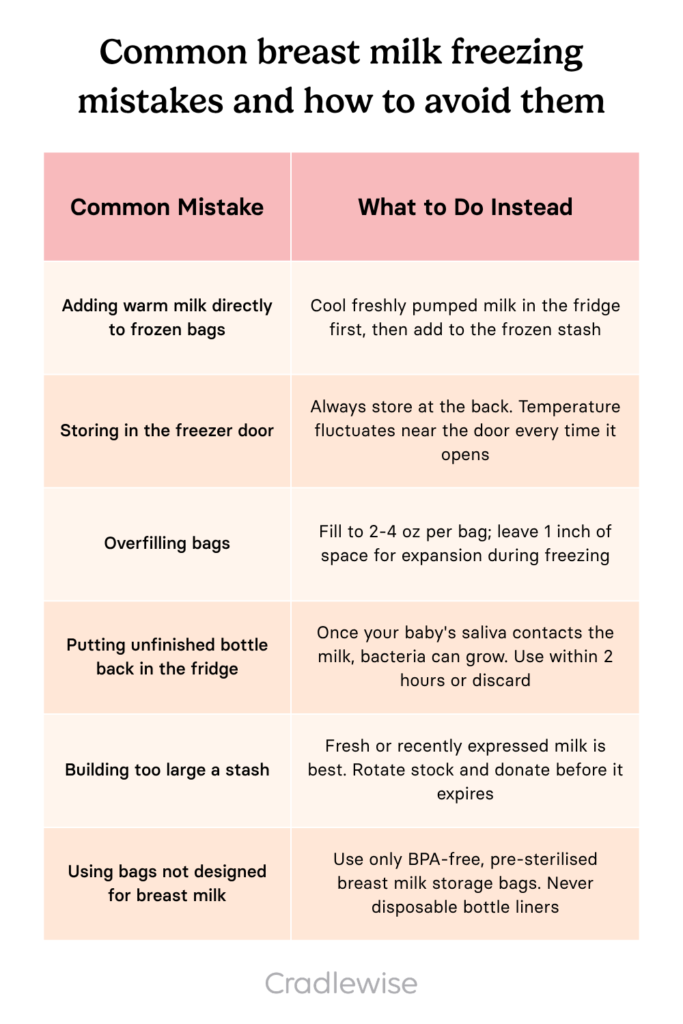
- Cool before freezing. Freshly expressed warm milk should go into the fridge first, then be transferred to the freezer. Adding warm milk directly to an already-frozen bag partially thaws it which compromises the older milk.
- Freeze in 2-4 oz portions. Smaller batches mean less wasted milk if your baby doesn’t finish a feed. Aarani Montanari suggests saving milk in varying volumes of 1oz, 2oz, 4oz and 6oz increments. That way, if you ever need to thaw a little bit of extra milk to top off your baby, you don’t need to thaw a full 6oz bag.
- Leave space at the top. Breast milk expands as it freezes. Leave about an inch of space in your baby’s bottles and squeeze excess air from storage bags before sealing.
- Lay bags flat to freeze. Flat-frozen bags stack neatly, thaw faster, and take up less space. A labelled freezer bin with the oldest bags at the front makes rotation easy.
- Always store at the back. The back of the freezer maintains the most consistent cold, while the temperature near the door fluctuates every time it’s opened.
- Label with date, time, and volume. Waterproof marker on every bag. If the milk goes to a childcare provider or NICU, add your baby’s name too.
Cradlewise Tip: A simple stackable freezer bin dedicated to breast milk makes rotation easier. Oldest bags at the front, newest at the back. It also prevents bags from getting lost or buried for months behind other frozen items.
How long does breast milk last in the freezer
The CDC says breast milk can last in the freezer with temperature at 0°F or -18°C for 12 months, but it’s best used within 3-6 months for optimal taste and quality. After 6 months, the nutritional value may start to decrease slightly.
Does freezing breast milk affect its nutrients
Yes, to an extent.
The proteins, fats, and most immune factors in breast milk survive freezing well. What degrades over time, even in a well-maintained freezer, are levels of folacin and bioavailable vitamin C. This is one reason the CDC recommends using frozen milk within 6 months even though 12 months is technically safe.
How to store breast milk in freezer
To freeze breast milk, use BPA-free, pre-sterilised breast milk storage bags with a double-seal closure, or food-grade glass or hard plastic bottles with tight-fitting lids. Never use disposable bottle liners or bags not specifically designed for breast milk as they aren’t built to withstand freezing and can split.
Bags are generally more practical for freezing as they take up less space, freeze flat, and thaw more quickly than bottles. Bottles are useful when you’re feeding directly from the thawed milk and want to avoid the transfer.
“ Plastic is common and considered safe, but glass is ideal if you’re trying to limit plastic exposure. Silicone molds like Boob Cubes are also a great option. You can freeze in smaller portions and then move them into a larger bag. Even if it’s BPA-free, I always say the less plastic contact, the better.”
How to build a breast milk stash
A stash is a buffer for the days when supply dips, a feeding gets missed, you are not feeling well, or you return to work. But more stash isn’t always a good thing.
A practical strategy to build your breast milk freeze stash:
- Aim for 50–75 oz (roughly 2–3 days’ worth) as a working buffer for most families returning to work.
- Rotate stock consistently. Use the oldest bags first, add new ones to the back.
- If you find yourself with more frozen milk than you can use before it expires, look into donation. Most major cities have HMBANA-accredited human milk banks.
Thawing and warming frozen breast milk
When you’re ready to use the frozen breast milk, it’s important to thaw it properly.
Once warmed, swirl the milk gently to redistribute the fat layer. Never shake. Serve promptly; warmed milk should not sit out.
Cradlewise Tip: For the middle of the night feeding, keep a small insulated cooler with a fresh ice pack by your bedside, pre-loaded with one bottle or bag. It will stay safe for up to 24 hours and won’t require leaving the room at night.
Note: Once milk has been thawed, it should be used within 24 hours. The CDC expressly suggests not to refreeze thawed milk, however, lactation experts have a different view.
Can you refreeze thawed breast milk?
Does thawed breast milk look different?
Yes, thawed breast milk often looks and tastes different from fresh breast milk. Keep in mind that thawed breastmilk can have different shades of color and odors than freshly pumped milk.
Joanna says, “When milk that is stored, the fat separates and rises to the top of the container. The “thinner” milk can look a bit blue or green depending on factors like diet.”
Aarani adds, “In most situations, breastmilk that has been thawed and has a strong odor (metallic or fishy) is indicative of enzyme activity that has degraded some of the compounds in the milk. It is perfectly safe for a baby to consume, though many babies may not like the smell/taste. In these scenarios, parents can mix the thawed milk with a strong smell with some freshly pumped milk to mask the taste.”
Can you combine fresh and frozen milk?
Remember that the new milk must be cooled first. Once combined, date the bag with the oldest expressed date, not the newest.
Joanna Kryeling shares a good tip: The more milk is combined, you will lose fat and calories lost to the container sides. Breast milk should never be shaken, roll the container between your hands instead to incorporate fat back into the milk.
How do I know if breast milk has gone bad
Sometimes breast milk, particularly after freezing and thawing, can develop a soapy, metallic, or even fishy smell. This is usually high lipase activity, not spoilage. Lipase is an enzyme in breast milk that begins breaking down fats after expression; in some parents, it’s especially active.
High-lipase milk is safe for babies to drink. Many will accept it without any issue; some will reject it because of the taste. You can fix it by scalding the milk immediately after expression; heating it to just below boiling (around 180°F / 82°C) and then cooling it quickly before freezing. This deactivates the lipase before it can act on the fats.
So, how can you tell if breast milk has gone bad?
- Smell: Fresh breast milk typically has a mild, sweet scent. If it smells sour, metallic, or just “off,” it’s best to toss it.
- Look: Separation (a cream layer rising to the top) is totally normal. Just give it a gentle swirl. But if it stays clumpy or looks curdled after mixing, that’s a red flag.
- Taste: If you’re ever unsure, a quick taste test (yep, it’s okay!) can help. Spoiled milk often tastes soapy or sour.
Conclusion
Freezing breast milk can provide you with peace of mind as a parent. It allows you to prepare for your baby’s needs, even if you’re not always there to nurse. By following proper freezing and thawing guidelines, you’ll ensure that the milk remains nutritious and safe for your baby.
Remember, while frozen breast milk is an amazing tool for parents, the key to making it work is proper storage and careful handling.
If something smells off when you thaw a bag, trust your nose. Rancid is rancid, and soapy is lipase. When in doubt, and you know the dates are within range, the sniff test is usually enough. If you’re unsure, your baby’s lactation consultant is always a good first call.
FAQs
Q: Does freezing breast milk change its texture or consistency?
A: Yes, that’s totally normal. It can separate or look a little grainy when it thaws. Just swirl it gently to mix it back together. Do not shake.
Q: <strong>What should I do if I accidentally freeze expired breast milk?</strong>
A: Unfortunately, it’s best to discard expired milk, even if frozen as it may no longer be safe or nutritionally optimal for your baby.
Q: Can I freeze milk that has already been refrigerated for several hours?
A: Yes, as long as it’s been stored properly and hasn’t exceeded 4 days in the fridge, you can safely transfer it to the freezer.
Q: How long does breast milk last in the freezer?
A: Up to 6 months for best quality, and up to 12 months is considered safe. Quality degrades slowly over time even in a well-maintained freezer, so using within 6 months is the recommended target.
Q: Can I add fresh milk to a frozen bag?
A: Cool the fresh milk in the fridge first, then add it. Never add warm milk directly to a frozen bag. Once combined, date the bag with the oldest expressed date and use it first.
Q: My thawed milk smells soapy. Is it safe?
A: A soapy or metallic smell after thawing is usually high lipase activity, not spoilage. It’s safe to use, though some babies will reject the taste. Rancid or curdled milk that doesn’t swirl back together should be discarded.
Q: Can I refreeze breast milk?
A: Only if there are still ice crystals present. Milk that has fully thawed cannot be safely refrozen. Refrigerate it and use within 24 hours, or discard after 2 hours at room temperature.
Q: How do I organise breast milk in the freezer?
A: Freeze bags flat, stack them chronologically in a dedicated freezer bin, oldest at the front. Label every bag with the date, time, and volume. Rotate consistently so nothing expires unused. If you build more stash than you can use, consider donating to a milk bank.
Q: How to warm milk from fridge?
A: For fridge-cold milk or frozen milk, a bowl of warm (not hot) water or holding it under the faucet work well. However, for frozen breast milk, it is better to plan ahead and move the bag from freezer to fridge the night before you need it so it thaws gradually.
You may also like:
- Breast milk for baby acne: Does it really work?
- How breast milk can impact the quality of your baby’s sleep—and yours.
- Finding your rhythm: How long should a newborn breastfeed at each session?
Sources:
- How to freeze breast milk. CDC. 2026. Breast Milk Storage and Preparation.
- How long does breast milk last in the freezer. CDC. 2023. Breast Milk Storage Questions and Answers.
- Levels of folacin and bioavailable vitamin C. The American Journal of Clinical Nutrition.1985. Effect of storage time and temperature on folacin and vitamin C levels in term and preterm human milk.
You may also like


