Parenting
0 min read
When do babies start walking? A month-by-month guide
Medically Reviewed Dr. Adam Aponte, board-certified pediatrician
Written by Cradlewise Staff
A baby’s first steps are a milestone that parents eagerly wait to capture, share, and remember forever. There’s a reason so many phone galleries are filled with videos of those tiny, wobbly steps.
But behind that joyful moment lies a fascinating journey of balance, muscle strength, and confidence.
In this guide, we’ll walk you through when babies typically start walking, the signs they’re getting close to taking first steps, and how you can encourage them safely, and when to call your pediatrician. It also includes insights from Dr. Adam Aponte, a board-certified pediatrician with more than 25 years of experience caring for children and families and CEO of the East Harlem Council for Human Services (EHCHS).
When do babies start walking?
Most babies take a few steps on their own by 15 months and walk without holding on by 18 months, according to the CDC. Some babies start walking earlier and others later, and both fall within the normal range.
So when do babies walk?
The CDC’s milestones describe what 75% or more of children can do by a certain age, which makes them checkpoints rather than start dates. At 15 months that means most babies take a few steps alone, and by 18 months it means most babies can walk without holding on to a person or an object.
However, babies can learn to take their first steps earlier than 15 months and plenty of healthy babies are still working on it as their 15-month mark passes.

Did you know?
Around your baby’s first birthday, their brain starts building stronger links between the areas that control movement and the areas that handle awareness and balance, according to research from WashU Medicine. Those connections help babies coordinate their steps, stay steady, and help them walk.
Baby walking milestones by month
Floor time encourages walking. These are the age brackets and milestones that the CDC treats as checkpoints.
| Age | Milestone | What you’ll see |
|---|---|---|
| 6 to 8 months | Building strength | Your baby grabs their feet, pushes up on straight arms during tummy time, and holds some weight on their legs when you support them upright. |
| 9 to 12 months | Pulling up and cruising | Pulls to stand on sturdy furniture and shuffles sideways while holding on. The CDC lists both by 12 months. |
| 12 to 15 months | First steps | A few unsteady steps alone, usually with arms raised for balance and plenty of sitting down. The CDC lists this by 15 months. |
| 15 to 18 months | Walking on their own | Longer stretches of walking, fewer falls, and steadier balance. The CDC lists walking without holding on by 18 months. |
For the bigger picture across the first year, see our guide to your baby’s developmental milestones.
Walking at 10 months: Standing alone and cruising
CDC says many infants start pulling up to stand and walk, holding onto furniture around their first birthday. However, a small number of babies can show these skills as early as 10 months, which is on the early side, but not a cause for concern. Low, sturdy furniture gives your baby a safe circuit to practice on.
Sleep can get disrupted during this stage.
Dr. Aponte notes: A child who has recently learned to pull up may practice repeatedly in the crib or become frustrated because they know how to stand but have not yet learned how to sit back down. Excitement-increased physical activity and changes in routine can also affect sleep.
These disruptions are generally temporary, and a predictable bedtime routine helps. If sleep trouble lasts or comes with pain or breathing problems, speak with your pediatrician.
Our guide to the 10-month sleep regression covers this stage in more detail.
Signs your baby will walk soon
Watch for these signs in the weeks before your baby takes their first steps:
- Pulling to stand at every chance, which tends to be the strongest signal
- Cruising along furniture faster and with more confidence
- Standing alone for a few seconds
- Letting go with one hand to reach for a toy
- Fussiness and changes in sleep
During this time, you will also observe that while your baby stands up in the crib, they cannot lie back down. Dr. Aponte suggests showing your baby how to bend their knees and lower themselves from standing into a seated position.
He also recommends keeping the crib mattress at its lowest setting, and keeping the crib free of bumpers, pillows, toys and other objects the baby could use for climbing.
How to help your baby practice walking
Babies learn to walk by moving, so the most useful thing you can offer is room and time to do it.
- Clear floor space. A baby-proofed, uncluttered area lets your baby pull up, cruise, and tumble safely. The CDC suggests moving sharp or breakable things out of reach and locking away medicines and cleaning products.
- Barefoot at home. Bare feet help foot and toe development, and shoes are only needed outdoors. Shoes should fit properly, since poorly fitting ones can make walking harder, according to Pregnancy, Birth and Baby, an Australian government service.
- A weighted push toy. A sturdy toy with a stable base gives your baby something to lean on and push. However, skip baby walkers. The AAP says walkers can delay walking and send thousands of children to emergency rooms each year.
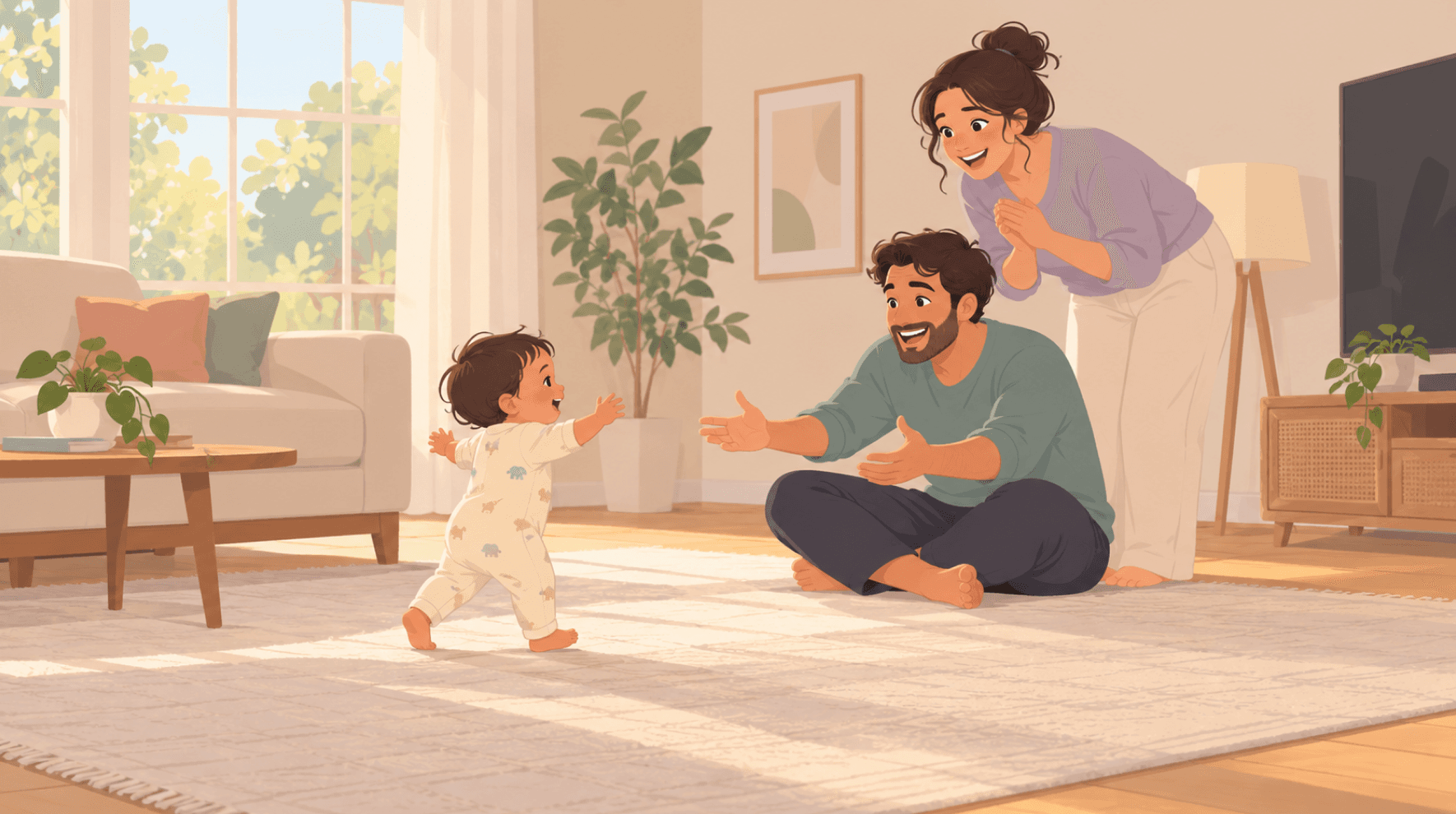
- Supported steps. Offer a hand, then step back and invite your baby to come to you. Pregnancy, Birth and Baby suggests starting a couple of meters (about 6 feet) away and increasing the distance as your baby gains confidence.
- Cheering them on. Your tone of voice and facial expressions show excitement even when your baby does not understand the words.
Our post on tummy time explains how early floor play builds the strength walking needs.
Did you know?
AAP says a baby in a walker can move more than 3 feet in a single second, which is why most walker injuries happen even when an adult is watching.
Why do some babies walk earlier or later than others?
Healthy babies walk across a wide window. Dr. Aponte says the same.
Baby walking early
Some healthy babies begin walking at 8 or 9 months and walking early is never a concern, according to Dr. Aponte.
He pays more attention to how a baby moves. Unusual stiffness, consistent toe walking, favoring one side, or poor balance deserve a closer look no matter when a baby starts walking. If you have an early walker, babyproofing can help since an early walker can reach hazards before the adults expect it.
Late walkers
Many children begin walking later, but develop normally. Though a delay in walking deserves attention, it does not automatically indicate a concern.
“ Walking exists on a broad developmental spectrum, and some children simply focus first on language, fine-motor, or social skills. I look at the whole child rather than one milestone in isolation, including whether the child is sitting independently, crawling or moving another way, bearing weight, and continuing to make progress.”
In practice, a baby who is sitting, bearing weight, getting around in their own way, and picking up new skills is usually on a steady path, even when walking has not started yet. In Dr. Aponte’s words, developmental milestones are “guides rather than deadlines.”
Some babies bottom scoot, roll, or skip crawling entirely and go from cruising straight to walking. The CDC’s updated milestones no longer list crawling as a sign to walking, according to Zero to Three.
Our guide on when babies start crawling covers the other ways babies get around.
Cradlewise Note: For your preemie baby, use their adjusted age rather than their birth date when you check milestones. Our guide to preemie milestones explains how to calculate it and the AAP recommends you do it until age 2.
Is tiptoe walking normal?
Dr. Aponte adds: I become more concerned when a child walks exclusively on their toes, cannot lower their heels, favors one side, or experiences stiffness, pain, or frequent falls.
Toe walking that continues after several months of independent walking is worth raising with your pediatrician.
When to call the pediatrician about walking
Most walking timelines sort themselves out. However, a few signs are worth a call. Contact your pediatrician if your baby:
- Is not pulling to stand by about 12 months, especially if they are also not sitting on their own or bearing weight
- Is not independently walking by 18 months
- Has lost a skill they had before
- Seems unusually stiff or floppy, favors one side, or has difficulty bearing weight
- Walks for a while and then starts limping or refuses to walk
Your pediatrician will review your baby’s full developmental history, do a physical and neurological exam, and decide whether a referral for early intervention or physical therapy makes sense.
Conclusion
Each wobble, each determined stand, each tiny shuffle forward is worth celebrating. These moments may arrive before 12 months or closer to 18, and the CDC’s 15- and 18-month milestones are the checkpoints to bring up at your next pediatrician visit.
Once walking starts, nighttime practice sessions are common, so is sleep disruption. Practice a steady bedtime routine to keep things manageable.
FAQs
Q: When do babies start walking?
A: Most babies take a few steps on their own by 15 months and walk without holding on by 18 months, according to the CDC. Some may start earlier than that, and some take a little longer.
Q: What are signs my baby will walk soon?
A: Pulling to stand, cruising along furniture, standing alone for a few seconds, and letting go with one hand to reach for a toy are the clearest signs. Some babies also get fussier or sleep differently as they practice.
Q: Do one year olds walk?
A: Yes, some one year olds can walk, but it’s not a norm. CDC says most babies take their first steps at 15 months and walk independently by 18 months.
Q: Is it normal for a baby to walk at 17 or 18 months?
A: Yes. A baby who is cruising and pulling to stand at 17 months is often close to walking. Since the CDC expects most children to walk without holding on by 18 months, mention it to your pediatrician if your baby is not there yet.
Q: When should I call the doctor about walking?
A: Call if your baby is not walking on their own by 18 months, is not pulling to stand by about 12 months, has lost a skill, seems unusually stiff or floppy, or favors one side.
Q: Do babies have to crawl before they walk?
A: No. Some babies bottom-shuffle or skip crawling and go straight from cruising to walking. The CDC’s updated milestones no longer list crawling as a sign to walking.
Q: Can I help my baby learn to walk faster?
A: You can create the conditions with floor time, barefoot play, and a safe space to cruise, but your baby will follow their own developmental timeline.
You may also like:
- Milk teeth schedule: When babies get (and lose) each tooth, with teeth chart.
- Is it time for a toddler bed? Here’s what the experts need you to know.
- Toddler sleep: What to expect & how to help.
Sources:
- First few steps. CDC. 2026. Milestones by 15 months.
- First few steps. CDC. 2026. Milestones by 18 months.
- Baby walkers. AAP. 2022. Baby walkers: A dangerous choice.
- CDC Milestones. CDC. 2026. Milestones by 15 months.
- Brain builds stronger links around baby’s first birthday. WashU Medicine. 2017. Brain networks that help babies learn to walk ID’d.
- Age at which infants pull up to stand and walk. CDC. 2026. Milestones by 1 Year.
- Lock away medicines and cleaning products. CDC. 2026. Milestones by 15 months.
- Proper shoes for your baby. Pregnancy, Birth and Baby. 2026. Learning to walk.
- Preemie baby. AAP. 2026. Your Preemie’s Growth & Developmental Milestones.
You may also like


