Parenting
0 min read
What are the 3 types of breast milk? A guide for curious parents


Cradlewise Staff
There’s something awe-inspiring about how nature prepares you for motherhood. From the moment your baby arrives, your body starts producing breast milk in a form that matches exactly what a newborn needs, even before you’ve had time to think about feeding schedules or supply.
What surprises a lot of parents is that breast milk changes volume, color, and composition as your baby grows, and their needs change. There are 3 types of breast milk that come through different stages, each with its own purpose.
In this guide, we’ll walk through colostrum, transitional milk, and mature milk, including what’s different about preterm milk, with insights from three lactation experts:
- Leigh Anne O’Connor, IBCLC, a lactation consultant with over 20 years of experience supporting breastfeeding families.
- Aubrey Phelps, MS, RDN, CLC, a registered dietitian and lactation counselor at Matrescence Nutrition, focused on postpartum recovery and infant feeding.
- Sharon Berger, RN, IBCLC, a registered nurse and lactation consultant at Our Milk House.
What are the three types of breast milk?
Your body reads cues from your baby’s saliva, age, time of day, metabolism, and health status, and adjusts your milk’s protein, fat, water content, lactose, and immune content in response.
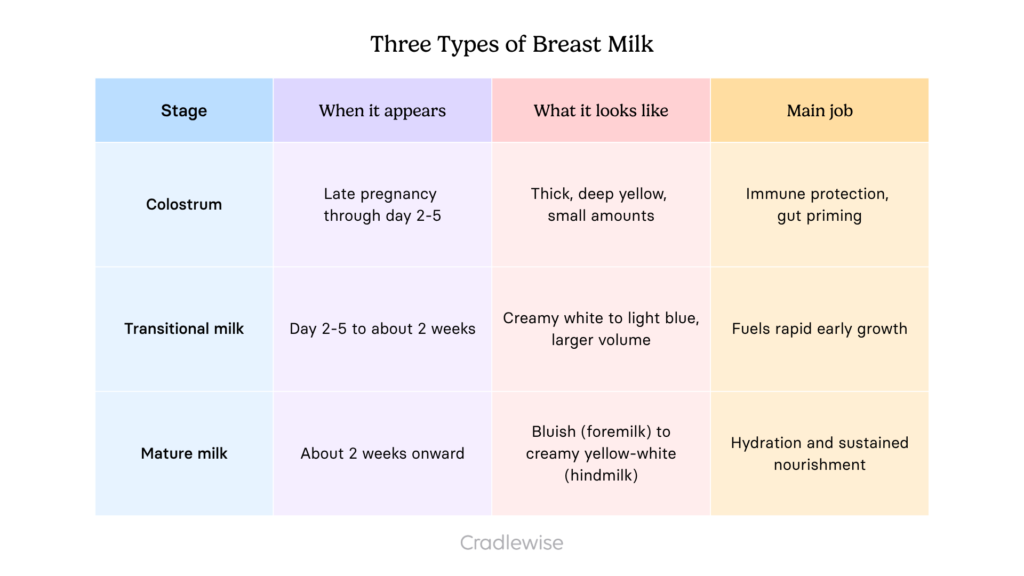
The three stages of breast milk are:
- Colostrum: the first milk, rich in antibodies
- Transitional milk: the bridge stage, higher in volume and calories
- Mature milk: the long-term milk that balances hydration and nutrition
If you are thinking about pumping your breast milk, this expert-backed, comprehensive guide on breast milk storage will answer all your questions.
What is colostrum?
Colostrum is the thick, yellow first milk your body starts producing in late pregnancy, continuing through roughly day 2 to 5 after birth. It’s often called “liquid gold” because of how concentrated it is, even a small amount delivers a strong dose of protein, immunoglobulins, and growth factors.
The volume is intentionally small because a newborn’s stomach is only about the size of a marble on day one. Colostrum supports early immune protection and helps prepare your baby’s digestive system for the milk that follows.
Cradlewise Tip: Skin-to-skin contact in the first hour after birth helps trigger your body’s early feeding cues and supports colostrum transfer, even before your milk “comes in.”
What is transitional milk?
Transitional milk takes over from colostrum around day 2 to 5, lasting approximately two weeks. As progesterone drops after birth, your milk volume increases and its composition shifts.
Transitional milk brings more fat, lactose, vitamins, and calories to match your baby’s growing energy needs.
You may notice fuller breasts during this stage, and some parents find certain breastfeeding positions more comfortable as supply increases. The color also changes, from thick yellow toward a creamy white or pale blue. This unique color of breast milk signals the transition.
It’s called transitional milk for a reason. It helps your baby shift from immunity-boosting colostrum to nutrient-rich mature milk.

Cradlewise Smart Crib
Smarter Sleep for Your Baby
An award-winning crib—loved by parents, approved by experts.
0 to 24 months of use
Automatic soothing
Built-in video & sound machine
AI-powered sleep insights
Customizable soundtracks
Get 2 extra hours of sleep nightly
What is mature milk?
By about 2 weeks, mature milk is established. It’s roughly 87 to 90% water, along with the proteins, fats, and carbohydrates your baby needs at this stage and later on. The milk composition continues to change within each feed and across the day.
One important concept to understand at this stage is the difference between foremilk and hindmilk.
Types of mature breast milk: Foremilk and hindmilk
Foremilk and hindmilk aren’t separate types of milk, but they’re two phases within a single mature-milk feeding, as described by La Leche League.
- Foremilk comes first in a feed. It’s lighter, often with a bluish tint, and lower in fat, mainly designed to quench your baby’s thirst.
- Hindmilk follows later in the same feed. It’s thicker and creamier, higher in fat, provides satiety and supports steady weight gain.
Letting your baby nurse long enough on one side before switching to the other breast helps them get both phases, the hydration of foremilk and the calories of hindmilk.
What is preterm milk?
If your baby arrives early, your milk adjusts for that. Research shows that milk produced by mothers of preterm infants tends to be higher in calories, protein, free amino acids, and sodium than milk for full-term babies. It is the body’s way of meeting a premature baby’s more intensive nutritional needs.
According to NCBI’s StatPearls physiology review, preterm milk also carries higher concentrations of certain proteins and immune factors in the early weeks, but its composition still moves through the same colostrum-to-mature progression.
For very low birth weight or preterm infants, healthcare providers may also recommend additional vitamin D, iron, or calcium alongside breast milk, so it’s worth checking in with your pediatric team about your baby’s specific needs.
Breast milk color changes
Here’s what various breast milk colors can indicate:
- Blue breast milk: common in foremilk, which is lower in fat and higher in water.
- Yellow breast milk: seen in colostrum or in transitional/mature milk rich in carotenoids (from foods like carrots or sweet potatoes).
- White or creamy breast milk: typical matured milk offering balanced nutrition.
- Green breast milk: sometimes linked to leafy greens in your diet.
- Pink, red, or brown breast milk: known as “rusty pipe syndrome,” usually harmless. It is caused by small amounts of blood mixing with early milk, typically resolving within 4 to 7 days. See a provider if it persists.
- Black or dark breast milk: rare and serious. Consult your healthcare provider immediately.
What type of antibodies are in breast milk?
Your breast milk is full of natural antibodies that help protect your baby from germs. If your baby is sick, your milk may even produce more immune cells and antibodies to help fight infection and support their recovery.
The main antibodies in breast milk include:
- Secretory IgA (SIgA): The most important antibody in breast milk. It coats your baby’s nose, throat, and gut, helping stop germs before they can cause an infection.
- IgG: Helps your baby’s immune system learn which bacteria are helpful and which are harmful. It also helps reduce inflammation.
- IgM: One of your baby’s first lines of defense against viruses and bacteria, especially in the digestive system.
- IgD and IgE: Found in very small amounts. They help the immune system recognize and respond to germs and other foreign substances.
Tips to increase milk supply
Every breastfeeding journey is unique, but there are a few simple practices that can support your milk supply, ease your mind, and help you and your baby find your rhythm together.
- Feed frequently in the early days to help establish colostrum production and build supply.
- Alternate breasts and let feeds run long enough for your baby to receive both foremilk and hindmilk.
- Stay hydrated and well-nourished. A balanced diet influences your milk’s nutrient levels and appearance.
- Prioritize rest and reduce stress. Your body produces milk more effectively when you are relaxed, well-rested, and emotionally supported.
- Reach out to a lactation consultant if color changes persist or you’re worried about supply.
Cradlewise Note: A predictable wind-down routine can help your baby settle after a feed. Cradlewise smart bassinet responds to early stirring with gentle motion and sound, so your well-fed baby has an easier time settling back to sleep.
Conclusion
Understanding these three types of breast milk can help make sense of what’s happening with your milk supply at each feed and why your milk looks differently from one week to the next. Whether your baby arrived on time or early, your body is continuously adjusting to meet your baby’s needs.
If something about your milk or feeding routine feels off, a lactation consultant is one of the most useful people you can loop in.
FAQs
Q: What are the 3 types of breast milk?
A: Colostrum, transitional milk, and mature milk. Colostrum comes first (late pregnancy to day 2-5), followed by transitional milk (day 2-5 to about 2 weeks), and then mature milk (about 2 weeks onward).
Q: Which milk is better, foremilk or hindmilk?
A: Neither is “better,” both foremilk and hindmilk are essential parts of a complete feed. Foremilk hydrates, hindmilk nourishes, and together they meet your baby’s needs during every single session.
Q: Is watery breast milk healthy?
A: Yes. During the day, your breast milk naturally changes from watery to thicker during a feed, to give your baby both hydration and calories in the same session.
Q: Is breast milk supposed to be creamy?
A: Yes, creamy breast milk is a good sign. It usually means your body is producing the fat-rich hindmilk your baby needs for steady growth.
Q: Do babies sleep better with hindmilk?
A: Yes, hindmilk is richer in fat and calorie content, which helps babies feel fuller and more content. This fullness often leads to better, longer stretches of sleep though every baby’s pattern varies.
Q: Does breast milk change if my baby is sick?
A: Yes. When your baby is exposed to an illness, your breast milk composition can shift to include more antibodies and infection-fighting white blood cells, offering extra immune support during your baby’s recovery. Your milk color changes to more yellow too.
Q: Can stress affect breast milk quality?
A: Yes. Stress can affect your let-down reflex and milk flow, but it doesn’t change the nutritional quality of your milk, which stays largely consistent.
You may also like:
- Baby feeding chart: A guide to year one
- Why can’t babies have honey? (even in baked goods)
- How to freeze breast milk: Guidelines for new parents
Sources:
- Colostrum supports early immune protection. AAP. 2023. Breastfeeding Benefits Your Baby’s Immune System.
- What is mature milk? La Leche League International. Foremilk and Hindmilk.
- What is preterm milk? Pediatr Clin North Am. 2014. Human milk for the premature infant.
- Preterm milk carries higher concentrations of proteins and immune factors. NCBI StatPearls. 2025. Physiology, Breast Milk.
- Rusty pipe syndrome. Korean Journal of Family Medicine. 2020. Bloody Nipple Discharge Post Delivery: A Case of “Rusty Pipe Syndrome.”
- Breast milk is full of natural antibodies. Immunol Rev. 2024. Antibodies in breast milk: Pro‐bodies designed for healthy newborn development.
You may also like