Parenting
0 min read
What roseola rash really looks like on baby skin (and why it’s often misdiagnosed)


Cradlewise Staff
Few things worry parents more than a sudden high fever followed by a rash that seems to appear out of nowhere. Roseola is one of those childhood illnesses that often catches families off guard, partly because it can look dramatic and partly because the rash arrives after the worst seems to be over. However, roseola rash is usually harmless. Understanding what roseola rash really looks like and how it behaves can help you feel more confident and less alarmed if your child develops it.
You will also find helpful insights from Dr. Jonathan Jassey, DO, board-certified by the American Academy of Pediatrics and the Founding Pediatrician of Concierge Pediatrics.
What is roseola?
Roseola is a common viral illness that mostly affects babies between six and 12 months of age. 90% of roseola infantum cases occur in children younger than two years, as per the National Library of Medicine.
Roseola is caused by human herpesvirus 6 and sometimes human herpes virus 7. Most children will have roseola at some point in early childhood, often before they turn two.

Did you know?
Roseola is also called the Sixth disease because it was the sixth common childhood rash that scientists named. A few other names for it include: roseola infantum, baby measles, three-day fever, and exanthem subitum which means “sudden rash.”
Roseola is contagious but usually mild. However, children with weak immune systems may have more serious complications from roseola. Sometimes, the high fever and the ability of the virus to cross the blood-brain barrier can cause febrile seizures in some children. These seizures are often mild and short-lived, with usually no lasting effects, but can cause worry in parents.
In very rare cases, children can get dehydration due to high fever and serious health complications. You can check out more information here.
Once your child recovers, they typically develop lifelong immunity.
Symptoms of roseola
Roseola in kids
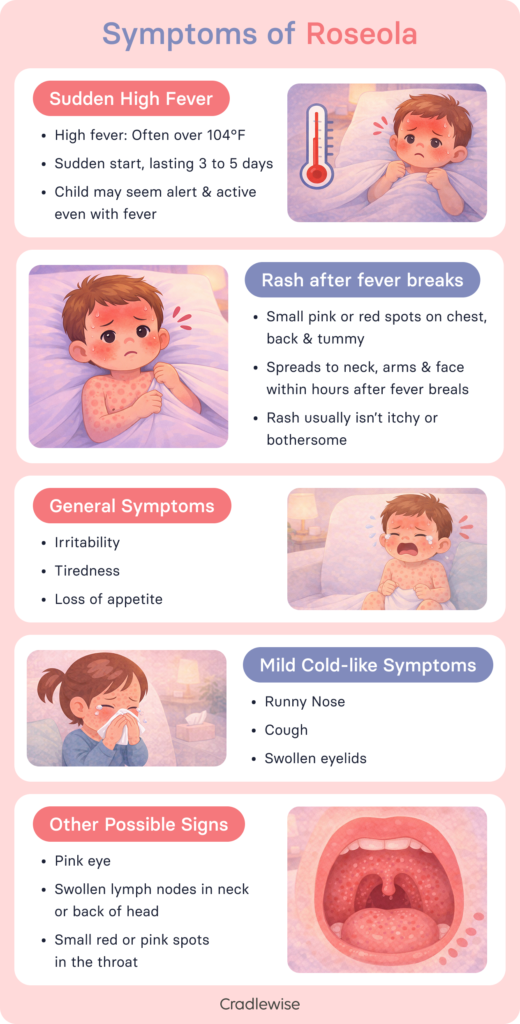
Roseola usually begins with a sudden high fever, often exceeding 104°F, that lasts three to five days. During the fever phase, you may notice your child looking surprisingly well, though they may be fussy, tired, or less interested in food.
Your infant might experience mild cold-like symptoms such as a runny nose, cough, or swollen eyelids, but that is not always the case. Apart from this, your child may develop pink eye, swollen lymph nodes in their neck or back of the head, and small red or pink spots in the throat.
Once the fever breaks, a rash often appears within hours. This timing is one of the key features that help distinguish roseola from other childhood illnesses.
Roseola in adults
Roseola is uncommon in adults (or older children) because most people are exposed as young children. However, if you get a roseola rash, its symptoms will be mild or nonspecific, such as fatigue, low-grade fever, or a faint rash. Adults with weakened immune systems may experience more noticeable symptoms and should consult a doctor.
What does roseola rash look like?
Most children develop a rash within 24 hours of their fever breaking. The rash on your child will look like small-pink or rose-colored spots or patches. These spots may be flat or slightly raised and often start on the trunk, including chest, back, or tummy before spreading to the neck, arms, and sometimes the legs. The roseola rash usually does not itch and does not cause your child any discomfort.
The good news is that children often start feeling better once the rash appears. As the fever goes down, your child’s energy and appetite may start to return. The rash can last one to two days and fades on its own.
What can roseola virus rash be mistaken for?
You may confuse the rash with food allergies or medication reactions, especially if you started administering antibiotics to your child just before the rash developed, which is why its timing and pattern matter. The rash appearing after the fever ends is a key differentiator.
Dr. Jassey adds, “The rash can also be mistaken for a different illness, such as measles or scarlet fever, as rashes may happen with those illnesses but present differently. Also, it can be mistaken for a different type of viral exanthem since many viruses can lead to a rash.”
Roseola vs measles
Roseola and measles can look similar at first glance, but they behave very differently. A measles rash is red or brown with small, raised white spots on top of the red spots, while a roseola rash is usually pink in color.
Measles typically starts with a rash while the child is still very sick and febrile, and the rash often begins on the face before spreading downward. Measles also comes with symptoms like cough, red eyes, and sensitivity to light.
With roseola, the fever resolves before the rash appears, and children usually look and feel better when the rash shows up. Vaccination has made measles far less common in many regions, while roseola remains widespread.
Measles is a more serious illness than roseola and can lead to complications. You can protect your child against measles by giving them either of these vaccines (MMR and MMRV) as recommended by the Centers for Disease Control and Prevention.
Causes of roseola
Roseola is caused by a viral infection, most commonly human herpesvirus 6. It spreads through saliva or respiratory droplets, often from caregivers or other children who may not even know they are contagious.
Your child is most contagious during the fever phase, before the rash appears. By the time the rash shows up, the risk of spreading the virus is usually much lower.
Is roseola rash contagious?
Yes, roseola is contagious. The infection spreads when a child with roseola talks, sneezes, or coughs, sending tiny saliva or respiratory droplets into the air, which others can breathe in and become infected. It is most contagious during the fever phase, before the rash appears, which often makes it hard to recognize and prevent early spread. It takes anywhere from five to 15 days for symptoms to start after exposure to a virus that causes roseola. By the time the rash shows up, children are usually no longer contagious.
How long does roseola rash last?
Most children recover from roseola in about a week. The fever can last from 3 to 5 days. If they get a rash, this can last anywhere from a few hours to a few days (1-2 days). The rash typically does not itch or bother your child and goes away on its own without peeling or scarring.
How to diagnose it’s roseola?
Doctors usually diagnose roseola based on symptoms and timing rather than tests. A sudden high fever for 3-5 days, followed by a rash after the fever breaks, is often enough to make the diagnosis.
Also, another sign is that the rash usually starts on your baby’s trunk and then spreads to their neck, arms, and face. Because the rash appears late, roseola is often identified in hindsight. Blood tests are rarely needed unless symptoms are unusual or severe.
Roseola rash treatment
There is no specific treatment for roseola, but supportive care can help your child stay comfortable. We asked Dr. Jassey how parents can make symptoms easier and more tolerable for their baby, and this is what he shared with us.
Dos
- Offer plenty of fluids, including electrolytes like Pedialyte to prevent dehydration
- Control fever. Some medicines that are safe to give are Tylenol, ibuprofen (Motrin/Advil), if your baby is over 6 months old
- Dress your child in lightweight, comfortable clothing
- Allow rest and quiet play
- Watch for seizures
- Offer reassurance whenever necessary
Don’ts
- Do not give aspirin to your child for fever, as it can cause Reye Syndrome
- Do not use antibiotics, as roseola is viral
- Do not assume roseola is an antibiotic allergy if your child was administered medicines
- Do not apply antihistamines or creams, as the rash isn’t itchy
How to prevent your child from roseola?
There is no vaccine to prevent roseola. Also, as many people carry the virus without symptoms, complete prevention is difficult, and your baby getting exposed is usually unavoidable. However, maintaining good hand hygiene and avoiding sharing cups or utensils and close contact with sick people in your family or in the community can help reduce risk to some extent.
The good news is that roseola usually provides lasting immunity to your child.
When to call your doctor?
We recommend trusting your instincts if something feels off.
Conclusion
Roseola can look alarming, especially when the rash appears suddenly on your child after days of high fever. But for most children, it is a brief and self-limiting illness that resolves without treatment. However, febrile seizures are a possible complication. So, keeping a close watch on your child, especially when their fever is high, is recommended.
Knowing what roseola really looks like and how it behaves can help you stay calm, informed, and confident as your child’s body does what it is designed to do: heal, attain immunity and move forward.
FAQs
Q: Can your child get roseola twice?
A: It’s possible to get roseola more than once if your child is immunocompromised, but it’s rare. Usually, children develop immunity to roseola once they have it, so they are unlikely to catch it again.
Q: What can roseola be mistaken for?
A: Because of the rash and fever, some people might mistake roseola for measles. However, the rash is different and measles is a much more serious infection.
Q: Why is roseola called the sixth disease?
A: Roseola is called the sixth disease because it was historically the sixth of six common childhood illnesses identified by doctors that cause fever and rash. The first five included measles, scarlet fever, rubella, Duke’s disease, and erythema infectiosum.
Q: How long does roseola last?
A: The fever of roseola lasts from 3 to 5 days, followed by a rash lasting from hours to a few days (1-2 days).
Q: Is roseola contagious?
A: Roseola is contagious. The infection spreads when a child with roseola talks, sneezes, or coughs, sending tiny saliva or respiratory droplets into the air, which others can breathe in and become infected.
Q: What time of year is roseola most common?
A: The infection most often occurs in the spring and fall.
Q: Can my baby go to daycare with roseola rash?
A: Roseola is most contagious during the fever phase. Your baby can return to daycare or preschool as long as there is no fever for 24 hrs and they are acting better. The rash isn’t contagious, so it doesn’t pose a problem.
Q: Can you prevent roseola?
A: There is no roseola vaccine. The only way you can try to prevent roseola is by maintaining good hand hygiene and avoiding sharing cups or utensils and close contact with sick people in your family or in the community.
Q: Can adults get roseola from a child?
A: An adult can get roseola from a child, but it’s rare. Most adults had roseola when they were a child, and this makes them immune to getting it again. However, if the adult has a suppressed immune system, they could get it a second time.
Q: How do you soothe roseola rash?
A: The rash isn’t itchy, so it doesn’t need antihistamines or creams.
You may also like:
- RSV in babies: Why this common virus can turn serious in newborns
- How much sleep does a 2 year old need?
- What’s a healthy temperature for a newborn? A quick guide for parents
Sources:
- Etiology of roseola infantum. National Library of Medicine. 2023. “Roseola Infantum.”
You may also like