Pregnancy
0 min read
Rib pain during pregnancy: Causes and relief tips


Cradlewise Staff
Rib pain during pregnancy can feel sharp, sore, or like pressure under your ribs which can make rest and activity uncomfortable. For many expecting moms, this discomfort appears in the second or third trimester as the baby grows and your body changes to support pregnancy.
While rib pain during pregnancy can be uncomfortable, it’s often a normal part of your body making space for your baby. Hormonal changes, expanding organs, and your baby’s movements can all contribute to rib aches or soreness.
Whether you are a first-time mom or welcoming another little one, gaining insights into the causes and solutions for pain in the ribs when pregnant can help you navigate your journey more easily and confidently. So read on for our science-backed guide on managing rib pain during pregnancy.

Cradlewise Smart Crib
Smarter Sleep for Your Baby
An award-winning crib—loved by parents, approved by experts.
0 to 24 months of use
Automatic soothing
Built-in video & sound machine
AI-powered sleep insights
Customizable soundtracks
Get 2 extra hours of sleep nightly
Is rib pain normal in pregnancy?
Yes, rib pain during pregnancy is common. In the third trimester, especially at the end of your pregnancy, when your uterus expands as the baby gets bigger, it pushes your organs upward toward your rib cage. This causes your rib cage to tilt upward and outward, which can create pressure on the area and soreness.
Causes for rib pain during pregnancy
Rib pain is common among pregnant women. As your baby grows, your body adapts to support your little one. These changes place unexpected pressure on parts of your body, including the ribs.
1. Expanding uterus
As your baby and uterus grow, there can be a space crunch around your rib area. Rib pain typically increases near the end of your pregnancy as your uterus stretches and changes position in your abdomen to accommodate your baby, putting pressure on the ribs and surrounding organs.

Did you know?
Before pregnancy, your uterus is the size of a pear, but during the early stages of pregnancy, it starts expanding.
2. Hormonal changes
When you become pregnant, your body undergoes tremendous hormonal changes. One specific hormone, relaxin, causes the joints and ligaments to loosen and the ribs to expand. While this flexibility is good news for your lungs (which need the extra room), the same can’t be said for your ribs. The expansion may lead to inflammation which means your ribs usually ache throughout pregnancy.
3. Breast enlargement
Once you become pregnant you can expect several changes in your breasts. The veins in your breasts will become more prominent, your nipples enlarge, darken, and become more sensitive, and your breasts increase in size. As your breasts grow, your posture may change. This extra weight can cause rib pain due to the added pressure on the rib cage.
4. Weight gain and posture
As your baby develops, you gain weight and your center of gravity, posture, and weight distribution will change. This can put pressure on your hips, lower back, and ribs causing discomfort.
5. Increased blood volume
Your blood volume may increase by as much as 50% during pregnancy, which can add to the feeling of fullness or pressure in your chest and ribs. You might feel you are making extra effort just to breathe (shortness of breath), leading to using more accessory muscles that can cause rib pain.
6. Your baby’s position
Your baby’s position will change by the end of the second trimester. Their head will face downwards, and their feet will point toward your ribs. During this time, there is added pressure on the ribs because:
- The extra weight of your growing baby puts pressure on your abdominal muscles, which puts pressure on the rib muscles.
- Your baby’s kicks, stretches, and arm movements can cause your ribs to ache.
Prepping for baby’s arrival?
Ensure they (and you!) sleep better
from day one with Cradlewise.
SEE HOW IT WORKS

Prepping for baby’s arrival?
Ensure they (and you!)
sleep better from day one
with Cradlewise.
SEE HOW
7. Other causes of painful ribs in pregnancy
These less common reasons can also cause rib pain during pregnancy:
- Indigestion and heartburn: The hormone relaxin can relax the esophagus, which may lead to indigestion and heartburn. This can result in rib pain.
- Urinary tract infection: Pregnant women are at a higher risk of developing a UTI in the third trimester. Pregnancy changes the bacteria in your urinary tract and the baby puts pressure on your bladder, making it harder to urinate. Both of these changes can lead to a UTI. Rib pain is a common side effect of UTIs.
- Gallstones: Some pregnant women develop gallstones because of difficulty emptying the bladder and higher estrogen levels. Pain in the right abdomen is a symptom of gallstones.
- Constipation: Constipation during pregnancy occurs due to delayed bowel movements. As a result, you may experience pain in the upper abdomen below the ribs.
- Preeclampsia: Pregnancy complications such as preeclampsia or elevated blood pressure, can also cause pain under the ribs.
What does rib pain feel like in pregnancy?
Rib pain during pregnancy can feel different for each person. Some women notice a dull ache or soreness under the ribs, while others experience sharp or stabbing pain, especially when the baby kicks or stretches.
Common pregnancy rib pain symptoms include:
- Tenderness or soreness along the rib cage
- A sharp pain on one side of the ribs
- Pressure or tightness under the breasts
- Pain that worsens when sitting for long periods or bending forward
- Sore ribs after coughing or discomfort when taking a deep breath
You may also feel rib pain more on the right side, especially in your later stages of pregnancy when your baby’s head or feet push against the right side of the ribes, especially in breech positions.
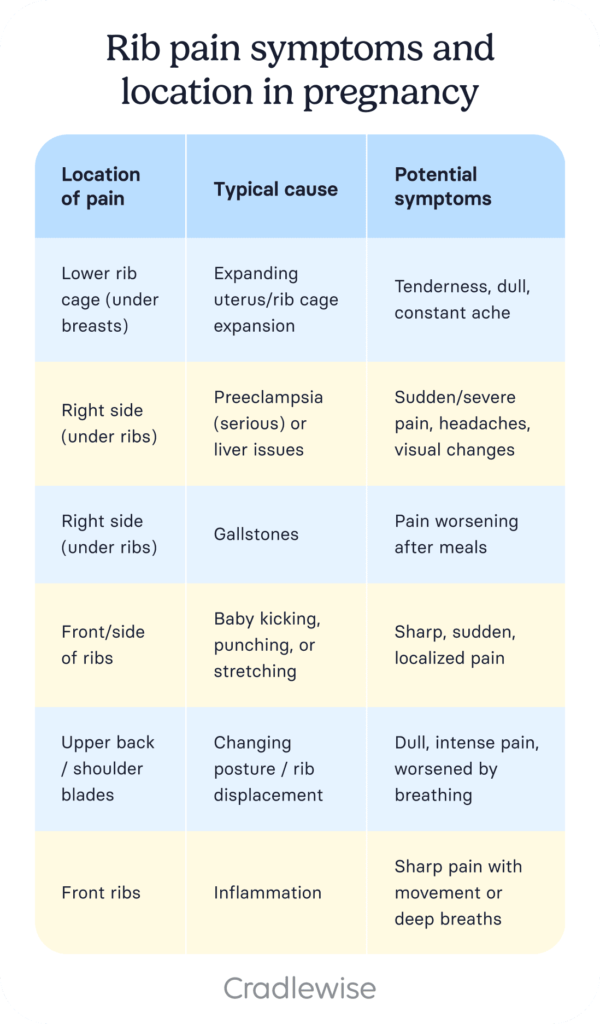
Rip pain symptoms and location in pregnancy
The below table will help you understand what your rib pain cause and symptoms are by identifying its location. However, do not self-diagnose, and if you are suffering from rib pain for a long time or think it is unusual, it’s advisable to consult your care provider.
How to relieve rib pain during pregnancy
Rib pain may be a common pregnancy occurrence, however, there are several ways to alleviate the pain.
Most remedies depend on the cause. For example, in the case of a UTI, prescription antibiotics can fight the infection. Similarly, to treat gallstones, surgery after birth is the most appropriate recourse. In some cases, gentle exercise is the solution, while your doctor may prescribe an analgesic to control heartburn..
Here are a few other remedies you might want to consider:
1. Posture correction
Adjusting your posture while sitting, standing, or lying down can relieve some of the rib pain you experience during pregnancy.
- Holding your head straight, knees straight (but not locked), and shoulder blades/chest forward while standing can help, among other things.
When sitting, ensure that you are not slumped. Consider using a lumbar support or a rolled up towel to support your back while sitting.
2. Cardio exercises
The Centers for Disease Control and Prevention (CDC) recommends at least 150 minutes of exercise per week for pregnant women. However, a study shows that only 40% of pregnant women exercise despite the myriad benefits for mother and child.
Exercises like swimming, water aerobics, stationary cycling, or brisk walking can improve strength and stability and help to keep postural muscles strong.
3. Stretches
Alternatively, you could try yoga stretches, pelvic floor exercises, or use an exercise ball (pilates ball) to stretch out your muscles and maintain flexibility, and keep your joints limber. Stretches like side bends and cat-cow pose can relieve tightness and pressure, and open up the rib cage thus relieving rib cage pain.
For the best results, it is best to seek advice from a certified chiropractor or pregnancy yoga instructor.
4. Heat and cold therapy
Heating pads and ice packs are both safe and effective ways to relieve rib pain (albeit temporarily), as long as you do not apply them directly to the abdomen.
Disclaimer: Ensure you consult a professional and clear it with your doctor before undertaking any exercise or trying remedies to ease your pain.
5. Well-fitting, supportive bra
Wearing a well-fitting, supportive bra is one of the most effective ways to manage rib pain during pregnancy, as it helps redistribute the weight of growing breasts and reduces strain on the rib cage.
- Invest in bras in soft, breathable, but strong fabric with molded cups.
- Use bras in wide straps and bands to help distribute the weight of the breasts more evenly, thus reducing pressure on your shoulders and back.
- Avoid underwrite bras as the wires can dig into the tender area under your breasts causing further pain, or even blocking milk ducts.
How to sleep with rib pain during pregnancy?
Sleeping with rib pain during pregnancy can be challenging, especially as your belly grows. The right sleep position and support can help reduce pressure on the ribs.
Try these strategies to sleep more comfortably:
1. Sleep on your side
Doctors usually recommend sleeping on your left side during pregnancy. This position improves circulation and reduces pressure on organs and ribs.
2. Use supportive pillows
Placing pillows around your body can relieve rib pressure. Helpful pillow placements include:
- Between your knees
- Under your belly
- Behind your back
- Hugging a pillow to support your upper body
3. Adjust your upper body
Sleeping slightly propped up with pillows can reduce pressure from the uterus on your rib cage.
4. Stretch before bed
Gentle stretching or prenatal yoga may relieve muscle tightness around the ribs and chest.
If rib pain worsens when lying down, changing sides or adjusting pillow support can often help.
When does rib pain start in pregnancy?
Rib pain during pregnancy most often begins in the second or third trimester, when the uterus grows large enough to push upward against the rib cage.
Some women may notice soreness earlier due to:
- Hormonal changes loosening joints
- Posture changes as the belly grows
- Early pressure from the expanding uterus
How long does rib pain last in pregnancy?
Rib pain during pregnancy can typically last throughout the third trimester as the uterus expands and baby grows. The rib pain usually becomes intense between weeks 32 and 36 of pregnancy. Symptoms frequently improve soon after the baby drops lower into the pelvis late in pregnancy in preparation for birth.
In most cases, rib pain resolves completely after childbirth, once the uterus returns to its normal size and pressure on the rib cage decreases.
When to worry about rib pain in pregnancy
Most rib pain during pregnancy is harmless. However, in some situations, it may signal a condition that needs medical attention.
Contact your healthcare provider if rib pain is:
- Severe or persistent
- Accompanied by fever, nausea, or vomiting
- Located in the upper right abdomen with headache or vision changes
- Associated with difficulty breathing
- Caused by a recent fall or injury
Though rare, severe upper right quadrant pain under the ribs could sometimes be linked to pregnancy complications such as preeclampsia or HELLP syndrome. Similarly, rib pain in third trimester on the right side of your body may be indicative of a liver problem or gallbladder issue.
If something doesn’t feel right, it’s always best to check with your doctor for reassurance.
Conclusion
Rib pain during pregnancy can be uncomfortable, but in most cases it’s a normal part of your body adapting to your growing baby. As your uterus expands and hormones loosen your joints, pressure on the rib cage can cause soreness, tenderness, or aching.
Simple changes like improving posture, adjusting sleep positions, and using supportive pillows can often help relieve the discomfort. And remember most pregnancy-related rib pain improves once the baby moves lower in the pelvis or after birth.
If your rib pain feels severe or comes with other unusual symptoms, reaching out to your healthcare provider can give you peace of mind and ensure everything is progressing safely.
FAQs
Q: How long does rib pain last in pregnancy?
A: Rib pain during pregnancy can last from the second trimester to throughout the third trimester (weeks 28-40) as your uterus expands and puts pressure on your rib cage. The discomfort usually improves after your baby drops lower in late pregnancy or after delivery.
Q: Can gas cause rib pain in pregnancy?
A: Yes, gas and bloating can sometimes cause discomfort under your ribs during pregnancy. Hormonal changes slow digestion, which can lead to trapped gas and pressure that may feel like rib or upper abdominal pain.
Q: Can rib pain feel like stomach pain in pregnancy?
A: Yes, rib pain during pregnancy can sometimes feel like upper stomach pain because your uterus pushes organs upward toward your rib cage. This pressure can create aching or tightness in the upper abdomen and ribs.
Q: How early can rib pain start in pregnancy?
A: Rib pain usually begins in the second or third trimester when your growing uterus presses against the rib cage. However, some women may notice mild rib discomfort earlier (between weeks 24-28) due to hormonal changes and posture shifts.
Q: What is the best position to sleep when pregnant with rib pain?
A: The best position to sleep with rib pain during pregnancy is on your left side with supportive pillows under your belly and between your knees. Sleeping in a semi-reclined position by placing a couple of thick pillows behind your back can help shift your body weight off of your ribs.
Q: Can constipation cause rib pain in pregnancy?
A: Yes, constipation during pregnancy can sometimes cause pressure or discomfort in the abdomen that may be felt near your ribs. Hormonal changes slow digestion, which can lead to bloating and abdominal pain.
Q: Why do my ribs hurt during pregnancy?
A: Rib pain during pregnancy usually happens because your growing uterus pushes organs upward and stretches muscles around the rib cage. Baby kicks, posture changes, and hormonal shifts can also contribute to rib discomfort.
You may also like:
- Perineal massage during pregnancy: what it is, when to start, and does it really help?
- How pregnancy tea can help with labor preparation and postpartum recovery
- What is lightning crotch during pregnancy and why does it happen? Plus tips for relief.
Sources:
- Increased blood volume causes rib pain. National Library of Medicine. 2016. Physiological changes in pregnancy.
- Lumbar support. NHS. Rib pain in pregnancy.
- Physical Activity Recommendation. CDC. 2025. Pregnant & Postpartum Activity: An Overview.
- Cardio exercises. National Library of Medicine. 2023. Pregnancy And Exercise.
- About rib pain in pregnancy. 2019. Medical News Today. What to know about rib pain during pregnancy.
- Pregnancy exercises.Medical News Today. 2023. Exercise tips for pregnancy.
You may also like


