Parenting
0 min read
Your first night home with a newborn: A practical survival guide

Medically Reviewed Dr. Leslie M. Treece (M.D., F.A.A.P., Pediatrician), Dr. David Ghozland (MD, OB/GYN), Juliana Parker (RN, Founder of Nurse Core Triage)
Written by Cradlewise Staff
At the hospital, there was always someone down the hall. A nurse to check the latch, answer a question, or simply confirm that yes, that grunting sound your baby just made is normal. Tonight is your first night home, and it’s just you, your partner, and a house that suddenly feels very quiet.
No wonder that thought makes your stomach drop a little. You may feel alone, but remember, you are not unprepared.
We will walk you through this night and prepare you for how to feed your baby, change their diaper, how to know if something’s actually wrong, and how to get some rest without constantly worrying that you are forgetting something.
We spoke with three medical experts, and all told us some version of the same thing: almost everything that feels alarming tonight is ordinary.
Read this short survival guide with newborn-care advice and practical tips from:
- Dr. Leslie M. Treece, M.D., F.A.A.P., a board-certified pediatrician
- Dr. David Ghozland, MD, board-certified OB/GYN at Cedars-Sinai Medical Center and UCLA Medical Center, and Founder of Intimate Health Center in Santa Monica
- Juliana Parker, RN, Founder of Nurse Core Triage, Inc with 21 years of experience as Labor & Delivery nurse
Jump to:
- What to expect tonight
- Feeding & cluster feeding
- Call 911, call the doctor, or wait until morning
- C-section recovery
- Episiotomy relief
- For your partner
- Baby & parent tips
- When to call a doctor
- Is this normal?
What to expect your first night home with newborn
A few things worth establishing before you settle in for the night, as per the recommendations of the American Academy of Pediatrics (AAP).
- Feedings: Your newborn, at this point, can take only smaller frequent feedings. As per the AAP guidance:
- For breastfed babies: Nurse every 2 hours, which makes 10-12 sessions in 24 hours.
- For bottle-fed babies: feed every 2 to 3 hours; 8 sessions is the recommended minimum in 24 hours.
Whether breastfed or bottle-fed, watch for hunger cues, like lip licking, rooting, hands to mouth, or fussiness.
- Change diapers frequently: Expect fewer wet diapers the first day or two, ramping up to about 8 a day by day 3-5.
- Keep the umbilical stump clean and dry. No special products needed, plain soap and water if it gets soiled.
- Watch for jaundice: Or a yellowish tint to the skin. Most cases are harmless, but call your pediatrician if you notice it.
- Set up a bare, firm sleep space nearby: Ideally place a bassinet within arm’s reach of your bed, with nothing else in it. While the AAP recommends room-sharing with your baby (it cuts SIDS risk by up to 50%) till they turn 6 months old, the AAP does not recommend bed-sharing under any circumstances. If you bring your baby into bed to feed, put them back before you sleep.
- Set up the room ambience: Keep the room calm; dim lighting, soft or white noise, and a comfortable room temperature between 68-72°F.
Why does my baby want to feed constantly?
Sometime in those first few days and nights, your baby may suddenly want to feed or latch every hour, or sometimes more. This is called cluster feeding. It doesn’t mean your milk supply is low, but it’s your baby’s way of telling your body to ramp up production, which usually happens after about 48 hours or so. Feed on demand through it rather than watching the clock.
A note for parents of preemies: If your baby spent time in the NICU, your first night home may look a little different, with extra attention to feeding, temperature regulation, sleeping routine, and a stricter visitor policy. See our full guide to bringing your preemie home from the NICU.
Call 911, call the doctor, or wait until morning?
Once you know the red flags, you know whom to dial:
- Call 911 or go to the ER immediately for: trouble breathing, a blue or gray tint to lips or face, a seizure, heavy bleeding that soaks a pad in under an hour, or a baby who is limp or won’t wake
- Call your doctor’s after-hours line for: fever, persistent vomiting, jaundice, feeding refusal, or any symptom on the lists above that isn’t a breathing or bleeding emergency
- It’s fine to wait until morning for: general fussiness that resolves with feeding or comforting, mild spit-up, or a diaper count that’s a little lower than expected on day one
Cradlewise note: Save your pediatrician’s after-hours number in your phone before you leave the hospital. Most practices have one, and using it isn’t overreacting.
How to care for yourself the first night home with baby
You just went through childbirth; your body needs care too.
First night home with baby after C-section
After a C-section, the biggest thing is trying to keep pressure off your incision while still making sure you are comfortable and supported.
Here are a few things that Dr. David Ghozland and Juliana Parker recommend:
- Stick to your discharge instructions: Follow the lifting limits your care team gave you before you left, generally nothing heavier than your baby.
- Try the football hold: Football hold position keeps your baby’s weight off your abdomen while breastfeeding.
- Keep baby close at night: A bedside bassinet cuts down on the getting up and reaching for your baby that strains your incision.
- Delegate what you can: Let your partner or support person handle diaper changes, burping, and settling, so you’re mainly just feeding.
For a complete walkthrough on C-section recovery, see our guide.
First night home with baby after episiotomy
Dr. Ghozland and Juliana recommend a few things to ease the episiotomy pain tonight:
- Use a peri-bottle: Warm water can ease stinging, especially after you urinate, and keep the area clean.
- Try cold first: Ice packs or a cold compress for 15-20 minutes can ease swelling and soreness tonight; never apply directly to the skin.
- Rest on your side: Side-lying takes pressure off sore areas, useful if sitting up to feed feels like too much right now.
- Skip hard surfaces: A soft, supportive pillow under you is more comfortable than a hard chair or the edge of the bed.
Cradlewise Tip: If the pain is still difficult to bear, call your OB for a postpartum numbing spray or Tylenol.
What it’s like for your partner
Partners often feel a specific kind of helplessness that first night, wanting to fix an exhaustion or pain they can’t actually take away. The good news: splitting the night into clear roles tends to help more than both of you trying to do everything together.
- On each wake: Your partner handles the diaper change and brings the baby to you for feeding. Once the feed is done, your partner takes over burping and resettling while you go straight back to sleep.
- If the baby’s fussy but not hungry, wet, or in pain: Your partner can just hold and walk with them for a while and try to soothe the baby.
- Ask, don’t wait to be asked: If you’re the partner, ask directly, “What can I take off your plate for the next hour?,” rather than waiting for your partner to ask for help. Exhausted new parents often won’t ask, even when they need to.
Tips for your first night home with your newborn
A handful of small choices tonight, how you hold your baby, how you feed and change them, how you handle the people who want to visit, tend to matter more than anything else you’ll read here.
Tips for baby
Skin-to-skin contact
Holding your baby against your bare chest helps regulate their temperature, heart rate, and breathing, and it’s calming for you too. Even 20 minutes can help settle a fussy baby faster than rocking or shushing alone.
Swaddling
A snug swaddle can help your baby feel secure, similar to the closeness of the womb. Whether swaddled or not, always place your baby on their back to sleep, never on their side or stomach.
Feeding on cue
Feed whenever you see hunger cues rather than watching the clock, and gently wake your baby if they go past 3 hours without feeding, until they’re back to their birth weight.
Tips for parents
Limit visitors
It’s completely fine to skip visitors entirely on the first night, or limit it to immediate family for a few minutes. There will be plenty of time for everyone to meet your baby later.
Accept help when it’s offered
A meal, a load of laundry, someone holding the baby while you shower, say yes. Accepting help isn’t a failure to cope, it’s how you’ll actually get through the next few days.
Rest when your baby rests
Even twenty minutes with your eyes closed adds up. Skip the urge to use every quiet stretch for chores; your body is recovering too.
Tag-team through the night
Juliana Parker recommends a tag-team approach for the middle of the night, rather than both of you staying awake every time the baby wakes. One rested parent is more useful tomorrow than two exhausted ones tonight.
When to call a doctor
Most of what feels alarming that first night is completely normal newborn behavior. Here’s how to tell the difference.
For the baby
If your baby seems unsettled, Dr. Treece suggests you check:
- Are they too hot or too cold? Adjust their clothing or the room temperature if needed.
- Do they seem unwell? Check their temperature. A fever or unusually low temperature can be a sign of illness.
- Is their diaper soiled? A wet or dirty diaper may be making them uncomfortable.
- Are they spitting up or vomiting? Consider whether it happened once or is happening repeatedly.
- Could they be hungry? If your milk hasn’t come in yet and nothing else is helping, a small supplement by bottle or syringe may help.
- Could they be in pain? Look for other signs that your baby may be uncomfortable.
For the mother
There are a lot of things to look for since this is a critical recovery period for you. It happens most often in this exact window, and not getting help immediately could be life-threatening.
However, Dr. Ghozland warns to never disregard these signs, even if you had a completely normal pregnancy, and call your doctor immediately.
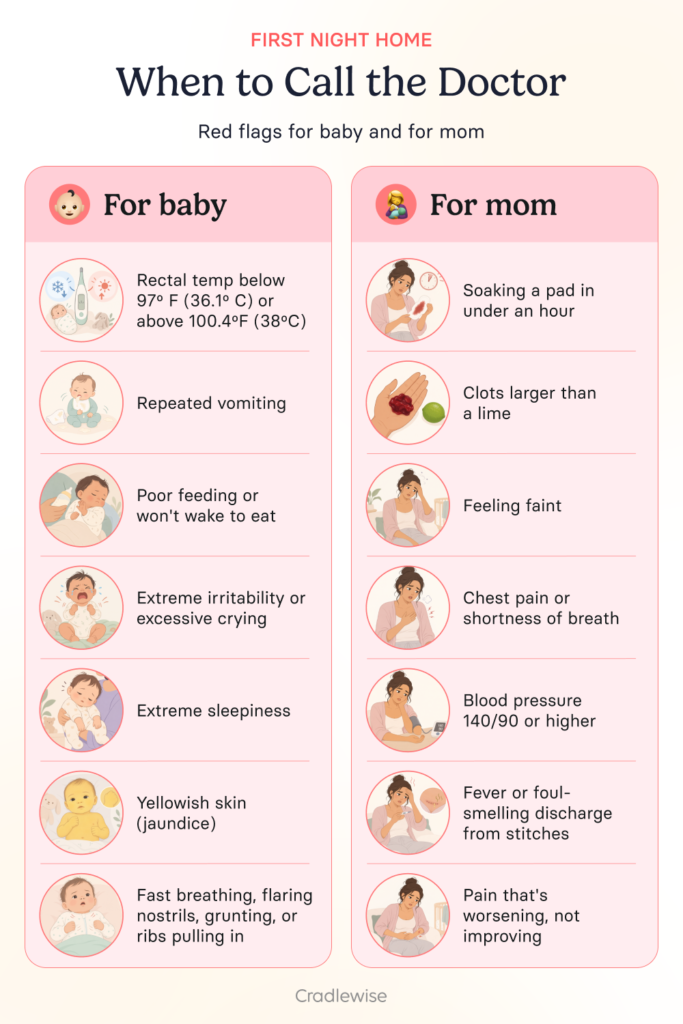
Is it normal to feel scared handling the baby alone?
It gets easier. Every time you feed your newborn, change their diaper, and soothe them, you become a little more comfortable, and a little more confident. As you get to know your baby and learn their cues, you start trusting yourself more and that fear settles down.
Conclusion
The first night with your newborn, you are bound to make mistakes. After all, babies don’t come with an instruction manual. However, Dr. Leslie Treece doesn’t consider the things new parents do to be ‘mistakes.’ She thinks it is all learning.
Also, you do not have to do it alone. Lean on the people around you. Ask for help. Apart from feeding your baby, let someone else handle the baby and give you a break.
The first night is about exhaustion and the second guessing. But tomorrow, you’ll know your baby a little better than you do tonight, you will heal, and your baby will learn to adapt too. Tomorrow it shall get better.
FAQs
Q: Is first night home with a newborn the hardest?
A: Yes, for many parents, largely because everything feels unfamiliar and there’s no nurse to double-check with. It tends to get more manageable with every night, as you learn your baby’s cues.
Q: First night home, baby won't sleep in the bassinet?
A: This is common. Try swaddling, white noise, and holding your baby until they’re deeply asleep before laying them down. Some babies need a few nights to adjust to sleeping outside of arms or a hospital bassinet.
Q: Newborn first night home won't stop crying?
A: Run through the basics: hunger, a wet diaper, temperature, and overstimulation. If your baby is otherwise feeding and behaving normally, prolonged crying is often just newborn adjustment, but extreme, inconsolable crying is worth a call to your pediatrician.
Q: What if my baby sleeps too much the first night home?
A: Newborns sleep a lot, but they still need to eat. Gently wake your baby to feed roughly every 2-3 hours if they haven’t woken on their own.
Q: Should we both stay up with the baby?
A: Not necessarily. A tag-team approach, one parent resting while the other is on duty, tends to leave both of you better rested than staying up together every time.
You may also like:
- How to relieve a clogged milk duct, and when to call a doctor.
- Fever after vaccines in babies: What’s normal and when to worry.
- Milk teeth schedule: When babies get (and lose) each tooth, with teeth chart.
Sources:
- What to expect your first night home with newborn. AAP. 2023. Your Newborn’s First Week: How to Prepare & What to Expect.
- Feeding. AAP. 2024. How Often and How Much Should Your Baby Eat?
- Safe sleep space. AAP. 2026. How to Keep Your Sleeping Baby Safe: AAP Policy Explained.
- Cluster feeding. La Leche. Signs of effective feeding in the early days.
You may also like


