Science of baby sleep
0 min read
Best music for baby sleep: Lullabies, white noise, and more

Medically Reviewed Dr. Jessica Meers, a Licensed Clinical Psychologist, Diplomate in Behavioral Sleep Medicine
Written by Cradlewise Staff
Every culture has its own lullabies, and music has always been part of how parents bond with their children. Every night all around the world, parents use baby sleep music as part of their bedtime routine.
Some babies drift off to gentle lullabies. Others seem to prefer white noise that sounds suspiciously like a running vacuum cleaner. Everyone knows that both music and sound can play a role in helping babies settle. What’s less clear is which is the best baby sleep music, how it compares with white noise, how loud is safe, and whether you should leave them playing all night.
In this guide, we’ll not only look at what science says about baby sleeping music, but also learn the recommendations of our experts:
- Dr. Jessica Meers, a Licensed Clinical Psychologist, Diplomate in Behavioral Sleep Medicine, and Founder of Rhythm Wellness
- Sally Goddard Blythe, Author of “The Genius of Natural Childhood” and Director of The Institute for Neuro-Physiological Psychology
- Patti Read, a certified Pediatric Sleep Consultant and Owner of Goldilocks Sleep Solutions
Does music help babies sleep
Yes. Music helps babies sleep. Music is found to be beneficial for preterm babies too. A study found that music therapy stabilized respiratory rates and oxygen saturations in sleeping preterm infants, a population particularly sensitive to environmental disruption.
Research published in Scientific American has shown that music can synchronize with the body’s natural rhythms, including heart rate, breathing, and brainwaves. When these rhythms align, the body relaxes and moves toward deeper sleep.
But the mechanism behind why music helps isn’t just biological. It’s also behavioural.
“ Sound and music can be very helpful for sleep, but often not for the reasons parents think. They work in two important ways. First, consistent background sound helps mask sudden noises that can startle babies awake during lighter stages of sleep. Second, it becomes part of the bedtime routine. When the same sound is used consistently before sleep, a baby’s brain begins to recognize it as a cue that it’s time to wind down and rest.”
In other words, the neurons that fire together wire together. Use the same sound consistently at the same point in your routine, and your baby’s brain begins to treat that sound as a reliable signal that sleep is coming.
What kind of music helps babies sleep
Not all music is equal when it comes to infant sleep. Babies are biologically primed to respond to harmony, rhythm, and predictability, and research confirms this.
A study published in Infant Behavior and Development found that even four-month-old babies were biologically prepared to treat consonant sounds as more pleasing than dissonant ones. In the experiment, babies looked significantly longer at the source of consonant music and fretted less while dissonant versions caused them to turn away and become more active.
This is why classical and instrumental music outperforms rock, pop, and anything with sudden tempo shifts or jarring sounds when it comes to sleep.
Do lullabies work for babies
Yes, they do.

Did you know?
The first known lullaby that we have discovered is 4,000 years old and was inscribed on clay tablets by the Sumerians.
Across cultures and across centuries, lullabies share musical similarities. A study in Science found that people across 86 societies could reliably identify lullabies from brief audio clips, suggesting a universal musical template for infant soothing.
According to Sally Goddard Blythe, “Lullabies are usually in triple meter or 6/8 time which has a characteristic swinging or rocking motion.” That gentle rocking rhythm mimics the physical motion babies experienced in the womb, which is why it helps them settle.
Popular songs that share this 6/8 rocking time signature include Hickory Dickory Dock, Can’t Help Falling In Love (Elvis Presley), and Hallelujah (Jeff Buckley) which is why many parents find lullaby-style versions of familiar songs work just as well as traditional nursery rhymes.
Bedtime lullaby songs for babies
For parents looking for practical options at bedtime, these are reliable choices:
- Brahms’ Lullaby (Lullaby and Goodnight)
- Twinkle Twinkle Little Star
- Hush Little Baby
- You Are My Sunshine
- Golden Slumbers (The Beatles)
Cradlewise Note: Lullabies work best as part of the bedtime wind-down routine, not as an all-night background sound. More on that in the next section.
White noise vs. music: What’s the difference
This is the question most parents ask and the answer is that they serve different purposes, at different points in the sleep cycle.
“ Music or lullabies should be used only for a child’s bedtime routine, not during their actual sleep. White noise, by contrast, works better than lullabies for sleep itself because it is a continuous, monotonous, and repetitive sound. Lullabies, with their changing words and pitches, can be disruptive to sleep.”
How white noise works differently from music
White noise works by masking unpredictable environmental sounds, like a barking dog, a door slamming, a truck outside, that would otherwise trigger a baby’s startle reflex and break a light sleep cycle. Even though not melodic, its consistency is exactly what makes it effective through the night.
A study published in PubMed found that 80% of newborns fell asleep within five minutes of white noise exposure, compared to just 25% in the control group. Another study published in the Journal of Clinical Nursing found that white noise also significantly reduced crying duration and increased sleep time in colicky babies.
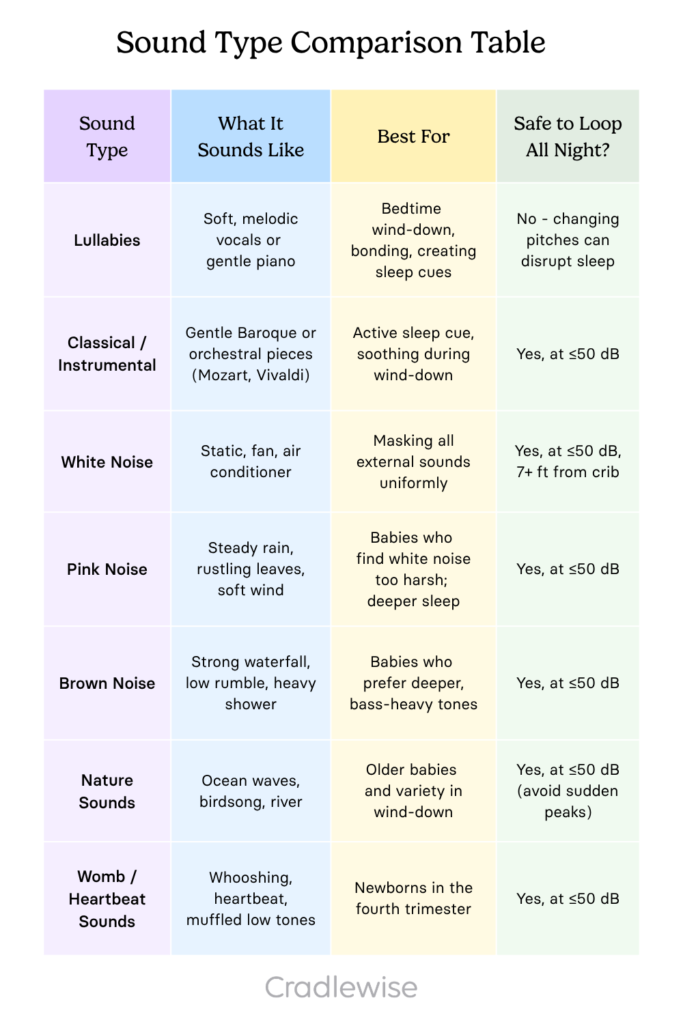
White noise, pink noise, brown noise: What’s the difference
All three consist of all the sound frequencies we can hear. The difference is in how that energy is distributed:
- White noise: equal energy across all frequencies. Sounds like a fan, static, or air conditioning. It is the best contender for blocking ambient noise.
- Pink noise: more energy in lower frequencies, less in higher ones. Sounds like steady rain or rustling leaves. Research in The Journal of Theoretical Biology found that pink noise reduces brain wave complexity and induces deeper sleep. Many sleep specialists prefer it over white noise for babies.
- Brown noise: deeper still sounds like a strong waterfall or low roar. Preferred by some babies who respond better to bass-heavy tones.
Check out our cool, in-built sound machine to experience different sounds.
Which should you use
This simple framework should help:
- During the bedtime routine: music (lullabies, classical, instrumental). It’s an active sleep cue that signals wind-down.
- Through the night: white noise, pink noise, or nature sounds. Continuous, monotonous, and effective at keeping baby asleep between cycles.
- Many families use both: music during bath, feed, and the 15 minutes before sleep, then a sound machine all night.
How does music affect a baby’s developing brain
The sleep benefits of music are real. Listening to music can positively impact a baby’s brain development, including language acquisition, cognitive processing, and emotional regulation. Studies have found that music enhances high-level cognitive brain networks in premature infants.
When your baby listens to music, four brain regions activate:
- Auditory cortex: processes rhythm and pitch, priming the brain for language development.
- Prefrontal cortex: supports attention and decision-making — stimulated by the predictable structure of melody.
- Hippocampus: involved in memory formation; consistent musical cues help build sleep associations.
- Limbic system: regulates emotion and stress; calming music reduces cortisol and promotes a relaxed state.
How loud should baby sleep music be
The most common mistake with baby sound, whether music or white noise, isn’t the type of sound. It’s the volume.
The American Academy of Pediatrics (AAP) safe sound guidelines at a glance:
- Maximum volume: 50 dB or below at the baby’s ear level
- Placement: at least 7 feet (2 metres) from the crib
- Check it: use a free NIOSH decibel meter app to verify the level at mattress height, not from across the room
- For premature babies: below 45 dB, as their auditory systems are less developed (NICU guidance)
- Never: place a speaker or sound machine inside the crib, on the crib rail, or directly beside the baby’s head
Cradlewise quick reference: 50 dB is roughly a quiet fridge. A normal conversation is 60 dB. A vacuum cleaner is 75 dB. Aim for the lower end.
Should you keep white noise on all night for baby
This is one of the most common questions new parents have and the answer, from both the research and the experts, is yes for white noise, and no for lullabies during sleep.
The reasoning is practical. If music or sound is playing as your newborn falls asleep, it should ideally still be playing when they move through lighter sleep cycles in the early hours, otherwise the changed sound environment can itself become a wake trigger. However, if you prefer to use a timer, that works well for babies who use music as a falling-asleep cue but don’t depend on it to stay asleep.
Dr. Meers offers a useful long-term solution:
“ Think of sound as a tool, not a requirement. While using white noise throughout the night is common, it’s worth considering a timer or gradual fade feature once healthy sleep habits are established. The long-term goal is to help children learn to sleep independently, with sound serving as a support rather than something they feel they can’t sleep without.”
If your baby is waking at 3 am when the music stops, switching to all-night continuous play usually resolves it.
The best types of baby sleep music and sound
Based on the research and expert guidance above:
- For newborns (0–3 months): Pink noise, white noise, or womb/heartbeat sounds. These most closely mimic the prenatal sound environment and activate the calming reflex.
- For older babies (3–12 months): Pink noise or white noise through the night. Lullabies and soft instrumental music as part of the bedtime routine.
- For the bedtime routine at any age: Classical music (Baroque era especially), gentle instrumental tracks, or consistent lullabies. Keep the tempo slow, the melody consonant, and the volume quiet.
- For colicky or highly sensitive babies: Pink noise or shushing sounds have the strongest evidence for soothing babies with colic.
Baby sleep music playlists to try
If you’re not ready to sing on demand at midnight, these curated playlists do the work:
- Lullaby Baby
- White Noise Baby Sleep
- Pink Noise for Baby Sleep
- Nature Sounds for Babies
- Sleepy Baby: Classical Lullabies
Whichever you choose, verify the volume at mattress level before leaving your baby to sleep. Apps can play surprisingly loud on full volume.
Cradlewise Tip: Cradlewise App lets you record the lullabies that your baby is most fond of, in your own voice, so that you can play them on demand, even when you are not around.
Conclusion
Music has always been part of how humans put babies to sleep. What’s changed is how much we now understand why baby sleep music works and how to use it well. The big takeaway is simple: lullabies for the routine, steady sound for the sleep, and always at a volume your baby’s developing ears can handle safely.
If you’re using a Cradlewise crib, the built-in sound system lets you customize white, pink, and brown noise with layered heartbeat and rain sounds directly in the app so you can fine-tune exactly what works for your baby without reaching for your phone at 2 am.
FAQs
Q: Does music help babies sleep?
A: Yes, music helps babies sleep in two ways. It can synchronize with the body’s natural rhythms (heart rate, breathing, brainwaves), promoting a relaxed state. And when used consistently at bedtime, it becomes a sleep cue.
Q: What type of music is best for baby sleep?
A: Lullabies in triple meter or 6/8 time, and classical music from the Baroque era (Mozart, Vivaldi) work for bedtime routine. Pink noise or white noise, which are continuous and monotonous, works best for making your baby sleep through the night
Q: Should I leave music on all night for my baby?
A: Leave continuous white noise or pink noise on all night if your baby depends on it to stay asleep, and wakes up when the sound stops.
Q: How loud should baby sleep music be?
A: The American Academy of Pediatrics recommends keeping all sound sources in a baby’s sleep environment at or below 50 dB, measured at mattress level. Place the speaker or sound machine at least 7 feet from the crib. For premature babies, the recommended threshold is even lower: below 45 dB.
Q: Is white noise better than lullabies for newborns?
A: For actual sleep, yes, white noise (or pink noise) outperforms lullabies because it is continuous and monotonous. Lullabies have changing words and pitches that can disrupt sleep cycles. For newborns specifically, white or pink noise also mimics the womb environment.
Q: When to stop using white noise for baby?
A: There is no recommended age to stop. Certified sleep consultant, Patti Read believes sound machines can benefit sleepers well into adulthood, especially in environments with unpredictable external noise.
You may also like:
- The science of sound and baby sleep.
- Newborn sleep guide: How much do newborns sleep and when is it too much?
- The science of baby sleep: Your essential sleep safety checklist.
Sources:
- Music Therapy for babies. PubMed. 2021. Music Therapy Is Effective during Sleep in Preterm Infants.
- Music’s ability to heal. Scientific American. 2021. How Music Can Literally Heal the Heart.
- What kind of music helps babies sleep. Science Direct. 1998. Infants’ perception of consonance and dissonance in music.
- Do lullabies work for babies. Science. 2019. Universality and diversity in human song.
- Newborns fall asleep with white music. PubMed. 1990. White noise and sleep induction.
- White noise reduces crying duration and increases sleep time in colicky babies. Journal of Clinical Nursing. 2017. Comparison between swinging and playing of white noise among colicky babies: A paired randomised controlled trial.
- Pink Noise. PubMed. 2012. Pink noise: effect on complexity synchronization of brain activity and sleep consolidation.
- Music and cognition in babies. PNAS. 2019. Music in premature infants enhances high-level cognitive brain networks.
- Music improves baby’s speech. University of Washington. 2016. Music improves baby brain responses to music and speech.
- How loud should baby sleep music be. Pediatrics. 2023. Preventing Excessive Noise Exposure in Infants, Children, and Adolescents.
- App to check safe sound at mattress level. CDC. 2024. NIOSH decibel meter app.
You may also like


