Pregnancy
0 min read
How long does IVF take? A clear IVF timeline from injections to pregnancy tests

Medically Reviewed Dr. Anthony Propst, a board-certified Reproductive Endocrinologist at Texas Fertility Center and former consultant to the USAF Surgeon General for OB/GYN
Written by Cradlewise Staff
If you’re considering in vitro fertilisation (IVF), there are chances that you may already have passed through the journey involving tracking ovulation, optimizing your lifestyle habits, and trying simpler, less invasive medical procedures like Ovulation Induction (OI) or Intrauterine Inseminations (IU) first.
Things haven’t worked out as planned. But, IVF comes with positive recommendations and a big ray of hope.
However, after answering questions involving emotional readiness, financial capacity, and the willingness to pursue alternative fertility paths, you ask yourself: how long does IVF take to get pregnant?
Well, this guide will answer this and many such questions. It will also walk you through the IVF process step by step, explain how long each stage takes, and flag the factors that affect how things move.
We also asked Dr. Anthony Propst, a board-certified Reproductive Endocrinologist at Texas Fertility Center and a retired US Air Force colonel and former consultant to the USAF Surgeon General for obstetrics and gynecology, to share what patients most need to know about IVF process.
What is IVF
In vitro fertilisation (IVF) is a form of assisted reproductive technology (ART) in which eggs are retrieved from your ovaries, fertilised with your partner’s or donor sperm outside of your body in a laboratory, and the resulting embryo is transferred to your uterus.
While the definition may sound overwhelming, IVF is one of the most effective fertility treatments, and it accounts for the majority of all ART procedures in the United States.

Did you know?
In 2022, 435,426 ART cycles were performed resulting in 94,039 live-birth deliveries. These babies represented about 2.6% of all infants born in the U.S. that year.
IVF is generally recommended to couples when other fertility treatments have not worked or are unlikely to work. Common reasons include:
- Blocked or damaged fallopian tubes
- Ovulation disorders
- Endometriosis
- Male factor infertility
- Unexplained infertility
- Genetic conditions
- Fertility preservation
IVF may also be offered as a first-line treatment for women over 40, or for same-sex couples and single parents using donor sperm or eggs.
Preparation for IVF
Before your first injection, there’s a pre-treatment phase that takes 1 to 2 weeks. This is when your clinic gets a full picture of your reproductive health and your partner’s sperm. Expect the following:
- Ovarian reserve testing
- Semen analysis
- Uterine assessment
- Infectious disease screening
- Mock embryo transfer
Your clinic will also review your medications and ask about lifestyle factors that affect IVF outcomes.
How long does IVF take
Most IVF cycles take around 4–6 weeks from the start of medications to pregnancy tests, but the full process may take longer if you include pre-treatment testing, frozen embryo transfer, genetic testing, or repeat cycles.
For IVF with PGT-A genetic testing and frozen embryo transfer, it takes approximately 6–8 weeks for the first cycle, plus 4–5 weeks for the Frozen Embryo Transfer (FET) in a subsequent cycle.
The following table will give you a better idea of the IVF timelines:
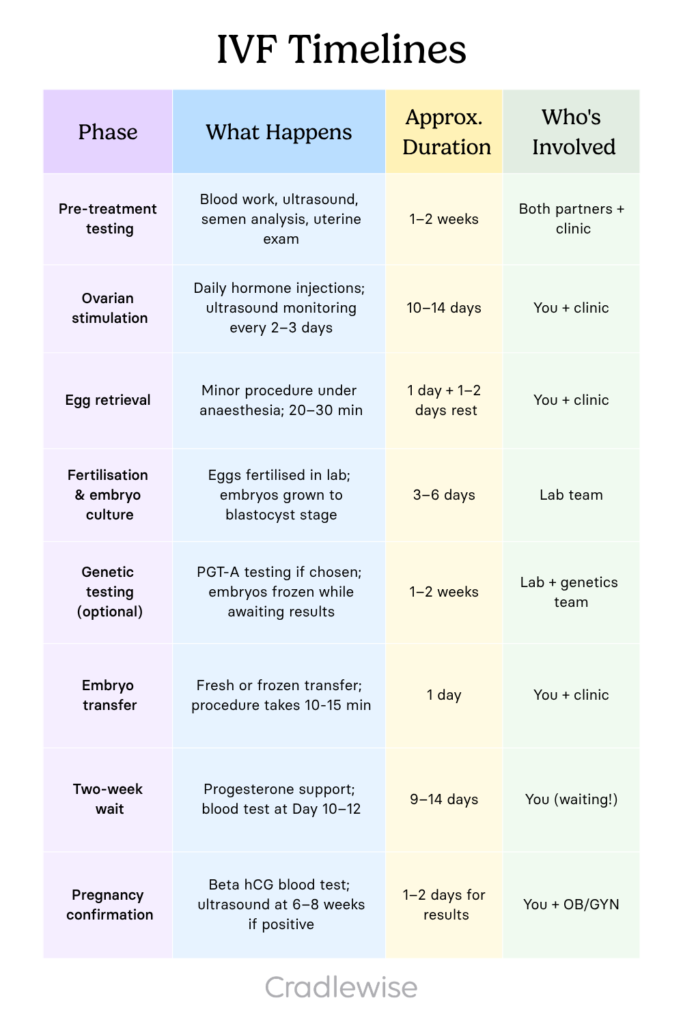
The IVF process: What to expect at each stage
Step 1: Ovarian stimulation (10-14 days)
This phase begins at the start of your menstrual cycle. You’ll give yourself daily injections of follicle-stimulating hormone (FSH) and/or luteinising hormone (LH) to stimulate the ovaries to produce multiple eggs, rather than the single egg released in a natural cycle. Your ultrasounds and blood tests (for checking estrogen levels) are monitored every 2-3 days for over two weeks to track follicle development.
When follicles reach the right size (typically 18-20 mm), a ‘trigger shot’ of human chorionic gonadotropin (hCG) is given exactly 34-36 hours before your scheduled egg retrieval.
When do you start IVF injections?
Injections begin at the start of your menstrual cycle, typically on Day 2 or 3. Your clinic will provide a personalized protocol based on your ovarian reserve and age.
Step 2: Egg retrieval (1 day + recovery)
Egg retrieval is a minor surgical procedure done under light anesthesia. Your healthcare provider will insert an ultrasound-guided needle through your vaginal wall into each follicle to pull out your eggs. This process typically takes 20-30 minutes, and you may return home the same day. However, keep this in mind:
“ It is a low-risk procedure, but occasionally patients will have bleeding from an ovary which could result in hospitalisation for observation and rarely a surgical procedure to stop the bleeding. Some patients experience common side effects such as headaches, abdominal bloating, and bruising from the hormone injections.”
The number of eggs retrieved varies depending on age and ovarian reserve. Not all retrieved eggs will be mature, and not all mature eggs will fertilize successfully.
Step 3: Fertilisation and embryo development (3-6 days)
In the lab, an embryologist will try to fertilize your mature eggs with sperm using one of two methods:
- Conventional insemination: sperm are placed with eggs in a controlled environment.
- Intracytoplasmic Sperm Injection (ICSI): a single healthy sperm is injected directly into each mature egg. This method is employed when sperm quality or count is a concern, or if prior IVF cycles had poor fertilisation rates.
Fertilised eggs are cultured in the lab for 3 to 6 days. The goal is a blastocyst which means an embryo that has reached the 5th or 6th day of development and is considered the most viable stage for transfer to your uterus.
Step 4: Genetic testing (optional, adds 1-2 weeks)
If you choose preimplantation genetic testing for aneuploidy (PGT-A), a small sample of cells is biopsied from each blastocyst and sent for chromosomal analysis.
Genetic testing adds time to the process but can improve the chances of a successful transfer by selecting chromosomally normal (euploid) embryos.
Step 5: Embryo transfer (1 day)
Your healthcare provider will insert a thin catheter through your cervix into the uterus, and one or more embryos will be placed in the uterine lining. The procedure is quick, usually takes 10-15 minutes. No anaesthesia is usually required.
Transfers may be ‘fresh’ (in the same cycle as egg retrieval) or ‘frozen’ (FET), using embryos stored from a previous cycle. Most clinics now prefer frozen transfers, particularly when genetic testing is involved, as they allow the uterine lining time to fully recover from stimulation.
Step 6: The two-week wait and pregnancy test (9-14 days)
After transfer, progesterone support continues to prepare the uterine lining for implantation. Your provider will use a blood test to measure your beta-hCG levels 9-14 days after embryo transfer to determine whether pregnancy has occurred. Pregnancy occurs when the embryo implants itself to your uterine lining.
If you’re pregnant after IVF, this may help you to learn What to Expect in Your First Trimester.
IVF success rates
IVF success rates vary significantly by age and underlying cause of infertility.
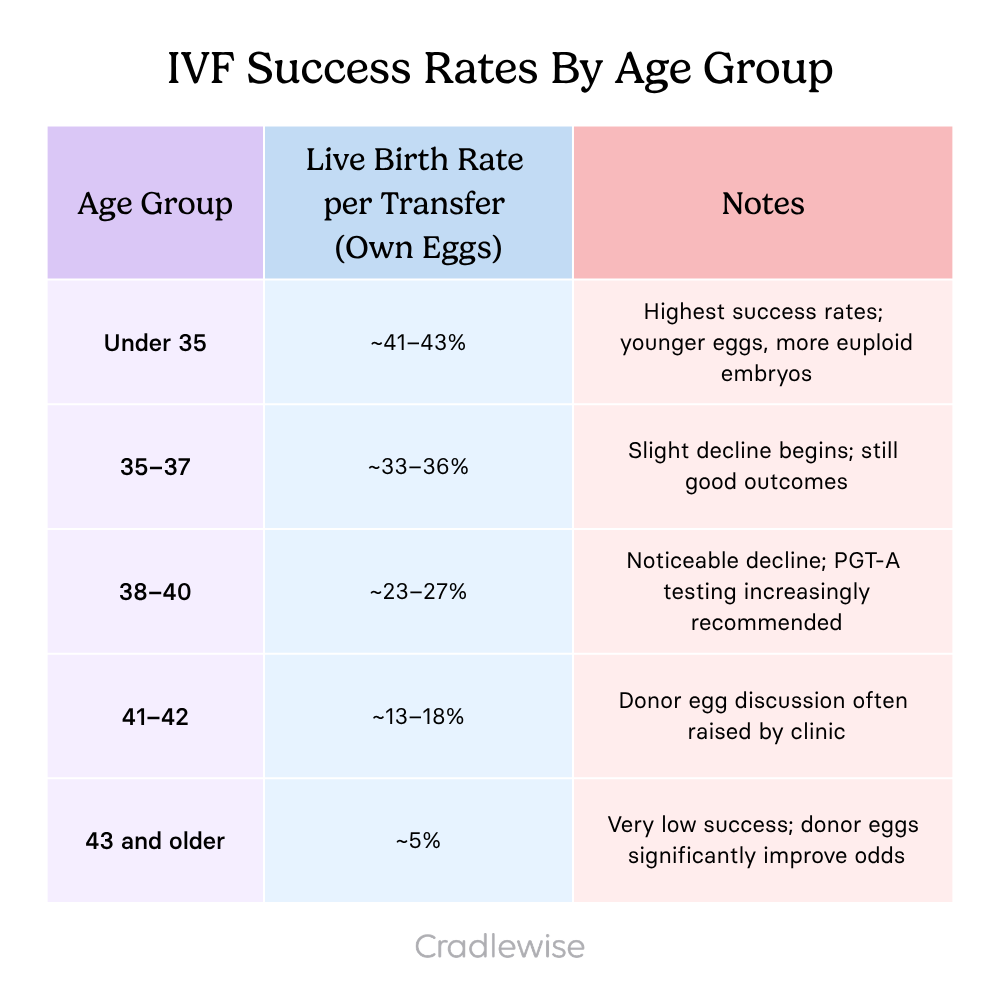
Source: IVF – In Vitro Fertilization and CDC ART Surveillance 2022
For patients using donor eggs, success rates are significantly higher and are largely independent of the recipient’s age, since it is the donor’s egg quality that matters most.
Why do IVF treatments fail?
IVF may be unsuccessful for many reasons, Dr. Propst says, including:
- You may not make many eggs or the eggs may not fertilize to become embryos.
- Eggs that fertilize may not develop into blastocysts and they may not have an embryo to transfer.
- Lastly if an embryo is transferred into your uterus it may not implant or the pregnancy may result in a miscarriage.
Side effects of IVF
Most side effects from IVF are related to the hormonal stimulation phase and the egg retrieval procedure. They resolve once the cycle is complete. Common ones include:
- Bloating
- Breast tenderness
- Bruising from injections
- Abdominal pain
- Hot flashes
- Constipation
- Mood changes
- Headaches
- Enlargement of ovaries
You may also experience:
- Dehydration
- Shortness of breath
- Nausea and vomiting and might require hospital admission
What are the complications associated with IVF
As with any medical procedure, there are risks associated with IVF as well, which include:
- Ovarian hyperstimulation syndrome (OHSS): OHSS is a rare condition involving ovaries to swell and leak fluid into the abdomen causing bloating, nausea, blood clots, and swelling of the abdomen. OHSS occurs when the ovaries over-respond to stimulation medications.
- Pregnancy loss after IVF: The risk of miscarriage following an IVF pregnancy is similar to that of natural conception for the same age group, approximately 15% for those in their 20s and rising to over 50% for those in their 40s.
- Multiple births: Transferring more than one embryo at a time increases the chance of twins or triplets.
- Preterm births: You may have a slightly higher risk of your baby born before term or at a lower birth rate.
Did you know?
The risk of OHSS has decreased significantly in recent years due to the use of GnRH agonist trigger shots and the widespread adoption of freeze-all strategies.
Can IVF cause birth defects?
“Babies from IVF have similar rates of birth defects as babies conceived naturally. The risk for a child with a birth defect is approximately 3%,” assures Dr. Anthony Propst.
How long should you wait for a second IVF attempt?
“It depends on the procedure. If you are doing an ovarian stimulation cycle to obtain eggs for in vitro fertilization and you do not have eggs or embryos, then you should usually wait at least one cycle before beginning another IVF treatment. If you made embryos and the embryo transfer was unsuccessful and you have additional embryos then you can start another embryo transfer the next menstrual cycle,” according to Dr. Anthony Propst.
Conclusion
IVF is one of the most effective fertility treatments available, but it’s also one that takes time, preparation, and patience. Most people find that understanding the process in advance makes each stage feel less daunting. Whether you’re just starting to explore IVF or already scheduled for your first cycle, knowing what to expect at each step puts you in a much better position.
Furthermore, IVF is also an emotional journey which involves deep shifts in your feelings as you move from hope to anticipation, and finally to the anxiety of waiting. Recognizing and preparing for these psychological phases is a vital part of the process.
If you’re already pregnant or preparing for a baby after IVF, the Cradlewise blog has a growing library of resources on pregnancy, newborn sleep, and preparing for life with a new baby.
FAQs
Q: How long does IVF take to get pregnant?
A: For most people, a single IVF cycle runs 4 to 6 weeks from the first injection to the pregnancy blood test. However, getting pregnant with IVF may take one cycle or several.
Q: Can you select the sex during IVF?
A: Yes, and Dr. Anthony Propst adds, “If you do genetic testing of the embryos, you can find out if they are male or female embryos. If you prefer a male or female, you can request the transfer of the preferred sex.”
Q: Should you freeze embryos during IVF treatment?
A: Embryos must be frozen if you are opting for genetic testing of the embryos. The results typically take 1–2 weeks.
Q: What is the best age to get IVF?
A: The best age to get IVF using your own eggs is under 35. During this time, both your egg quality and quantity are optimal.
Q: How to increase chances of pregnancy with IVF?
A: Increase your chances of pregnancy with IVF as per Dr. Propst: Healthy living by eating whole foods, maintain a normal weight, do not smoke and limit alcohol intake. Women should take a prenatal vitamin. Follow the medicine regimen closely and to take the medications at the dose and time as instructed by their physician.
Q: How does IVF make you feel?
A: Physically, you may feel bloated, tired, and bruised at injection sites, while emotionally, you may experience irritability and mood swings as you go through various stages of anxiety, hope, and stress. Many of these effects resolve once the IVF cycle is complete.
You may also like:
- 15 Weird signs labor is near.
- Hospital bag checklist: What to pack for mom, baby, and partner.
- More moms over 35: What you need to know about advanced maternal age.
Sources:
- Did you know? Number of ART cycles in 2022. CDC. Art Surveillance.
- IVF Success Rates. American Pregnancy Association. IVF – In Vitro Fertilization.
- IVF Success Rates. CDC. CDC ART Surveillance 2022.
- Did you know? The risk of OHSS has decreased. PubMed Central. 2021. Co-administration of GnRH agonists with vaginal progesterone compared to vaginal progesterone in luteal phase support of the frozen-thawed embryo transfer cycle: An RCT.
You may also like


