Pregnancy
0 min read
Prenatal genetic testing: What should parents know


Cradlewise Staff
Finding out you are pregnant brings an immediate wave of questions, and for many first-time parents, prenatal genetic testing is one of the most confusing topics to navigate. However, the landscape of prenatal genetic testing has seen a dramatic change in recent years. Tests can be done through a simple blood draw and the range of conditions that it can identify has expanded significantly too.
That is good news for parents who want information, but it can also feel overwhelming when you are trying to make decisions in the middle of a pregnancy.
In this guide, we try to cut through your overwhelm and make things simpler for you. We cover major types of prenatal genetic tests, when each is offered, what it screens for, how accurate it is, and who it is recommended for.
We also consulted two leading specialists. Dallas Reed, MD, FACOG, FACMG, is the Chief of Genetics, an OB-GYN, and Medical Geneticist at Tufts University School of Medicine, and is the Principal Medical Advisor for Women’s Health at Myriad Genetics. Dr. Angela Leung is a Reproductive Endocrinologist at IVI RMA North America.
What is prenatal genetic testing?
Prenatal genetic testing is an umbrella term for a range of tests done during pregnancy, or before you conceive, to gather information about your baby’s genetic health and your likelihood of passing on inherited conditions.
Understanding prenatal genetic testing starts with knowing that there are two distinct categories, and they serve very different purposes.
Dr. Angela Leung explains it clearly:
There are two different categories of genetic testing:
- Genetic screening of the pregnancy – This is intended to test the genetics of your baby, to identify if there are chromosomal abnormalities, or other major genetic anomalies. It identifies chromosomal abnormalities, not specific genes or diseases.
- Genetic carrier screening of the parents – This is to identify if the parental genetic material poses a high risk of conceiving a child with a specific genetic disease. This tests the parents and what “could be”, not what is happening with the current pregnancy itself.
Possible benefits of prenatal genetic testing
“ Testing can provide reassurance (if normal) that the baby is chromosomally normal. This does not guarantee a healthy baby, but it does eliminate possibilities of known chromosomal issues such as Down syndrome or Turner syndrome. Alternatively, if the testing is positive, it can give important information to the parents to help them decide how to proceed.”
Let us simplify the benefits of prenatal genetic testing:
- Earlier peace of mind for the majority of parents; most results are reassuring.
- More time to prepare if a condition is identified, including specialist referrals, delivery planning, and connecting with support resources.
- In the case of carrier screening, you have the option to consider reproductive choices before a pregnancy is underway.
Cradlewise note: Choosing not to test is also a valid decision. American College of Obstetricians & Gynecologists (ACOG) is clear that patients have the right to accept or decline any test after understanding their options, and your provider should never pressure you either way.
Prenatal genetic screening tests
Hearing terms like NIPT, carrier screening, and NT scans can make pregnancy suddenly feel filled with unfamiliar medical language. But these tests all serve one purpose: helping you and your care team better understand your baby’s health and identify whether there may be a higher chance of certain genetic conditions.
Most screening results are reassuring, but understanding what each test does can make the process feel much less overwhelming.
Before pregnancy: Carrier screening
Carrier screening looks at the parents’ genetic makeup to see whether they carry genes for inherited conditions such as cystic fibrosis or spinal muscular atrophy. Ideally, it is done before pregnancy, but it can also be done early in pregnancy.
- What it checks: Inherited genetic conditions that parents may unknowingly carry
- When: Before pregnancy or during early pregnancy
- How: Blood or saliva sample
First trimester screening (10 to 13 weeks)
In the first trimester, screening is designed to give an early picture of your baby’s development and assess whether there may be a higher chance of certain chromosomal conditions. These tests do not provide a diagnosis, but they can help guide whether additional testing may be helpful.
NIPT (non-invasive prenatal testing)
For many parents, NIPT (also called Cell free DNA screen) is one of the first major prenatal tests they hear about. It is a simple blood test that analyzes small fragments of fetal DNA circulating in the mother’s bloodstream and screens for common chromosomal conditions.
- What it checks: Down syndrome, trisomy 18, trisomy 13, and sex chromosome conditions
- When: From 8–10 weeks onward
- How: Blood test
- Accuracy: More than 99% for Down syndrome screening
Nuchal translucency (NT) scan
The NT scan is an ultrasound that measures the fluid at the back of your baby’s neck. On its own, it does not diagnose anything, but when combined with blood tests, it can provide additional information about possible risks.
- What it checks: Signs that may indicate a higher chance of chromosomal conditions
- When: 10–13 weeks
- How: Ultrasound scan
Second trimester screening (15 to 22 weeks)
Second-trimester screening is typically offered between 15 and 22 weeks of pregnancy, and gives a closer look at your baby’s growth and development. These tests can help identify signs that may need additional monitoring or follow-up testing..
- Quad screen: A blood test that looks at several pregnancy-related markers to estimate the chance of certain chromosomal conditions, including Down syndrome and Edwards syndrome, as well as neural tube defects such as spina bifida.
- Maternal serum AFP (alpha-fetoprotein): This test measures a protein made by the baby during pregnancy. Levels that are higher or lower than expected can sometimes signal a higher chance of neural tube defects or other conditions.
- Anatomy ultrasound (18 to 22 weeks): While this is not technically a genetic test, it is one of the most detailed scans during pregnancy. It takes a closer look at your baby’s growth and physical development and may help identify findings that could lead to additional genetic evaluation. ACOG recommends a second-trimester anatomy ultrasound for all pregnant patients.
Prenatal genetic diagnostic tests
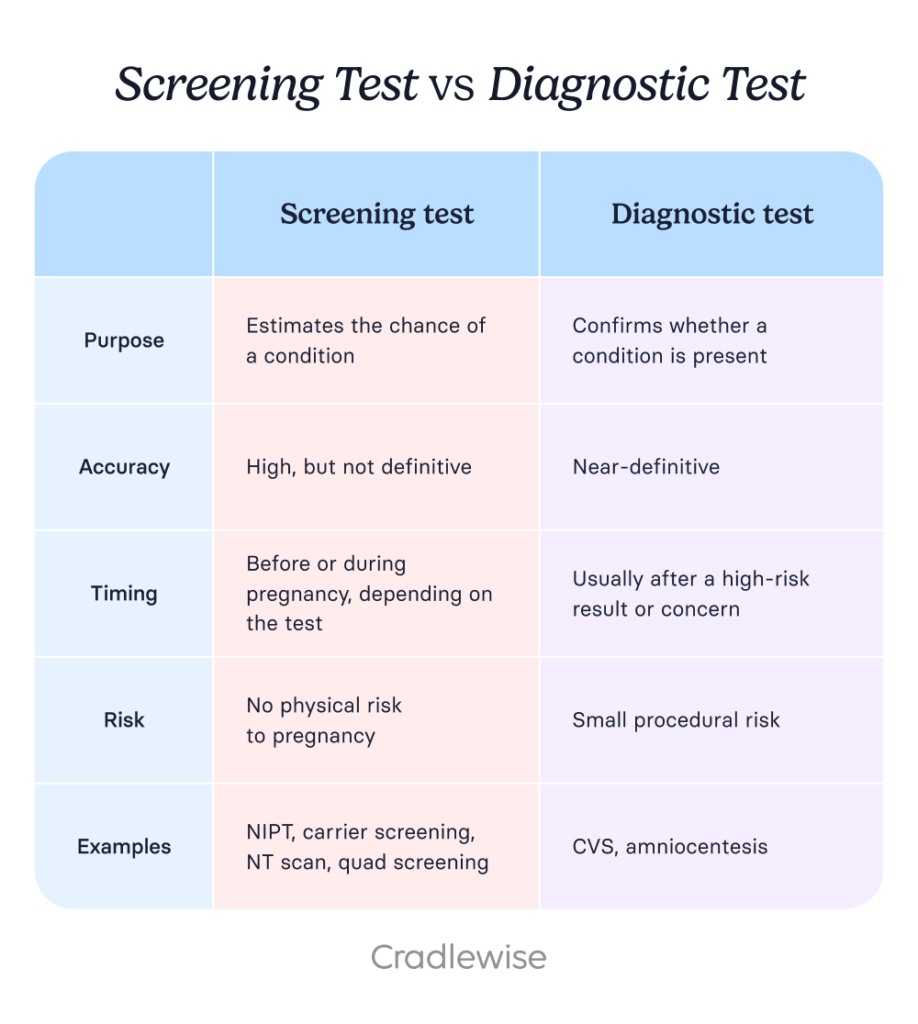
Unlike screening tests, diagnostic tests are more invasive, carry a small procedural risk, and are typically offered when a screening test returns a positive result, when there is a concerning ultrasound finding, or when there is a known family history of a genetic condition.
The two main diagnostic tests are:
Chorionic villus sampling (CVS)
Done between 10–13 weeks, CVS collects a small sample from the placenta for testing.
Amniocentesis
Done from 15 weeks onward, amniocentesis collects a small sample of amniotic fluid for testing.
Cradlewise Note: Factors such as timing of the test, maternal BMI, and IVF pregnancies can sometimes influence test accuracy.
What are the risks of genetic testing during pregnancy?
Dr. Reed says, “Screening tests do not pose a physical risk to the pregnancy because they are performed through a blood draw or saliva sample.”
However, Dr. Leung adds on overall diagnostic risk, “CVS and amnio are relatively riskier since they involve invasive procedures – a needle is inserted into the uterus to either sample the placenta (CVS) or amniotic fluid (amnio). Both have a risk of miscarriage, although the absolute risk is low when done with a skilled doctor (<1%).”
Cradlewise Note: It is an important conversation to have with your OB/GYN and know the nature of risks involved beforehand.
The difference between screening and diagnostic tests
This is one of the most important distinctions for first-time parents to understand, because confusing the two can lead to unnecessary anxiety or, conversely, a false sense of certainty.
Do I need prenatal genetic screening?
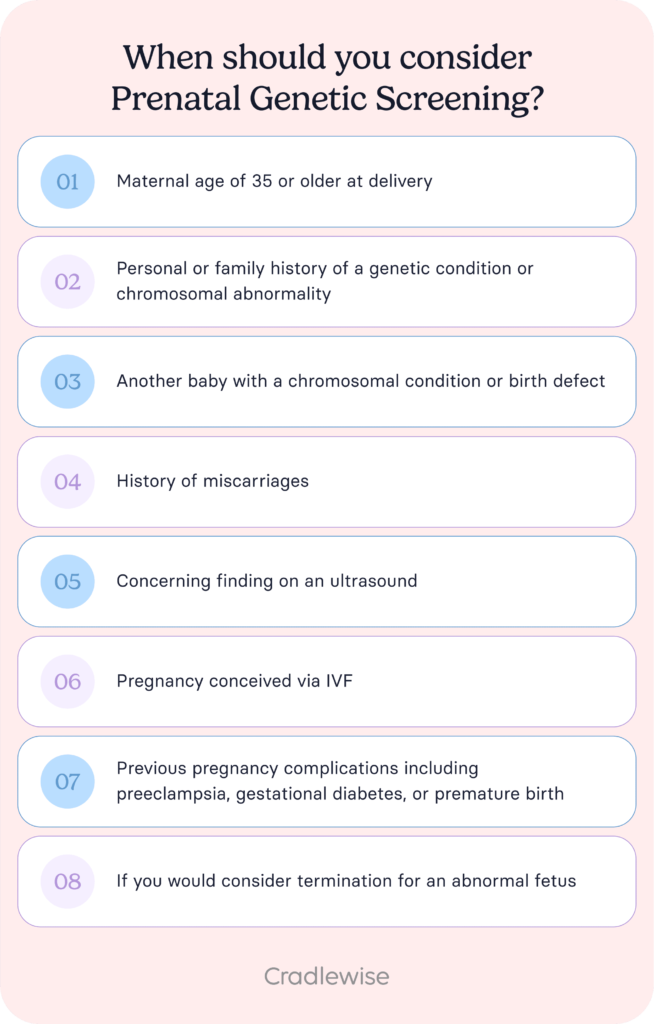
In line with this, ACOG’s Practice Bulletin No. 226 states that prenatal genetic screening and diagnostic testing options should be discussed and offered to all pregnant patients, regardless of age or perceived risk.
That said, there are specific situations where testing is particularly recommended:
Questions to ask your doctor about prenatal genetic testing
As per Dr. Dallas Reed, here are some useful questions to bring to the conversation, when you meet with your provider:
- What conditions does this test screen for?
- What happens if my results come back high risk or positive?
- Will I have access to a genetic counselor if I have questions about my results?
- Will my insurance cover screening or diagnostic testing?
- Are there any risks or limitations I should know about?
For the practical questions about prenatal genetic testing cost and insurance cover, we have a dedicated companion guide.
Conclusion
Prenatal genetic testing is one of the most significant advances in modern pregnancy care, and having good information about it puts you in the strongest possible position, whatever you decide.
Most test results are reassuring. And if they are not, your OB/GYN or a genetic counsellor is there to help you understand exactly what comes next.
As Dr. Reed puts it, “Early screening can provide patients and clinicians with more time to understand results, explore next steps, and make informed care decisions throughout pregnancy and delivery.”
Whatever you choose, make sure it is a choice you have made with full information and without pressure.
FAQs
Q: What questions should expecting parents ask their doctor about genetic testing?
A: As per Dr. Leung, “Parents should ask about the different types of genetic testing available, when they’re done, and what their doctor would recommend for their specific situation.” It is also worth asking what conditions are included in the testing, what the implications could be if a condition is found, and whether a genetic counsellor is available to help you review results.
Q: What is the difference between prenatal genetic screening and prenatal genetic diagnostic testing?
A: Screening tests assess the probability that a pregnancy may be affected by a chromosomal condition. They are non-invasive, carry no procedural risk, but cannot give a definitive yes or no answer. Diagnostic tests such as CVS or amniocentesis collect fetal cells directly and can confirm or rule out a condition with certainty. They carry a small risk of miscarriage (less than 1%).
Q: When should I start prenatal genetic testing?
A: Carrier screening can, and ideally should, be done before you become pregnant. NIPT and first-trimester screening can be done from 10 weeks of pregnancy. The earlier testing begins, the more time you have to understand results and consider next steps.
Q: What happens if my prenatal screening test comes back positive?
A: A positive screening result means the test has identified an elevated risk, not a confirmed diagnosis. The recommended next step is diagnostic testing through CVS or amniocentesis, which can confirm or rule out the condition. Speak to your provider who would refer you to a genetic counsellor.
Q: Can I do prenatal genetic testing if I used IVF or am carrying twins?
A: Yes. According to Dr. Dallas Reed, testing including NIPT and carrier screening is offered to couples with twin pregnancies and those who have used IVF to conceive. Some NIPT platforms are specifically validated for these populations. Speak with your reproductive endocrinologist or OB-GYN about which tests are appropriate for your specific situation.
You may also like:
- Ask the Expert: How to Choose the Right Prenatal Vitamins During Pregnancy.
- Constipation during pregnancy: What your gut microbiome and hormones have to do with it.
- How your baby’s brain develops during pregnancy.
Sources:
- Possible benefits of prenatal genetic testing. ACOG. 2026. Ethical Considerations for Genetic Testing and Counseling in Obstetrics and Gynecology.
- Anatomy ultrasound (18 to 22 weeks). ACOG. 2026. Current ACOG Guidance.
- Do I need prenatal genetic screening?ACOG. 2021. Non-Invasive Prenatal Testing.
You may also like


