Parenting
0 min read
Milk teeth schedule: When babies get (and lose) each tooth, with teeth chart

Medically Reviewed Dr. Sandip Sachar, DDS, and founder of Sachar Dental NYC
Written by Cradlewise Staff
Your baby’s gummy grin melts your heart, but at the same time it also makes you wonder: is this normal? Is my baby’s milk teeth schedule on track? Should that tooth have come in by now?
Milk teeth, also called primary teeth and deciduous teeth in clinical terms, are your baby’s first set of teeth, and they follow a fairly predictable timeline, both coming in and falling out. However, it’s natural to feel anxious.
We put together a full milk teeth schedule and chart below. We also spoke to Dr. Sandip Sachar, DDS, and founder of Sachar Dental NYC, who has weighed in on the questions that tend to worry parents most: teeth coming in out of order, a baby with no teeth at 12 months, and what to actually do about a stubborn loose tooth.

Did you know?
A baby is born with a full set of 20 milk teeth developing under the gums, they just haven’t erupted yet.
Milk teeth schedule: Teeth chart
Tooth eruption timing in children can certainly vary and most times this is not reason for concern.
Dr. Sachar adds, “There are tooth-eruption time charts that are readily available online and while these can be useful guidelines for parents, they should not be treated as urgent rules to create panic.”
When does the first tooth erupt?
Most babies get their first teeth, around 6 months old, though anywhere from 6 to 12 months is within the normal range. The first teeth to erupt are usually lower central incisors or the front two teeth on the bottom.
Also, most children have all 20 milk teeth by around age 3, though the exact timeline may vary for some.
There is a slight ambiguity in the range of months when the baby teeth come in. The American Academy of Pediatrics mentions that baby teeth come between 6 to 12 months and between 6 to 10 months.
Most babies typically get their first teeth around 6 months, though some babies might get them early and some get it later. The range of normal is wide, and not a cause for concern. Still, it is better to consult a pediatric dentist in case of questions.
Baby teeth chart
Here’s the full milk teeth schedule, covering both when each tooth typically erupts and when it typically falls out.
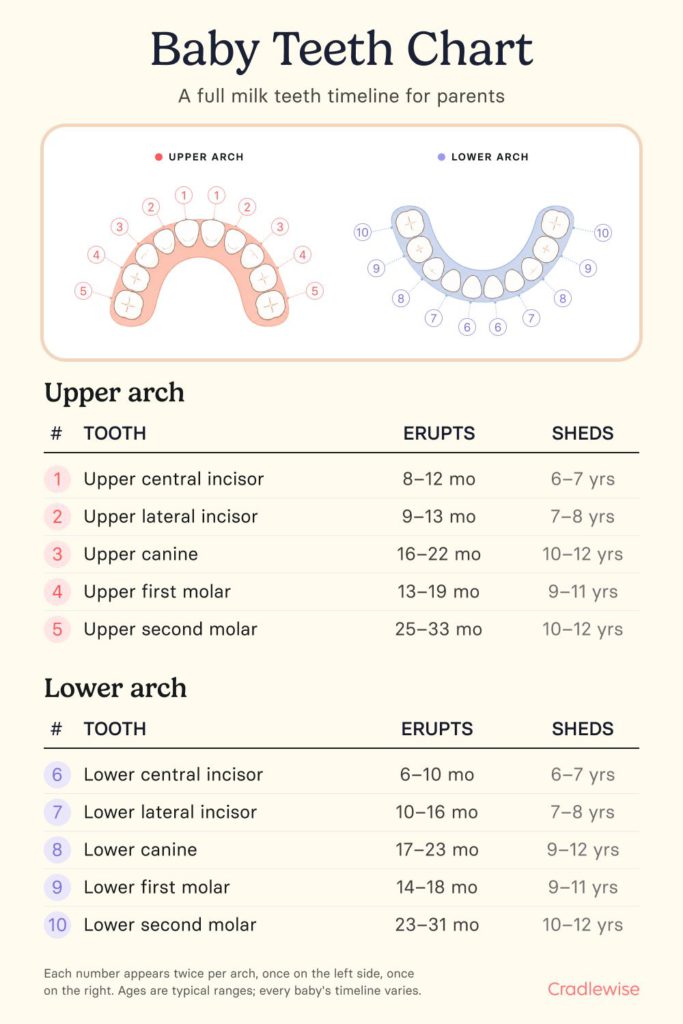
Sources: American Dental Association (ADA)
Did you know?
Deciduous teeth get their name from the same root as deciduous trees, both shed what they’ve grown once something new is ready to take its place.
What order do baby teeth come in?
While every baby is a little different, you will see your baby’s teeth generally erupt in this predictable order:
- Lower central incisors
- Upper central incisors
- Lateral incisors
- First molars
- Canines
- Second molars
This same order, front to back with canines coming in later than expected, is one of the more distinctive patterns of the primary teeth.
What if baby teeth don’t come in order?
“ If a baby’s teeth come in out of the usual order, yes, that may simply be a normal individual variation or ‘how that child develops.’ Occasionally an unusual eruption order can indicate that something is interfering with a tooth’s eruption, and this should be evaluated. Perhaps there is significant crowding or lack of space.”
How many teeth does a child have?
Children have 20 milk teeth in total, 10 on top and 10 on bottom. This is fewer than the 32 permanent teeth adults eventually have, since your child’s growing jaw simply doesn’t have room for a full adult set yet.
Most children will usually have all their milk teeth by the time they turn 3 years.
How many teeth by 18 months?
By 18 months, most toddlers have somewhere between 12 and 16 teeth, typically their incisors, first molars, and often their canines. However, some toddlers will have more and some fewer.
How to know if my baby is teething
Teething signs can show up days or even weeks, possibly as early as 3 months, before your baby’s first tooth actually breaks through. Common signs include:
- Increased drooling
- Rash around the mouth from drooling
- Gnawing or chewing on toys, fingers, or anything within reach
- Swollen or tender gums
- Fussiness or trouble settling for sleep
- Slightly lower appetite, especially for solids
- A mild, temporary bump in temperature (true fever is not typically caused by teething, and is worth mentioning to your pediatrician)
First-time parents often wonder if teething affects their baby’s sleep. If you are wondering too, check out our blog – Do babies sleep more when teething for more information.
How can I ease my baby’s teething discomfort?
Your baby may begin to feel the teething discomfort weeks or months before the first tooth erupts. A few simple, well-established remedies tend to help most:
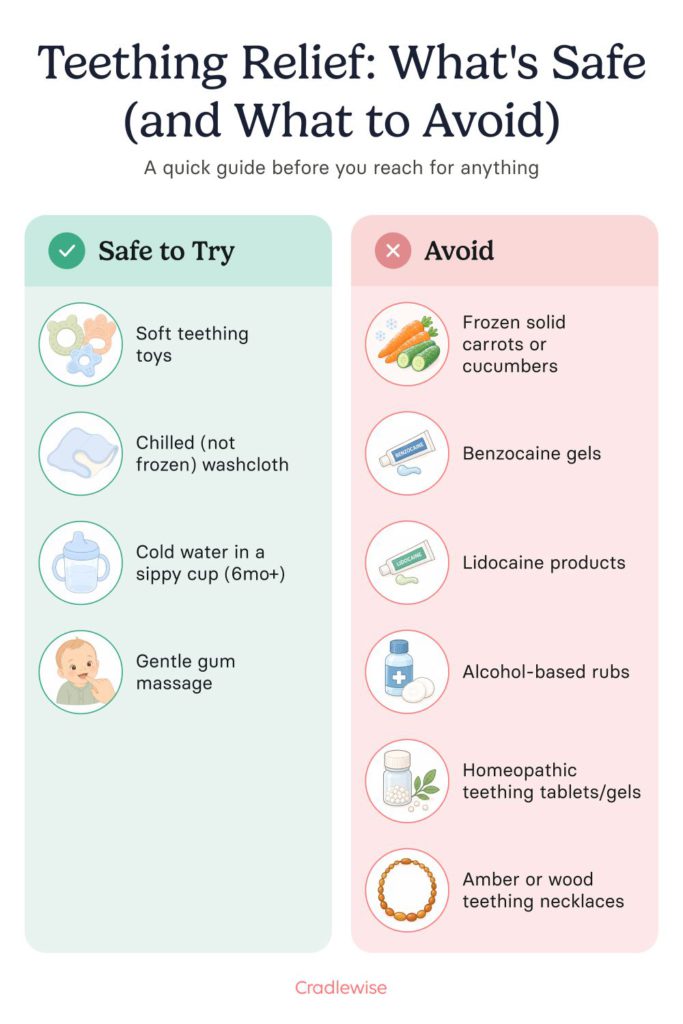
Cradlewise Note: If your baby seems uncomfortable, ask your pediatrician about an over-the-counter medication containing acetaminophen.
Delayed tooth eruption
Few things trigger new-parent worry faster than a baby who seems “behind” on teeth. However, the reassuring news is that a wide range of timing is normal.
Is it normal for a baby to not have teeth at 12 months?
Dr. Sachar adds: The baby’s first dental exam and evaluation should be when the first tooth erupts, but no later than 12 months of age. If a child is older than 12 months with no teeth at all, I would want to know if there are other developmental or growth delays as well.
When to visit a dentist
It may come as a surprise that many parents genuinely don’t know when is the right time to bring in their child for the first dental evaluation.
According to Dr. Sachar, it may be because they feel anxious at the thought of bringing their child to a dentist. Hence many parents wait until there is actually a dental concern or problem, or when all or several of the baby teeth have already erupted.
When do baby teeth fall out
Milk teeth typically start falling out around age 6 and 7, beginning with the same lower central incisors that came in first, and continuing about age 12 years.
How many baby teeth do you lose?
All 20 of them, eventually. Each one of your baby’s teeth is replaced by a permanent tooth underneath, and the full process usually wraps up by the time your baby is around age 12.
Which teeth fall out and which don’t?
Every milk tooth of your baby will eventually fall out and will be replaced by a permanent tooth. The permanent teeth that come in after, particularly the molars further back in the mouth, are new additions rather than replacements, since baby teeth don’t include those back molars at all.
How to care for milk teeth
Your baby’s milk teeth need the same level of care as adult teeth, even though they’ll eventually fall out anyway. Dr. Sachar explains why:
- Baby teeth allow children to chew food, and a child’s healthy growth and development depends on healthy nutrition.
- Baby teeth also contribute to proper speech development as well as appearance, and they help to maintain the space needed for the eruption of the permanent teeth developing underneath them.
- Additionally, baby teeth too can develop cavities just like permanent teeth, causing pain and risk of infections.
Here’s how you can take care of your baby’s milk teeth:
- Wipe gums with a soft, damp cloth even before the first tooth appears
- Start brushing with a soft, baby-sized toothbrush as soon as the first tooth erupts, using a smear of fluoride toothpaste the size of a grain of rice
- Move to a pea-sized amount of toothpaste around age 3
- Avoid putting your baby to bed with a bottle of milk or juice, which can contribute to early tooth decay
- Schedule that first dental visit by age 1
When do adult teeth come in?
Permanent teeth generally start replacing milk teeth around age 6 and 7, in roughly the same order the baby teeth erupted, and continue coming in through the early-to-mid teenage years.
When do molars come in?
Baby molars typically erupt between 13 and 33 months, with the first set arriving well before the second. Permanent molars start arriving around age 6, alongside the first permanent incisors.
When do back molars come in?
The permanent second molars, often called the “12-year molars,” typically erupt between ages 11 and 13. Third molars, or wisdom teeth, come in much later, usually in the late teens to early twenties, if they come in at all.
Do molars fall out?
Baby molars do fall out, typically between ages 9 and 12, same as any other milk tooth. Permanent molars, including wisdom teeth, are not replaced by anything further and are meant to last for life with proper care.
Conclusion
Milk teeth follow a fairly predictable schedule, but “predictable” still leaves plenty of room for your baby’s own timeline. A tooth arriving a little early, a little late, or slightly out of order is rarely a reason to worry.
When in doubt, that first dental visit by age 1 is a sure-shot way to get real reassurance, rather than guessing from a chart alone.
FAQs
Q: When does the first tooth erupt?
A: Most babies get their first tooth around 6 months old, though anywhere from 6 to 12 months is considered within normal range.
Q: What teeth do babies get first?
A: The lower central incisors are typically first, usually followed by the upper central incisors a few weeks to months later.
Q: When do babies get all their teeth?
A: Most children have all 20 milk teeth by around age 3, though the exact timeline varies from child to child.
Q: What if my child's tooth is loose, but not falling out?
A: It’s usually fine to simply wait, most loose teeth work their way out on their own without any intervention needed. If the tooth stays firm despite a permanent tooth coming in behind it, or there’s pain, swelling, or significant crowding, have a dentist take a look.
Q: Why is my child's adult tooth growing in behind the baby tooth?
A: This is fairly common and doesn’t automatically mean the baby tooth needs to be pulled. As long as the baby tooth is loosening on its own over time, many dentists recommend simply monitoring it. If it stays firm, you may want to take your child for a dental evaluation.
Q: Is it normal for a baby to not have teeth at 12 months?
A: Yes, this can still be a normal variation, especially if it runs in the family. That said, your baby should still have their first dental exam by 12 months regardless of how many teeth they have, so a dentist can confirm nothing else needs attention.
Q: Do baby teeth have roots?
A: Yes. Baby teeth have roots just like permanent teeth do. As a permanent tooth develops underneath, it gradually dissolves the baby tooth’s root, which is what allows the baby tooth to loosen and eventually fall out on its own.
You may also like:
- Baby colic: How your newborn baby’s gut impacts their health.
- Baby vision development week by week: What your newborn sees as the world comes into focus.
- Baby feeding chart: A guide to year one
Sources:
- A baby is born with a full set of 20 milk teeth. JADA. 2005. Tooth eruption.
- How to know if my baby is teething. AAP. 2025. Teething Pain Relief: How to Soothe Your Baby’s Discomfort.
- When do baby teeth fall out. JADA. 2005. Tooth eruption.
- Fluoride toothpaste. AAP. 2022. Baby’s First Tooth: 7 Facts Parents Should Know.
You may also like


