Parenting
0 min read
Fever after vaccines in babies: What’s normal and when to worry


Cradlewise Staff
Shot days are hard for parents. Your baby cries, you are emotional, you fret and you spend the rest of the day watching them for any sign that something is off. When a fever shows up that evening, it’s easy to spiral.
Here’s what you should know from the start to reduce your anxiety later: a fever after vaccines in babies, in most cases, is not a problem. It means the vaccines are doing what they are supposed to do, and your baby’s immune system is building protection.
This guide explains how vaccines work in your baby’s body, which vaccines are more likely to cause a fever, what you should and shouldn’t give at home, and the specific signs that mean it’s time to call the pediatrician.
We consulted Natalie Thoni, MD, Pediatrician, Arnold Palmer Hospital for Children whose valuable insights will help allay your worries about getting your baby vaccinated.
How do vaccines work?
Vaccines help your baby’s immune system learn how to recognize and fight harmful germs before they ever cause a serious illness. They do this by introducing a weakened, inactivated, or small part of a virus or bacteria (or a protein from it), giving the immune system a safe chance to practice. In response, your baby’s body makes protective antibodies and builds immune memory, so it’s ready if it encounters the real infection later.
Because your baby’s immune system is actively learning, it’s normal for them to be a little fussy, sleepy, or develop a mild fever for a day or two after vaccination. While it can be hard to see your little one uncomfortable, these short-lived reactions are a sign that their immune system is doing its job, which is building lasting protection against diseases that once caused serious illness and claimed the lives of many children.
Wondering which vaccines your baby needs and when? Check out our complete baby vaccine schedule.

Did you know?
Childhood vaccines prevent an estimated 4 million deaths worldwide each year.
Why do vaccines cause fever in babies?
Unlike popular belief, fever is not a side effect of vaccines. On the contrary, it’s part of the immune response itself.
When your baby’s immune system detects the vaccine antigen, it releases chemical messengers called cytokines, which among other things raise the body’s temperature. This high temperature is actually an active defence mechanism that makes your baby’s immune system work more efficiently and creates a less hospitable environment for pathogens.
Fever after vaccination is most common in infants receiving multiple vaccines at once, which is why the 2-, 4-, and 6-month visits tend to generate the most questions.
How soon after vaccines do babies get fever?
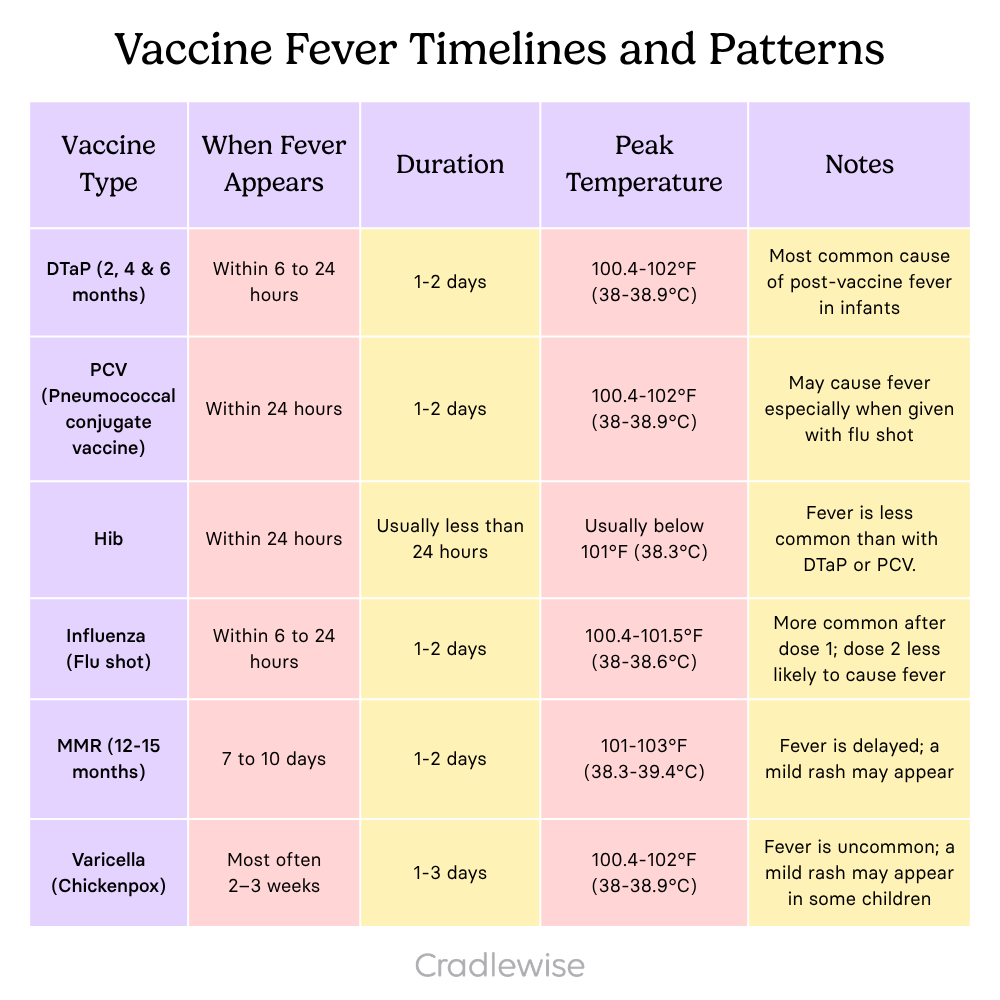
Timing depends heavily on which vaccine was given. Most post-vaccine fevers from inactivated vaccines (like DTaP, PCV, and Hib) appear within the first 24 hours and resolve within 1-2 days.
Live attenuated vaccines like MMR (measles, mumps and rubella) are different as they replicate slowly in the body and fever typically appears 7-10 days after the injection, sometimes with a mild rash.
Which vaccines are most likely to cause fever?
“Several routine childhood vaccines can cause a low-grade fever, but some are more likely than others. The vaccines most associated with fever include the 2,4, and 6 month combined vaccines as well as the influenza vaccine,” says Dr. Natalie Thoni
Dr. Thoni also adds, “Around 12-15 months children receive the MMR and varicella vaccines which are also often associated with fever. Again, these fevers are usually mild, short-lived, and resolve on their own.”
Source: Vaccine Information Statements (VIS) and Taylor and Francis Online
How long does fever last after the MMR vaccine?
The post MMR vaccine fever typically appears within 7 to 10 days after the shot and lasts 1-2 days. It’s caused by the measles component of the vaccine, which replicates slowly, hence the immune response is delayed compared to other vaccines.
This delay is one reason parents don’t always connect a fever at day 8 to the vaccine their baby received almost two weeks earlier. If your baby has their MMR at 12 months and develops a fever 7 to 10 days later, the vaccine is usually the cause.
What are the side effects of vaccinations?
These are the normal side effects of vaccinations that you can expect. Keep in mind that these are signs your baby’s immune system is working and typically resolve within 1 to 3 days:
- Low-grade fever (under 101°F / 38.3°C)
- Fussiness or irritability
- Sleepiness or reduced activity
- Reduced appetite
- Redness and swelling, or soreness at the injection site
You can check the following page to know more about the possible side effects of various vaccinations.
How to treat baby fever after vaccination?
For most babies, comfort measures are all that’s needed. Keep your baby well-hydrated, dress your baby in light, comfortable clothes and keep the room temperature comfortable. Offer extra feeds if needed, and let them rest.
Cradlewise Note: Cradlewise doesn’t encourage medicating unless advised by your healthcare provider. However, while administering acetaminophen or ibuprofen, always dose by weight, not age. Use a dosing syringe rather than a kitchen spoon as a kitchen spoon can deliver significantly more or less than the correct dose.
Can I give my baby medicine before shots?
However, if your baby is already on a prescribed medication schedule, speak with your pediatrician before the appointment.
This is a good resource to learn how to support your child before, during, and after shots.
Did you know?
Severe allergic reactions to vaccines are extremely rare, roughly 1 per million doses administered. They almost always occur within 15 minutes of the shot, which is why clinics ask you to wait before leaving.
What are the warning signs after a baby vaccine?
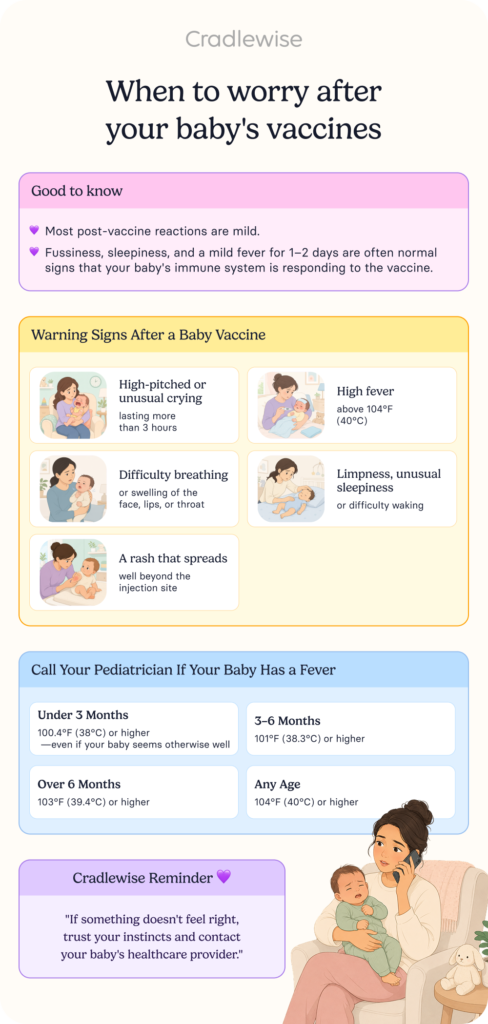
Though unusual, if you notice any of these signs, take it up immediately with your doctor.
Fever after vaccines in babies under 6 months
Any fever in a baby under 3 months, regardless of how it looks or whether it came after a vaccine requires an immediate call or visit to the pediatrician. At this age, the immune system is still immature and fever can progress quickly.
Fever after vaccines in babies 6 months and older
For babies over 6 months, low-grade fever with normal behaviour is usually manageable at home with comfort measures and appropriate medication dosing. As per AAP’s HealthyChildren site, call your pediatrician if the fever is above 103°F (39.4°C), persists beyond 2 days after vaccination, or your baby has any of the warning signs listed above.
Cradlewise note: The CDC’s National Immunization Information Hotline is available 24/7 at 1-800-232-4636. It is bilingual, and staffed for exactly these after-hours questions. The CDC’s V-safe program is also worth bookmarking. It’s a free smartphone-based tool for monitoring and reporting post-vaccination symptoms related to COVID-19 and RSV (Respiratory Syncytial Virus).
Conclusion
A fever after vaccination is, in the vast majority of cases, your baby’s immune system learning to recognize and fight dangerous infections. It’s temporary and most often manageable at home with rest, fluids, keeping your baby comfortable, and appropriate fever relief when needed.
Dr. Thoni advises parents to stop focusing on the temperature reading but focus on how your child looks and acts. If your baby is drinking fluids, making eye contact, and can be comforted; than the number on the temperature matters less.
However, if you’re ever unsure, don’t hesitate to call your pediatrician.
FAQs
Q: Is it necessary to get a fever after vaccination?
A: No. Many babies don’t develop a fever at all and are still fully protected. Fever is one possible immune response, but its absence doesn’t mean the vaccine didn’t work.
Q: How soon after vaccines do babies get a fever?
A: For most vaccines (DTaP, PCV, Hib, flu), fever appears within the first 24 hours. For the MMR vaccine, fever characteristically appears 7-10 days after the shot due to the slower-replicating measles component.
Q: How long does a fever last after vaccines?
A: Most post-vaccine fevers from inactivated vaccines resolve within 1-2 days. If fever persists beyond 2-3 days, call your pediatrician.
Q: Can I give my baby medicine before shots?
A: No. Research has shown that pre-medicating with fever reducers may slightly reduce the body’s immune response to some vaccines. However, if your baby is already on a prescribed medication schedule, speak with your pediatrician before the appointment.
Q: What is better, icing or a hot patch on the injection site?
A: A cool compress is the better choice during the first day as it can help reduce soreness and swelling. A warm compress generally isn’t necessary immediately after vaccination and may increase blood flow to an area that’s already inflamed, suggests Dr. Natalie Thoni.
Q: My baby is sleeping more after vaccination. Is that normal?
A: Yes. Dr. Natalie Thoni says it’s very common for babies to be sleepier, fussier, or eat a little less for 24 – 48 hours after vaccines. It shows the immune system is at work. Contact your pediatrician if your baby is difficult to wake, not feeding for a prolonged period, or crying inconsolably.
Q: What to do when baby has high fever after vaccination?
A: A mild fever is a normal sign that the immune system is responding to the vaccine, but a high temperature may point to significant infection or dehydration. Call your doctor immediately if your baby is:
1. under 3 months with a fever ≥100.4°F (38°C), even if your baby shows no other signs or symptoms of being ill
2. between 3 and 6 months and has a fever ≥101°F (38.3°C)
3. older than 6 months and has a fever ≥103°F (39.4°C)
4. Any age and has a fever ≥104°F (40°C)
You may also like:
- Hydration 101 for babies: When, how, and why to offer water.
- 15 sweet things to put in your baby’s time capsule.
- What roseola rash really looks like on baby skin (and why it’s often misdiagnosed).
Sources:
- Immunization prevents deaths worldwide. CDC. Fast Facts on Global Immunization.
- DTaP vaccine. CDC. 2021. DTaP (Diphtheria, Tetanus, Pertussis) Vaccine: What You Need to Know.
- PCV vaccine. CDC. 2026. Pneumococcal vaccination.
- Hib vaccine. CDC. 2025. Hib vaccination.
- MMR at 12 months. Taylor and Francis Online. 2020. Parental risk factors for fever in their children 7–10 days after the first dose of measles-containing vaccines.
- Severe allergic reactions are 1 per million doses administered. CDC. 2024. Possible Side Effects from Vaccines.
- Clinics ask you to wait 15 minutes before leaving after vaccination. CDC. 2024. Fainting and Vaccines.
- The possible side effects of various vaccinations. CDC. 2024. Possible Side Effects from Vaccines.
- Fever in babies 6 months and older. AAP. 2025. Fever and Your Baby.
You may also like