Science of baby sleep
0 min read
Do babies sleep in the womb?
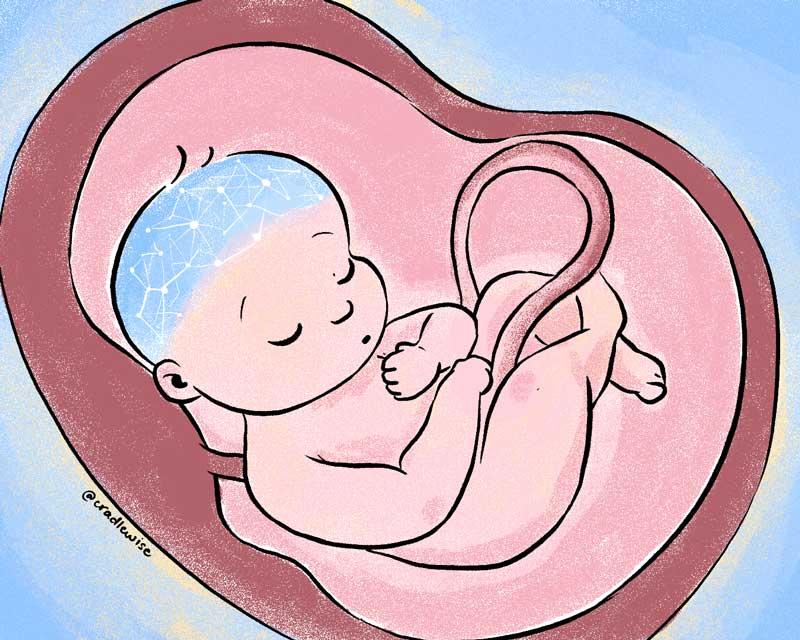
Medically Reviewed Dina El Kady, MD, Chief, Maternal Fetal Medicine at Mount Sinai South Nassau
Written by Cradlewise Staff
You may have noticed your little one kicking and moving in your womb, how they are quiet when you are walking around, but active when you lay down for some rest. And how when you want to feel and enjoy their movements, they can be silent for hours.
So, do babies sleep in the womb? Yes, and they do it a lot. And those quiet spells you feel are almost always your baby mid-nap.
But how does sleep actually develop in the womb? When does it start? Does your baby follow your sleep schedule? Does your baby dream in the womb? These are genuinely fascinating questions, and science has some equally fascinating answers.
In this guide, we’ve got these answers and more. We have consulted:
- Samantha Radford, PhD, an Exposure Scientist with a focus on maternal-child health and the Owner of Evidence-Based Mommy
- Dina El Kady, MD, Chief, Maternal Fetal Medicine at Mount Sinai South Nassau
- Dr. Rupali Drewek, Pediatric Pulmonologist and Sleep Lab Medical Director at LCMC Health.
Do babies sleep in the womb
Babies do sleep in the womb. In fact, they sleep a lot. By the time you reach about 38 weeks, your baby is sleeping 95 percent of the time!
Dr. Dina El Kady says: Babies have 4 main sleep and wake activity patterns. Scientifically we categorize the sleep patterns as:
- 1F Quiet sleep: 15-25% of the time the babies are in a deep sleep.
- 2F Active sleep: 55-75% of the time they are sleeping but moving around (like when we toss and turn in bed). They spend the majority of time in this stage which is needed for healthy brain development.
- 3F Quiet awake: 0-5% of the time, most babies when awake are moving, sometimes you only see eye movements.
- 4F Active awake: 5-15% of the time, this is when you feel most kicks during the high activity times.
How do babies sleep in the womb
The way your baby sleep changes significantly across pregnancy. Let’s see the four stages of sleep in the womb and how your baby sleeps through them.
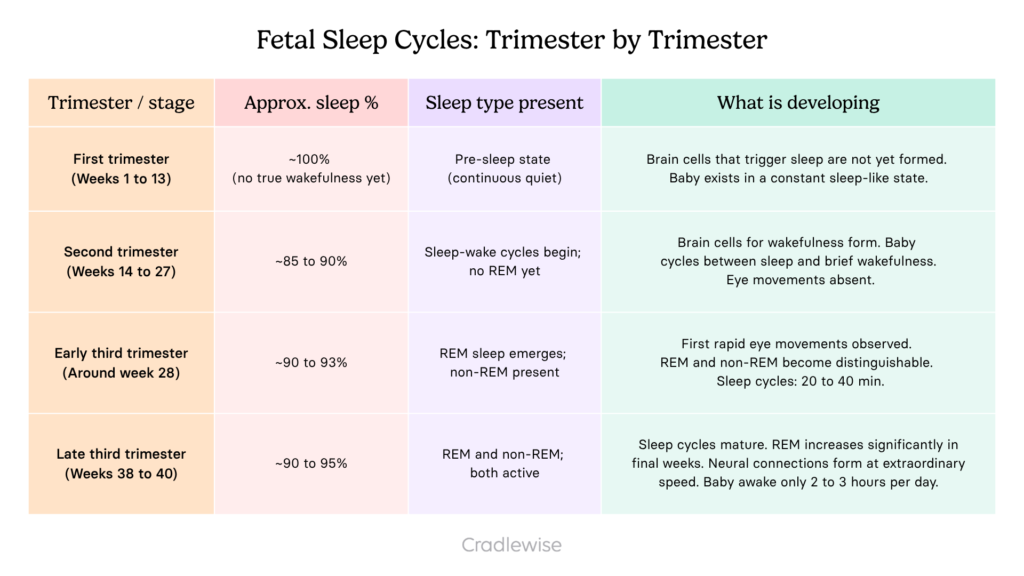
In the first trimester: Your baby does not yet have the brain cells needed to switch between sleep and wakefulness. Your little one is in a constant state of sleep.
By the second trimester: By this time, the brain cells that cause your baby to fall asleep have formed, and they’ll start waking up and falling asleep in cycles.
Around week 28: Fetal sleep cycles of 20 to 40 minutes first appear around 28 weeks of pregnancy, when REM sleep begins, as per a research published in ScienceDaily. Around the seventh month, your baby’s eyes will start moving rapidly as if they were dreaming.
By 38 to 40 weeks: Your baby’s REM sleep increases from nine to 12 hours each day, with only only 2 to 3 hours of actual wakefulness in a full 24 hours.
How baby sleep develops: Trimester by trimester
Here is a clear picture of what is happening with sleep at each stage of your pregnancy.
Why do babies sleep so much in the womb
REM-like sleep that includes spontaneous fetal movements and fetal breathing movements (FBM) are believed to play an important role in preparing your baby’s vital systems.
Sleeping helps your baby with:
- Rapid brain development: During REM sleep, your baby’s brain is buzzing with activity. Neural connections form and strengthen at a remarkable pace. The abilities to hear, move, process sensations, and eventually recognise your voice all develop during these sleeping hours.
- Building memory: These sleep cycles are essential for the creation of memory and long-term memory circuits, as per a study published in ScienceDirect.
- Organ system maturation: A strong association between FBM and REM-like states suggests that fetal sleep behavior may help your baby’s lungs grow and mature.
In the last few weeks before birth, REM sleep increases significantly, because the brain is making its final, most intensive preparations. That is why a week before birth, a baby can spend as much as 9 to 12 hours a day in REM sleep alone.

Did you know?
A baby is born with approximately 100 billion neurons. The vast majority of the neural connections between those neurons form during sleep in the womb.
Does your baby follow your sleep schedule
Your baby does not yet have their own functioning body clock. Their internal circadian system is still developing. So where do their sleep-wake signals come from?
One argument is that the baby follows your schedule. During pregnancy, your body produces melatonin (the sleep hormone) in a daily rhythm: high at night, low during the day. Melatonin can pass the placenta and transfer light and dark signals to the fetus. In other words, your melatonin should serve as your baby’s body clock.
However, Dr. El Kady has a different opinion.
Dr. Rupali Drewek and adds, “A mother’s melatonin helps give the baby cues about the difference between day and night, but that doesn’t mean the baby sleeps and wakes on exactly the same schedule as the mother. It’s more like giving them a hint about the time of day rather than a strict bedtime order. Maternal melatonin is thought to help the developing baby begin learning about the body’s day-night rhythm, which becomes more important after birth.”
A few things worth knowing about your baby’s sleep patterns in the womb:
- Your daily rhythm of light and darkness, through your melatonin release, helps regulate (not entirely control) your baby’s sleep cycle in the womb.
- Getting regular sleep, spending time outdoors in daylight, and keeping a reasonably consistent schedule all support healthy melatonin rhythms, which in turn support your baby’s developing circadian system.
Did you know?
Your placenta itself has circadian rhythms in the enzymes that regulate what crosses it, meaning your daily routine has a direct effect on your baby’s biology.
Do babies dream in the womb
Possibly yes, and the science behind it is genuinely fascinating.
Here is what we know for certain: Adults dream primarily during REM sleep. Babies in the womb spend a significant proportion of their sleep time in REM sleep, especially in the third trimester. The brain activity during fetal REM sleep has been measured and described as rivalling that of consciousness, meaning the brain is highly active, not at rest.
However, Dr. Dina El Kady has a different view on this subject.
Dr. El Kady explains, “If they do dream, it often times will unlikely be like adult dreams since our experiences shape our dreams, for babies, they might dream about experiences related to Internal sensations, Sounds from the mother’s body, rhythmic heartbeat patterns of both the baby and the mom, vestibular sensations from movement. Many neuroscientists think REM sleep before birth may primarily support brain development rather than producing rich narrative dreams.”
Can you feel your baby sleeping
If you are in your third trimester and you have just spent two hours wondering why your baby has gone quiet, this section is for you.
Your baby sleeps in 20 to 40 minute cycles, and during those sleep windows, movement significantly decreases or stops. If you are noticing a quiet period, it most probably means your baby is sleeping.
Why does baby move more at night in the third trimester?
Pregnant people often notice that babies are most active in the evenings or when they sit or lie down.
“There are a few reasons this may happen,” says Dr. Rupali Drewek, “During the day, your movements, such as walking around, can gently rock the baby and lull them to sleep. At night, when you’re resting and it’s quieter, it’s easier to notice your baby’s movements. Hormone changes and your body’s natural day-night rhythms may also cause babies to be more active in the evening.” Also, your blood sugar rises after dinner, which increases fetal activity in the night.
How do babies sleep in the womb: What’s normal?
- Quiet stretches of 20 to 40 minutes while your baby completes a sleep cycle.
- More movement in the evening and at night.
- Movement that slows when you are active and picks up when you rest.
When to count kicks?
From around week 28, most providers recommend daily fetal kick counting as a way to get to know your baby’s normal pattern. You count how long it takes to feel 10 movements. In most cases, this takes under an hour, though up to two hours is still considered within normal range.
Dr. Dina El Kady says, “We also do encourage that fetal kick counts are done after a meal or something to eat, and for best results while laying on her left side.”
When you keep a count of kicks, you know what is normal for your baby, and you also notice if something changes.
When to call your provider?
- You have not felt your baby move for more than 2 hours and stimulation (a cold drink, gentle movement, music) has not prompted any activity.
- You notice a sudden and significant change in your baby’s usual movement pattern.
- Movement has stopped entirely.
Do not wait until your next scheduled appointment if you notice any of the above signs. As Dr. El Kady suggests, “Moms should never shy away from going to Labor and Delivery (they are open 24/7!) a noticeable decrease from a baby’s normal activity pattern deserves attention.”

Cradlewise Smart Crib
Smarter Sleep for Your Baby
An award-winning crib—loved by parents, approved by experts.
0 to 24 months of use
Automatic soothing
Built-in video & sound machine
AI-powered sleep insights
Customizable soundtracks
Get 2 extra hours of sleep nightly
How sleep patterns in the womb connect to newborn sleep
Here is the part that will make a lot of things click into place once your baby arrives.
- Sleep cycles: Those 20 to 40 minute sleep cycles your baby is running in the womb? They are the same ones they will arrive with. However, Dr. Rupali Drewek explains, “After birth, newborns’ sleep cycles become a bit longer, about 50–60 minutes. Newborns also spend more time awake compared to fetuses.”
- Circadian rhythm: According to Dr. El Kady, “There is some evidence to suggest that some of the foundations of circadian timing are established prenatally, however the baby’s clock is still dependent on the maternal environment. Some of the influences of the circadian rhythm are hormonal, maternal melatonin, eating, and body temperature fluctuations,” she adds, “The baby starts to develop an independent circadian rhythm only after birth, when the infant begins responding directly to environmental light-dark cycles.”
In short: Your baby may arrive without a functioning circadian clock of their own, but will start to develop one after birth.
- Newborn sleep: While it’s a possibility that your baby’s sleep patterns in the womb may match after birth, it more commonly does not happen. Dr. Drewek says, “Sleep after birth is heavily shaped by new factors such as hunger, light, noise, and temperature. While fetal sleep may help prepare the brain for life outside the womb, it doesn’t reliably predict whether a baby will be a “good sleeper” after birth.”
Cradlewise tip: Understanding that newborn sleep is womb sleep continued, same short cycles, same REM-heavy sleep patterns, same dependence on external cues, is useful for the early weeks. The Cradlewise Smart Crib is designed to respond to exactly those patterns: detecting early wake signs and soothing your baby back through sleep cycles, the way those cycles were designed to work.
Conclusion
When your baby goes quiet, they are almost certainly sleeping. When you feel a flurry of movement at 10pm, they have just woken up.
All that sleep in the womb is the most productive thing your baby can be doing. Every neural connection, every developing sense, every piece of the brain that will one day recognise your face and respond to your voice, is being built during those long, quiet sleeping hours.
And when they arrive, those same short cycles and that same REM-heavy sleep will travel out of the womb with them. Understanding that is one of the most useful things you can know heading into the fourth trimester.
FAQs
Q: How do babies breathe in the womb?
A: Babies in the womb breathe through their umbilical cord, which delivers oxygen-rich blood from the mother to the baby and removes waste products. It’s a process that keeps your little one healthy and growing strong.
Q: Do babies cry in the womb?
A: While babies can make sounds in the womb, they don’t cry like they do after birth. They may make soft grunts, hiccups, or other noises, but don’t worry – these sounds are perfectly normal and are signs that your baby is healthy and developing as they should.
Q: Why do babies get hiccups in the womb?
A: Hiccups are common in babies in the womb, and they can happen frequently. It’s believed that hiccups are caused by the baby’s developing nervous system and are a sign that their diaphragm muscles are developing and strengthening in preparation for breathing after birth.
Q: When can babies hear in the womb?
A: Your baby’s hearing starts to develop around 18-20 weeks gestation, and they can hear various sounds in the womb, including your voice and heartbeat. So go ahead and talk, sing, and read to your little one while they’re still in the womb.
Q: How many hours do babies sleep in the womb?
A: 17 to 20 hours per day in the third trimester. In early pregnancy, your baby is in a constant state of sleep
Q: How often do babies sleep in the womb?
A: 20 to 40 minutes sleep cycles around week 28, according to research on fetal REM and non-REM sleep patterns.
Q: Can you feel your baby sleeping in the womb?
A: In a manner, yes. When your baby enters a sleep cycle, movement decreases significantly or stops entirely, and you can feel a drop in the baby’s kicks.
You may also like:
- Baby noisy sleeper: Why it happens and when to worry.
- Why does day-night reversal happen in babies?
- How baby sleep affects maternal mental health.
Sources:
- Do babies sleep in the womb. National Library of Medicine. 2007. Neurophysiologic Measurement of Continuity in the Sleep of Fetuses during the Last Week of Pregnancy and in Newborns.
- Fetal sleep cycles of 20 to 40 minutes. ScienceDirect. 2009. Baby’s First Dreams: Sleep Cycles Of The Fetus.
- Creation of memory and long-term memory circuits. ScienceDirect. 2008. Sleep and Brain Development: The Critical Role of Sleep in Fetal and Early Neonatal Brain Development.
- Organ system maturation. Sleep. 2026. Fetal sleep: a cross-species review of physiology, measurement, and classification.
- Did you know? A baby is born with approximately 100 billion neurons. National Library of Medicine. 1992. The Development and Shaping of the Brain.
- Melatonin can pass the placenta. PubMed Central. 2019. Perinatal Use of Melatonin for Offspring Health: Focus on Cardiovascular and Neurological Diseases.
- Did you know? Your placenta has circadian rhythms. PubMed Central. 2026. Fetoplacental circadian rhythms develop and then synchronize to the mother in utero.
- Daily fetal kick counting. PubMed Central. 2024. Standardizing Fetal Movement Monitoring using Count the Kicks.
- Research on sheep fetuses. Chaos: An Interdisciplinary Journal of Nonlinear Science. 2008. Nonlinear analysis and modeling of cortical activation and deactivation patterns in the immature fetal electrocorticogram.
You may also like


