Parenting
0 min read
Dad starter pack: Surviving the first year


Cradlewise Staff
Nobody really tells dads what the first year with a baby feels like.
People will warn you about the lack of sleep. They’ll joke about diapers. Someone will definitely say, “Enjoy every moment,” while you’re holding a screaming baby at 3 a.m. wearing a 2 day-old T-shirt with coffee and burp stains.
But the truth is, the first year is equal parts beautiful, exhausting, hilarious, emotional, chaotic, and weirdly magical. One minute you’re Googling “why does my newborn grunt like a tiny goat,” and the next, your baby falls asleep on your chest and suddenly nothing else matters.
If you’re a first-time dad, welcome.
This is not a blog full of advice to cherish every moment. This Father’s Day, we bring something practical, honest, and written for every dad who has Googled something embarrassing at 4am. Consider this your starter pack for surviving the first year with your baby. And you are going to be fine.
The gear you actually need (and what to skip)
On Father’s Day, the baby gears industry will try to sell you everything under the sun, most of which you will never use. Here are a small number of things that helps dads survive the first year with a baby.
- A dad diaper bag. Get a comfortable, hands-free backpack with multiple compartments (the more the better). You need room for wipes, snacks, bottles, a change of clothes, swaddles, burp clothes, pacifier, and a portable changing mat (believe us, that can be a game changer). And of course, compartments for holding your water bottle and coffee mug.
- Extra phone chargers. In every room. You will be doing more one-handed phone use than you ever imagined: checking the baby monitor, Googling whether that rash is normal, or playing white noise at 3am. A dead phone at the wrong moment is genuinely stressful. Cable in the nursery, cable by the bed, cable in the living room. Done.
- A giant water bottle. You will forget to drink water. You will forget to eat. A large bottle parked somewhere visible is a small but surprisingly effective reminder to stay functional. Fill it before you sit down. You will not get up again for a while.
- One-handed snacks. Stocked and accessible in all rooms that you will possibly move around with your baby. Granola bars, nuts, bananas, or anything that does not require two hands or a plate. You will frequently find yourself holding a baby with one arm and needing to eat with the other. Plan for this in advance.
- Blackout curtains. In the nursery and your own room. Light is one of the biggest enemies of baby sleep and parent sleep. A properly darkened room makes naps longer, bedtimes easier, and early morning wake-ups less likely. This is one of the highest-return purchases you can make before the baby arrives.
- A smart crib. A smart crib feels like one of those baby products that sounds extra… until you are awake for the fourth time in one night. It gently bounces and soothes your baby when it detects early wake-ups, which means sometimes it handles the situation before you even have to fully open your eyes. For exhausted dads running on coffee and survival instincts, a smart crib can feel like a reliable backup at 2 a.m.
- A white noise machine. One of the highest-value baby purchases available. It helps your infant sleep through ambient noise and helps you speak at a normal volume once they are down.
- A baby carrier. At some point, your baby will decide they only want to sleep on you. That is where a good baby carrier becomes dad-level essential. It keeps your hands free for coffee, snacks, or panic-Googling newborn questions. Learn how to use it before the baby arrives.
Things you can skip:
- The wipe warmer.
- The nappy bin that requires special bags.
- The baby shoes for a baby who cannot walk.
- The video monitor with seventeen features you will never use.
- The elaborate bottle steriliser when a pot of boiling water does the same job.
- Any gadget described as ‘revolutionary’ that requires an app and a Wi-Fi password.
- Newborn clothes in sizes 0 to 3 months. Buy fewer. They outgrow them in weeks.
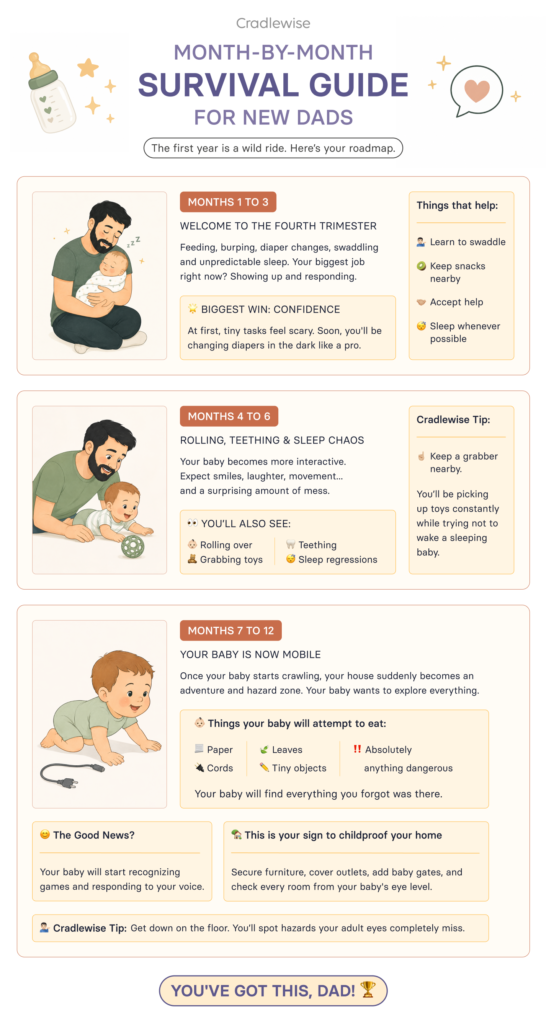
Month-by-month survival guide for new dads
The first year is not one long stretch of the same thing. It changes significantly every few months. Here is a rough roadmap to the fourth trimester.
Dad survival hacks that actually help
Nobody becomes an expert parent overnight. Here are a few practical tips for first-time dads that actually help during the newborn stage.
- Do the diaper changes whenever you can. Diaper changes are tiny moments that help you connect with your baby as your baby learns your voice, touch, and presence through these everyday routines. Also, the more you do them, the less terrifying they become.
- Try skin-to-skin contact. Holding your baby against your chest can help regulate body temperature, heart rate, breathing, and stress levels. For both of you. And yes, it counts even if you are sitting on the couch half awake at 1 a.m.
- Embrace your own parenting style. One of the biggest misconceptions new dads have is that they need to parent exactly like their partner. Find your baby’s cues and bond through your natural approach. Your baby will learn your voice, your rhythm, your silly songs, and your particular way of holding, bouncing, and soothing them.
- Treat parenting as a relay race. Trying to “power through” together without sleep usually ends with both parents exhausted and irritated. The smarter strategy is to coordinate handoffs. Maybe one parent handles bedtime while the other takes the early morning shift. When one person is on, the other rests. Tag in and tag out.
- Keep one thing from your pre-baby life alive. Even in a smaller form. A run, a phone call with a friend, an hour that is just yours. This is not selfish. You don’t want to let resentment build in gradually, as it always happens when you start sacrificing things that keep you sane.
- Narrate everything. Talk to your baby while changing diapers, making bottles, folding laundry, or walking around the house. Your baby may not understand the words yet, but your voice is already comforting and familiar.
- Connect with other dads. Finding someone else who is also doing night shifts and questioning their sanity changes the experience significantly. Even one person who gets it makes a difference. You need someone to tell you that you are not alone in this and this too shall pass.
- Watch for signs that you are struggling beyond normal tiredness.

Did you know?
Paternal postnatal depression affects 8-10% of new fathers.
It often presents as irritability, withdrawal, or persistent overwhelm rather than sadness. If things feel consistently heavy for more than two weeks, speak to your doctor.
One survival tip nobody tells new dads
Here is something that does not get said enough in dad content: your first year gets significantly easier when parenting feels like teamwork rather than two people managing separate emergencies.
While the blog is about dad surviving the first year with a baby, remember, it cannot be complete without your support to your partner.
Her body has just done something extraordinary and is still recovering. She is also learning a new role, just like you are, with physical recovery on top of everything else.
- Be specific, not general. ‘I’ll do bath and bedtime tonight’ is more useful than ‘let me know what you need.’
- Notice before being asked. The nappy bag that is running low, the formula that needs ordering, the appointment that needs booking. Getting there first matters.
- Share the load without being asked. Prepare meals, do laundry and household chores, and get groceries. Not as a favour. As part of the deal.
- Watch for postpartum signs. Sometimes the person in the middle of postnatal depression is the last to see it clearly. Gently encourage support to your partner if you notice persistent low mood, withdrawal, or anxiety that does not ease.
- Protect the relationship. Come back to difficult conversations when you are both less exhausted. The relationship is the foundation of the family you are building. It needs tending during this period, even when finding the energy is hard.
This phase of long nights and exhaustion shall soon pass
Some days will feel long. Some nights will feel impossible. But there will also be tiny moments that hit you out of nowhere: the first smile, the sleepy cuddles, the way your baby settles when they hear your voice.
Over time, you will become more patient, more tired, more resourceful, and probably much better at functioning while holding coffee in one hand and a baby in the other.
You do not need to be the perfect dad. You just need to keep showing up. And you will figure it out, one small win at a time.
FAQs
Q: How do new dads deal with sleep deprivation?
A: Taking shifts with your partner, sleeping whenever possible, limiting unnecessary tasks, lowering your standards, and asking for help can make the newborn stage more manageable.
Q: What is Purple Crying and how should dads handle it?
A: Purple Crying refers to a period of intense, inconsolable crying that all babies go through, usually peaking around weeks two to three. When it feels overwhelming, put your baby down in a safe place, step away briefly to reset, and come back calm. It is a developmental phase and it passes.
Q: Can new dads get postnatal depression?
A: Yes. Paternal postnatal depression affects approximately 8-10% of fathers. It often presents as feelings of emptiness and hopelessness, significant weight loss, insomnia, fatigue, and even recurrent thoughts of drying. If you have felt this way consistently for more than two weeks, speak to your doctor.
Q: How do I bond with my newborn as a dad?
A: You can bond through skin-to-skin contact, feeding, stroller walks, diaper changes, talking, singing, and simply spending consistent time with their baby.
Q: When does life with a newborn get easier?
A: Most parents notice things becoming more predictable around 3 to 6 months as babies begin sleeping longer stretches and developing routines.
You may also like:
- 25 TV dads we all love: Father’s Day edition.
- Rediscovering intimacy and sex after birth: A guide for new parents.
- First Father’s Day as a father-to-be: A letter to my future self.
Source:
- Postnatal depression in men. National Library of Medicine. 2019. Postpartum Depression in Men.
You may also like