Pregnancy
0 min read
When does a baby have a heartbeat? A fetal heartbeat by week guide

Medically Reviewed Dr. Kecia Gaither double board-certified OB/GYN, Dr. Pragati Kakkar, IVF specialist & OB-GYN
Written by Cradlewise Staff
Few moments in pregnancy are as breathtaking as the first time you see or hear your baby’s heartbeat. It is the “rhythmic proof” of life growing inside you. However, because every pregnancy develops at a slightly different pace, many parents find themselves searching for when does their baby have a heartbeat and exactly when those milestones should happen.
From the first flicker of cardiac activity at 6 weeks to the steady gallop you hear at 12 weeks, understanding fetal heartbeat development by week can help ease your mind and prepare you for your first prenatal appointments.
Let’s walk through the week-by-week magic of fetal development, from one mama to another— with insights from our experts: Dr. Kecia Gaither, a double board-certified OB/GYN and maternal-fetal medicine specialist who focuses on high-risk pregnancies and fetal health, and Dr. Pragati Kakkar, an IVF specialist and OB-GYN at United Wellness, with a deep focus on reproductive medicine and prenatal care.
When does a baby have a heartbeat?
The earliest heartbeat typically appears around week 6 of pregnancy, just a week or so after your missed period. At this stage, the baby is still an embryo, just a few millimeters long. And your heart is a simple tube-like structure.
When can you hear a baby’s heartbeat?
According to Dr. Gaither, most parents can hear their baby’s heartbeat around:
- 6 weeks via transvaginal ultrasound
- 7-8 weeks, using an abdominal ultrasound
- 10-12 weeks, using a handheld Doppler device, especially in low-risk pregnancies.
“In high-risk pregnancies, we typically confirm the fetal heartbeat every one to two weeks during the first trimester,” says Dr. Gaither.
Is it safe to use at-home Dopplers?
While at-home Dopplers are widely available, experts generally advise caution:
- They can be difficult to use correctly, especially before 10–12 weeks
- You may not find the heartbeat, causing unnecessary worry
- They can give false reassurance if used incorrectly
For these reasons, it’s best to rely on your healthcare provider for monitoring.
Cardiac activity vs Heartbeat
In early pregnancy, as the heart isn’t yet developed, the American College of Obstetrics and Gynecologists (ACOG) defines this movement as “cardiac activity” rather than a heartbeat.
According to medical guidelines:
- First heartbeat ultrasound detects cardiac activity, not a fully formed heartbeat
- The heart starts as a primitive tube that contracts rhythmically
- Valves and chambers develop later in pregnancy
This distinction matters because:
- It explains why detection timing can vary
- It helps avoid unnecessary anxiety if a heartbeat isn’t heard very early
- It reflects how fetal development actually progresses
Why you might not hear your baby’s heartbeat
It is common for parents to feel anxious if a heartbeat isn’t detected at the first appointment. It could simply be:
- Tilted uterus: A uterus that tips backward can make it harder for a Doppler to pick up the sound early on.
- Inaccurate dating: You might be earlier in your pregnancy than your last period suggested. Even a few days’ difference can change what is visible on an ultrasound.
- Placenta position: If your placenta is “anterior” (in front), it can muffle the sound of the heartbeat.
- High maternal BMI: Extra adipose tissue (body fat) can act as a barrier, making it more difficult for ultrasound waves or Doppler devices to detect fetal cardiac activity.
What is a normal fetal heart rate by week
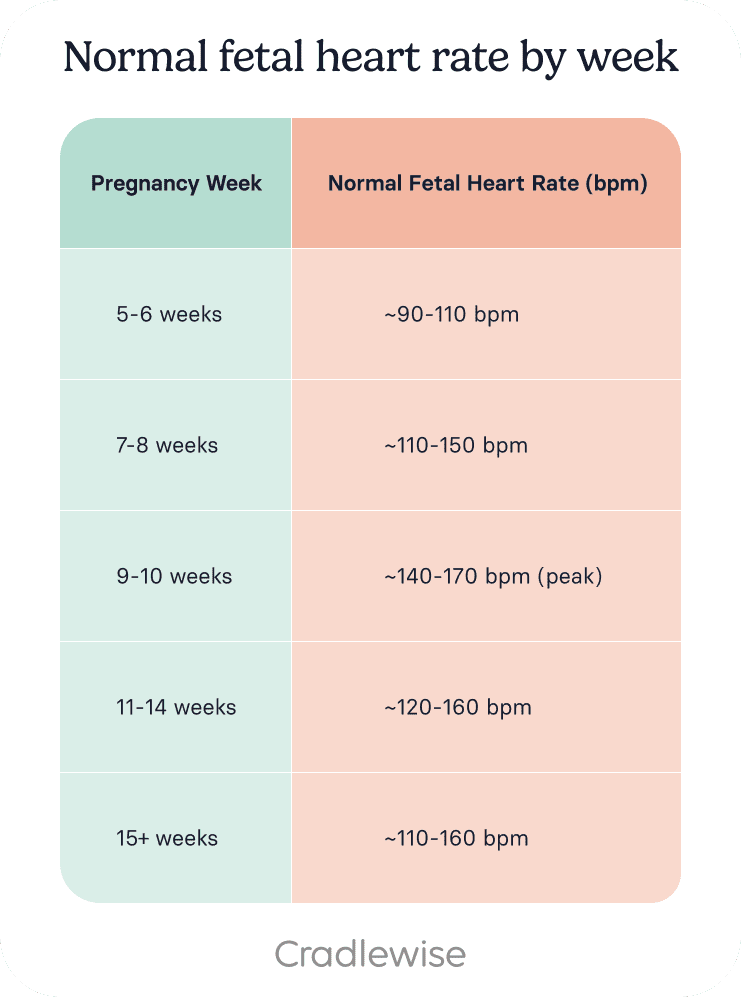
A healthy fetal heart rate typically ranges between 110 and 160 beats per minute (BPM), though it can fluctuate based on your baby’s activity level and stage of development.
Dr. Pragati Kakkar explains that while some variation in fetal heart rate is normal, extreme readings can be a red flag. “A fetal heart rate below 100 BPM after 6–7 weeks can be a warning sign of possible miscarriage or poor fetal development,” she notes.
On the flip side, if the heart rate consistently climbs above 180 BPM during the first trimester, it might signal a concern.
“A higher-than-normal heart rate could indicate fetal distress or another issue,” Dr. Kakkar adds. However, she reassures that “short bursts or accelerations—especially with fetal movement—can still be perfectly normal.”
This is why regular prenatal checkups and heartbeat monitoring are so important.

Did you know?
By week 8, your baby’s heart beats almost twice as fast as yours!
Why is the anatomy scan so important?
Between 18 and 22 weeks pregnant, your provider will likely schedule a detailed anatomy scan also called the 20-week anatomy scan. One of the most important parts of the scan is its ability to catch congenital conditions early.
According to Dr. Kakkar, “We can detect heart defects like ventricular septal defects or hypoplastic left heart syndrome, and issues with the brain, spine, kidneys, or abdominal wall.”
Spotting these signs early helps parents connect with pediatric specialists and plan for any interventions, if needed.
Alongside organ development, the scan also checks amniotic fluid levels, placenta placement, and the umbilical cord’s insertion point – three key factors that support healthy fetal development throughout the rest of your pregnancy.
Your baby’s heart development by week
Weeks 1-4: The beginning of it all
Conception marks the start. Once the sperm meets the egg, a zygote forms and becomes a blastocyst, nestling into your uterine lining. Around week 4, it officially becomes an embryo.
“Successful implantation is confirmed with a rising serum beta-hCG level and a transvaginal ultrasound showing a gestational sac and embryo in the uterus,” Dr. Gaither explains. She adds that in high-risk pregnancies, providers typically use ultrasound to assess the fetal heartbeat starting around 6 weeks, then monitor it every 1–2 weeks during the first trimester to ensure healthy development.
Did you know?
Your baby’s sex is determined at conception, even if you won’t find out for weeks!
Weeks 5-8: The embryo takes shape
The neural tube, which becomes the brain and spine, forms. This is also when a baby has a heartbeat for the first time, around week 6. Limbs bud, organs begin to take shape, and your embryo is now about the size of a raspberry.
What devices are used to hear the baby’s heartbeat?
Transvaginal ultrasound (as early as week 6)
Doppler fetal monitor (around week 10-12)
Fetoscope or stethoscope (after week 20)
Weeks 9-12: Hello, fetus!
At week 9, your baby graduates from embryo to fetus -a significant milestone in those early weeks of development. Their tiny facial features are taking shape, and those itty-bitty fingers, toenails, and even tooth buds are beginning to form.
By week 12, all of your baby’s major organs are in place, and the heartbeat is stronger and it is easier to detect the heartbeat with a Doppler. This is also when your baby starts showing off new skills -like stretching, yawning, and maybe even a little hiccup or two!
Did you know?
Your baby can yawn and hiccup by week 12!
Weeks 13-18: Movement and milestones
You might start to feel those first flutters—aka quickening—around week 18. It can feel like bubbles or soft taps, and it’s often the first time you really start to feel connected to your baby. By now, the fetus can hear sounds and even respond to light. Bones are hardening, and fingerprints are forming, giving your baby their own unique identity.
During this period, your baby’s heart continues to mature. By week 13, the heart rate typically decreases from its earlier peak to a range of 110–160 beats per minute, maintaining a rhythm faster than an adult’s heart rate. This adjustment supports the growing fetus’s metabolic needs and is a normal part of development.
Week 19-24: From wiggles to kicks
Skin is still translucent, but fat is forming, and the lungs are growing fast. By week 20, the anatomy scan gives a full view of baby’s development, including the heart.
She explains, “The scan helps diagnose major congenital abnormalities, eg, heart defects (like ventricular septal defects or hypoplastic heart syndrome), brain and spine problems (like spina bifida), kidney problems (like absent or cystic kidneys), and abdominal wall defects.
”Dr. Kakkar adds, “The scan also assesses the amniotic fluid, placenta location, and umbilical cord insertion to ensure healthy fetal development. Early identification of these can help referrals to specialists and offer early intervention.”
Did you know?
Your baby now has sleep-wake cycles, kind of like a newborn!
Weeks 25-32: Practicing for life outside
To support your baby’s brain and heart development, Dr. Gaither recommends starting with the basics.
Key steps she advises: take prenatal vitamins (mainly folic acid), avoid alcohol, tobacco, and drugs, manage conditions like diabetes or high blood pressure, and keep up with prenatal visits.
Did you know?
Your baby may respond to your voice with increased movement or a faster heart rate.
Weeks 33-40: Almost there!
Now gaining about half a pound per week, your baby’s organs are ready. By week 37, your little one is considered full-term and preparing for birth.
“Fetal heart rate patterns assess adequate oxygenation, reflecting variability, and a normal rate. Abnormal rates, loss of variability may be indicative of fetal distress and the subsequent need for intervention with delivery,” says Dr. Gaither.
When should you be concerned
Do not panic as often follow-up scans are needed before drawing conclusion, if:
- No cardiac activity is detected after 7-8 weeks (with accurate dating)
- Fetal heart rate is significantly outside normal range
- You experience symptoms like bleeding or severe cramping
Conclusion
And just like that, your baby goes from a barely-there bundle of cells to a heartbeat you’ll never forget—and soon, a little person you’ll get to hold in your arms. It’s pretty wild (and wonderful). How much happens in just 40 weeks? From that first flicker of a heartbeat around week 6 to the steady rhythm guiding delivery, every beat tells a story of growth, strength, and life.
Understanding what’s normal, when to expect it, and how your baby’s heart development works can help ease anxiety during early pregnancy. And if timing feels uncertain, remember, small differences in dating can make a big difference in what’s visible on a scan.
FAQs
Q: Can you hear a baby’s heartbeat at 6 weeks?
A: Sometimes, a heartbeat can be detected at 6 weeks via transvaginal ultrasound, but it’s not always guaranteed.
Q: When can you hear a baby's heartbeat with a stethoscope?
A: It is difficult to hear a fetal heartbeat with a regular stethoscope. Most doctors can pick it up between 18 and 20 weeks, but it requires a very quiet room and a specific position of the baby.
Q: How early can you hear a baby’s heartbeat on ultrasound?
A: A transvaginal ultrasound can often detect a heartbeat as early as 6 weeks. An abdominal ultrasound (the one on your belly) usually requires you to be at least 7 to 8 weeks along.
Q: What is a normal heart rate at 8 weeks?
A: A healthy fetal heart rate at 8 weeks is typically between 140 and 170 beats per minute.
Q: Can I use a home Doppler to hear the heartbeat at 8 weeks?
A: It is highly unlikely. Most home Dopplers are not powerful enough to pick up a heartbeat around weeks 10-12 or later. Using one too early can cause unnecessary anxiety if the heartbeat cannot be found.
Q: Does a fast fetal heart rate mean it's a girl?
A: This is a popular old wives’ tale, as scientific studies have shown no correlation between fetal heart rate and the baby’s gender.
Q: When does heart start beating in the womb?
A: Your baby’s heart begins to beat around week 6 of pregnancy, just a week or so after your missed period.
Q: What if there is no heartbeat at 6 weeks?
A: It may simply be too early. Doctors often recommend a follow-up scan in 1-2 weeks.
You might also like:
- 10 best pregnancy apps for new parents
- More moms over 35: What you need to know about advanced maternal age
- 10 pelvic floor exercises during pregnancy that you NEED to know
Sources:
- Cardiac activity vs Heartbeat. American College of Obstetrics and Gynecologists (ACOG). 2026. ACOG Guide to Language and Abortion.
- High maternal BMI. OB/GYN Online Library. 2014. Influence of maternal body mass index on accuracy and reliability of external fetal monitoring techniques.
- Weeks 13-18: Movement and milestones.National Library of Medicine. 2011. Fetal cardiac function during the first trimester of pregnancy.
You may also like


