Parenting
0 min read
Baby’s first smile: When do babies start smiling at you?


Cradlewise Staff
Your baby’s first smile is one of those unforgettable milestones – the moment that melts your heart and makes all those sleepless nights and every tired morning feel worth it. But when does a baby’s first smile actually happen? And how can you tell if it’s a real smile or just a reflex?
In the early weeks, newborn expressions can feel like a mystery. One moment they are serious, the next they flash what looks like a grin. Understanding when babies start smiling, what it means, and how to encourage it can help you feel more connected and confident as your baby grows.
In this blog, we’ll unwrap the when, the why, and the what r behind your baby’s first smile, along with some sweet and surprising tidbits that will make you look at those tiny grins in a whole new light.
When do babies first smile?
Most babies start smiling socially by the end of their second month. These early smiles are your baby’s first way of communicating joy and connection in response to seeing you.
Understanding your baby’s first smile
The first real smile, which is a direct response to a parent’s face or voice, usually appears a few weeks later and marks an important step in bonding and communication.
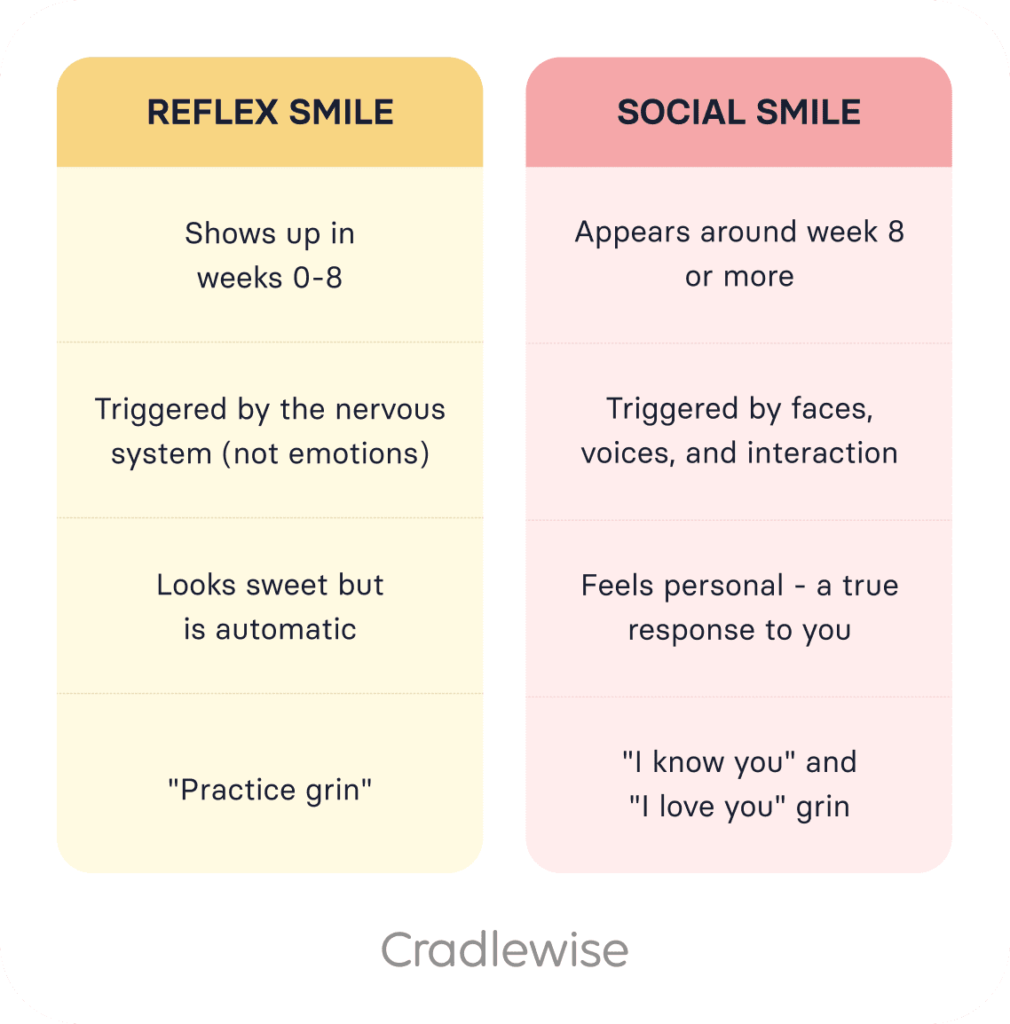
In the very early days, you may notice what looks like a smile while your baby is sleeping. These are reflex smiles, caused by internal processes, like gas or hunger, rather than emotion.
The real milestone is the social smile when your baby smiles in response to your face, voice, or interaction. This usually happens by the end of their second month, as per the American Academy of Pediatrics, when their vision improves and they begin recognizing familiar faces. Pediatricians often look for this milestone during a 2-month visit, since it signals early social and emotional development.
Reflex smiles vs social smiles: What’s the difference?
Reflex smiles (0–8 weeks)
- Happen randomly, often during sleep: Reflex smiles can appear suddenly, especially when your baby is asleep or drowsy, without any clear external trigger.
- Not triggered by interaction: These early smiles aren’t a response to your voice or face, but they happen involuntarily as part of your baby’s natural reflexes.
- Part of early neurological development: Reflex smiles are linked to your newborn’s developing nervous system and are a sign that their brain is starting to form basic connections.
Social smiles (8 weeks)
- Triggered by faces, voices, and engagement: Social smiles happen when your baby recognizes and responds to familiar stimuli like your face, voice, or playful interaction.
- A sign of emotional and social development: These smiles mark an important milestone, showing that your baby is beginning to connect emotionally and engage with the world around them.
- Often paired with eye contact and cooing: These smiles are usually accompanied by eye contact, little sounds, and expressions that feel like your baby’s first attempts at communicating with you.
Why do babies smile?
Babies smile in an attempt to join the conversation with you, long before their words arrive.
Research shows that smiling isn’t just a milestone, it’s a dialogue. Developmental scientists, Daniel Messinger and Alan Fogel describe how babies use smiles interactively, shaping them in response to your expressions.

Did you know?
Babies can<strong> </strong>sense different flavors and even flash a tiny smile while still in the womb. Thanks to their developing taste buds and senses, they’re already little food critics before their very first meal.
The science of smiles
Nature made babies irresistible. Big eyes, soft cheeks, that sweet baby smell and of course, the smile are all part of an evolutionary design. They’re nature’s way of making sure parents and caregivers can’t resist staying close and giving protection.
A baby’s grin doesn’t just happen, it’s meant to connect, invite closeness, and build trust.
Why your baby’s first smile matters
Your baby’s first smile is a key developmental milestone.
- It signals early brain development and recognition
- It shows your baby is beginning to form emotional connections
- It strengthens bonding between you and your baby
In many ways, this is your baby’s first “conversation” with you. Smiles release oxytocin and endorphins in both baby and parent, a feedback loop of joy and bonding.
How to encourage your baby’s first smile
While social smiles typically appear around 8 weeks, you can encourage your baby for these joyful milestones with a few simple, loving actions.
1. Make eye contact and smile
Babies are naturally drawn to faces, especially yours. They are also brilliant mimics. When you smile at them, they’re more likely to return the gesture. In fact, studies show that when your baby turns 4 months of age, they smile to get you (their mother) to smile more.
2. Play with expressions
Don’t be afraid to be a little silly. Babies love exaggerated facial expressions like wide smiles, raised eyebrows, or playful pouts. These big cues are easier for developing eyes to track and often elicit those magical first smiles.
3. Classic peek-a-boo
This timeless game works because it combines surprise, rhythm, and connection. Cover your face briefly, then reveal it with a big smile. Your baby learns to anticipate the fun, and soon enough, the giggles follow.
4. Gentle touch and tickle moments
Soft tickles on your baby’s belly, feet, or under the chin can trigger reflexive chuckles that gradually become real laughter. The key is to keep it gentle and playful, never overwhelming.
5. Talk and sing to your baby
As per a study published by Frontiers in Psychology in NIH, babies prefer being talked to in a happy voice.
Talking or singing in a soft, joyful, and rhythmic voice helps your baby feel secure and engaged. Those soothing tones can spark the first intentional grins as your baby learns to recognize and respond to you.
Smile storms: Why do babies grin in their sleep?
Many newborns have bursts of grins during REM sleep, nicknamed “smile storms.” The infants spend nearly half of their sleep in REM (Rapid Eye Movement) sleep, a stage where the brain is surprisingly active. It’s in these dreamy moments that their facial muscles twitch and expressive movements like smiles happen.
Parents see it as a window into baby dreams.
When to check with your pediatrician?
Most babies smile by the end of 2 months, unless they are preemies.
You may want to check with your pediatrician if:
- Your baby isn’t smiling by 10–12 weeks
- There’s limited eye contact or interaction
- You have any concerns about development
What comes after your baby’s first smile: next developmental steps
Once your baby starts smiling, you’ll notice a cascade of new milestones:
- Cooing and vocal sounds (around 2-3 months)
- Laughing out loud (around 3-4 months)
- More expressive faces and reactions
When do babies laugh?
Most babies begin laughing between 3 to 4 months.
After the charming reflex and social smiles, your little one may begin giggling around 3 to 4 months. By 4 to 6 months, you might hear the first genuine, full-bodied laugh.
These laugh moments aren’t random; they mark growing control over movements, blossoming emotional depth, and a love language before any words form.If you’d love to know more about those sweet belly laughs, read When do babies start laughing? The science behind baby giggles.
Conclusion
Your baby’s first smile is the beginning of connection, communication, and emotional bonding. The best thing you can do is keep engaging, smiling, and responding to your baby. These small, everyday interactions are what help your baby feel safe, seen, and loved and that’s what brings those first real smiles to life.
And before you know it, that tiny smile will turn into giggles, laughter, and a whole new way of connecting with your little one.
FAQs
Q: When do newborns smile for the first time?
A: Newborns may show reflex smiles from birth, but true social smiles usually begin at the end of 2 months.
Q: Is it normal if my baby smiles in their sleep?
A: Yes, these are reflex smiles and are completely normal in the early weeks.
Q: Why does my baby not smile at me yet?
A: Your baby may still be developing visual focus and social awareness. Most babies begin smiling socially by 2 months.
Q: Do breastfed babies smile earlier?
A: There’s no strong evidence that the feeding method affects when babies start smiling; it’s more about overall development.
Q: When do babies laugh?
A: Most babies begin laughing between 3 to 4 months, after they’ve mastered social smiling. By 4 to 6 months, you might hear the first genuine, full-bodied laugh.
You may also like:
- How can you foster a secure attachment in your baby?
- Your baby’s developmental milestones in year one.
- Is your baby a Velcro baby? What it means and how to make things easier.
Sources:
- The baby’s first smile. AAP. 2021. When Do Babies First Smile?
- Baby’s smile is a dialogue. Developmental Scientists – Daniel Messinger and Alan Fogel. The Interactive Development of Social Smiling.
- Babies smiling in the womb. Association of Psychological Science. 2022. Flavor Sensing in Utero and Emerging Discriminative Behaviors in the Human Fetus.
- Smile is a part of evolutionary design. University of Oxford. 2016. Babies Don’t Just Look Cute, Scientists Find.
- Purpose of baby smile. NIH. 2015. Infants Time Their Smiles to Make Their Moms Smile.
- Talk and sing to your baby. Frontiers in Psychology. 2013. Speech vs. singing: infants choose happier sounds.
- Babies smiling during sleep. NCBI. 2021. A video polysomnographic study of spontaneous smiling during sleep in newborns.
You may also like


