Parenting
0 min read
Can formula go bad? How to spot the signs and keep your baby safe

Medically Reviewed Michelle Retsky, MS, CCC-SLP, Infant Feeding Therapist and Speech-Language Pathologist at Words in Motion Therapy
Written by Cradlewise Staff
Baby formula feels reassuringly solid and shelf-stable in its tin. But it has rules, and when those rules are broken, even the best formula can become unsafe for your baby.
Can baby formula go bad? Yes.
Can prepared baby formula go bad faster than you think? Also yes.
The good news is that this is one of the most straightforward safety topics in baby care once you know the timelines.
This guide covers the signs that formula has gone off, the storage rules for every type of baby formula, what happens when formula is exposed to heat, and what to do if your baby has accidentally drunk spoiled formula.
To answer some of the most common safety questions parents have about baby formula, we spoke with experts across pediatrics, infant feeding, and nutrition.
Meet our experts:
- Michelle Retsky, MS, CCC-SLP, Infant Feeding Therapist and Speech-Language Pathologist at Words in Motion Therapy
- Dr. Kenneth J Cruse, MD, FAAP, Manning Family Children’s General Pediatrics
- Molly Wiges, RDN, LMNT, LD, Dietitian at Children’s Nebraska in Omaha
Can baby formula go bad?
Yes, baby formula can go bad in a few different ways.
- Expiration of baby formula. Every container of formula carries a ‘Use By’ date, and according to the FDA, formula must not be used after that date.
- Spoilage through improper storage. Even a formula well within its expiry date can go off if it is exposed to heat, humidity, or air after opening, or if the prepared formula is left out too long.
- Contamination. Powdered infant formula is not sterile. The Centers for Disease Control and Prevention (CDC) warns that it can carry bacteria including Cronobacter, which can be dangerous particularly for babies under 2 months, premature babies, or babies with a weakened immune system. This is why preparation hygiene matters as much as storage.
Feeding expired or spoiled formula can pose health risks to your baby, such as upset stomach, food poisoning, or nutrient deficiencies. Understanding the causes of formula spoilage is essential for preventing these risks.
How to store formula
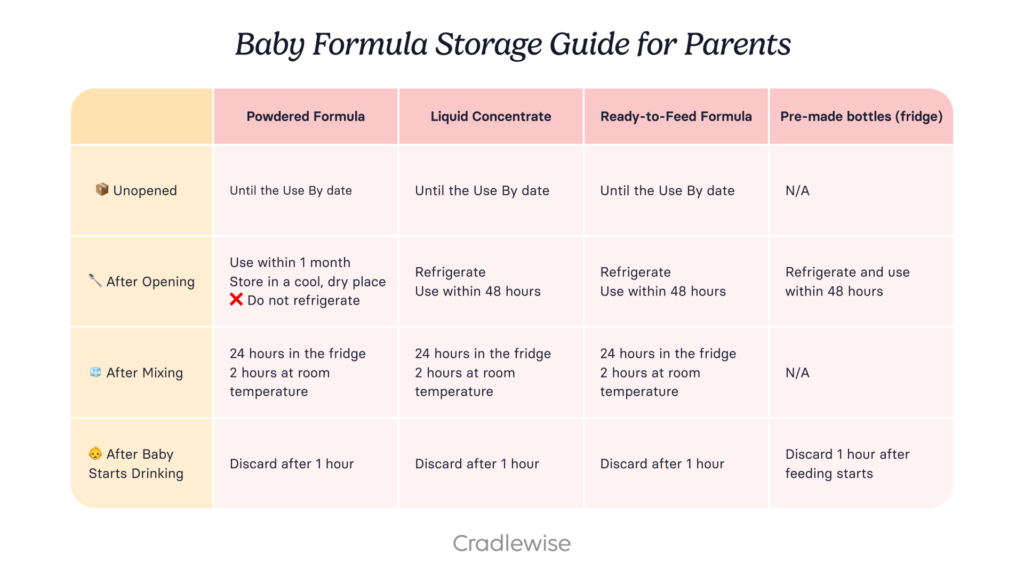
Save this before your next feed. It covers every formula type and every stage, from sealed tin to mid-feed bottle.
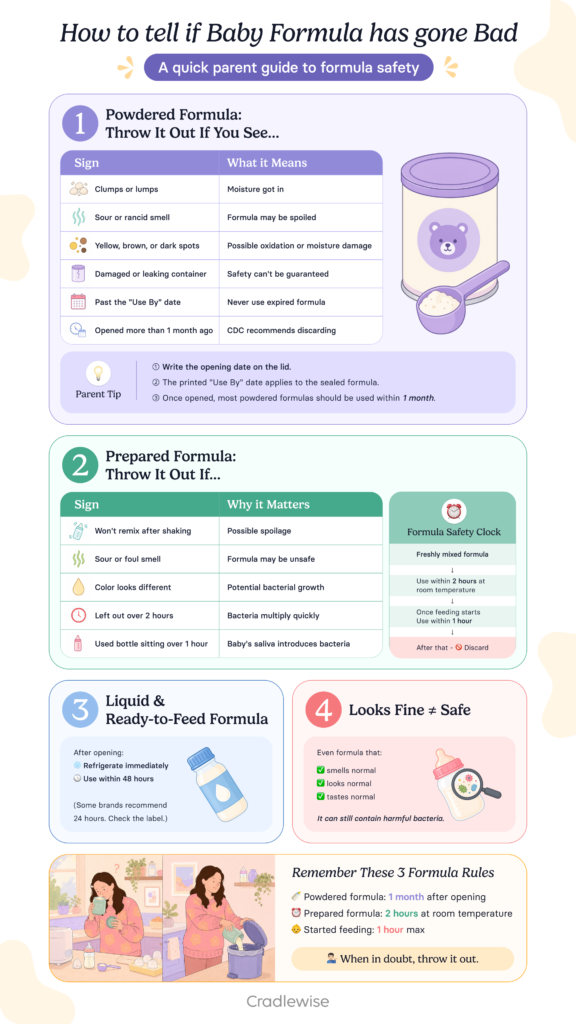
How to tell if formula has gone bad
“ Signs that formula may not be safe include an unusual smell, change in color or texture, clumping, separation, damaged packaging, or simply knowing it was left out too long. That said, spoiled or contaminated formula may not always look or smell obvious, so parents should not rely on appearance alone.”
Can baby formula go bad in heat
Yes. Heat can degrade nutrients in formula and accelerate bacterial growth.
Can formula go bad before the expiration date
Yes, and this surprises a lot of parents. The expiry date on a formula tin assumes it has been stored correctly in a sealed container. Once that changes, the expiry date changes too.
- Heat exposure: Heat can degrade the nutrients and accelerate the growth of any bacteria present, even in sealed containers.
- Humidity and moisture: Moisture can spoil powdered formula and lead to clumping. A tin stored in a humid kitchen, near a steaming kettle, or in a bathroom cabinet can absorb moisture every time you open the lid.
- Improper sealing: If you don’t firmly replace the lid after you open a tin of powdered formula, air and moisture enter.
What to do if your baby drinks spoiled formula
First, do not panic. Many parents have given their baby a bottle that was left out slightly too long, and in most cases the baby is absolutely fine.
Michelle Retsky says, “If a baby drinks questionable formula, parents should discard the bottle,” and Molly Wiges adds, “Offer normal feeds to maintain hydration.”
Monitor closely for the following symptoms over the next 24-48 hours:
- Vomiting
- Diarrhea
- Poor feeding
- Unusual sleepiness or lethargy
- Fussiness or crying
- Irritability
- Signs of dehydration, such as fewer wet diapers
When to call your pediatrician
Contact your child’s healthcare provider immediately if symptoms develop or if the infant is younger than two months old, was born premature, has a complex medical history or is immunocompromised.
Call for emergency care for severe symptoms such as trouble breathing, extreme lethargy, persistent vomiting, or difficulty waking the baby.
What if my baby seems fine?
This is one of the questions parents ask most.
Molly Wiges assures, “It is likely okay to monitor the infant at home if the child appears healthy. However, parents should not hesitate to call the pediatrician if the infant starts showing symptoms of illness. Extra caution is warranted for infants younger than 2 months old, premature infants and babies with weakened immune systems.”
Cradlewise Note: If there is any doubt, calling the paediatrician for guidance is always appropriate. A brief call is much better than second-guessing yourself all night.
Tips for storing formula safely
Proper storage is essential to keeping formula safe and fresh. Follow these guidelines by the CDC to ensure the best quality for your baby:
- Follow the expiration date: Never use a formula past the “Use By” date on the container, as its nutritional value and safety cannot be guaranteed.
- Write the opening date on every tin. So you never have to guess whether your opened formula is within the 1-month window.
- Store powdered baby formula in a cool, dry place: Keep it away from direct sunlight, heat, and moisture. Once opened, use powdered formula within one month.
- Do not refrigerate powdered formula. The condensation in the fridge can introduce moisture into the powder.
- Refrigerate prepared formula: Prepared bottles should be stored in the refrigerator and used within 24 hours. Do not leave formula out at room temperature for more than 2 hours.
- Store your formula in its original tin. Rather than transferring it to another container, as the original packaging is designed to seal properly.
- Seal containers tightly: Ensure lids and caps are securely closed to prevent contamination or moisture from getting in.
Tips for preparing formula safely
Follow these guidelines to ensure avoiding formula safety mistakes:
- Never use a microwave to warm the formula. Dr. Kenneth J Cruse warns against heating milk bottles in microwaves as the heat distribution is not even and can pose a burn risk for infants. He advises, “Place the prepared bottle in a pot of hot water for 5 minutes or hold it under running hot water. Frequent shaking of the bottle during the latter assures even distribution of the heat.”
- Prepare only what you need. Making up a single bottle at a time is the safest approach. If you prepare in advance for overnight feeds, refrigerate immediately and use within 24 hours.
- For overnight and travel storage: Refrigerate prepared bottles immediately, or keep them cold in an insulated cooler with ice packs. Michelle Retsky recommends another safe option, “Travel with clean bottles, safe water, and pre-measured powder separately, then mix the bottle when needed.”
- Use clean equipment every time. Wash your hands, sterilize bottles, and use a dedicated clean scoop.
- Do not top up an old bottle with a new formula. Always start with a clean bottle. Adding new formula to an already-used bottle introduces bacteria from the previous feed.
- Discard after every feed. Any formula remaining in the bottle after your baby finishes feeding should be discarded within 1 hour of when feeding began.
Read these instructions by the CDC on how to prepare and store powdered infant formula.
What to do if you run out of baby formula
If you find yourself without safe formula, avoid resorting to homemade recipes or cow’s milk for infants under one year old. Instead, consider these alternatives:
- Check for formula samples or emergency supplies from local hospitals, pediatric offices, or community programs.
- Ask a trusted friend or family member for an unopened formula.
- Contact your baby’s pediatrician for guidance on safe feeding options until you can get a new supply.
Conclusion
Formula safety is not complicated. The two things worth committing to memory: 2 hours at room temperature, and 1 hour once feeding has started. Everything else flows from those two rules.
When you are not sure whether a bottle is still okay, the safest answer is always to make a fresh one. And as Michelle Retsky puts it simply: formula safety is about time, temperature, cleanliness, and whether the baby has already started drinking from the bottle. If you are uncertain about any of those four things, start again.
FAQs
Q: Can powdered formula go bad?
A: Yes. Powdered formula expires on the ‘Use By’ date printed on the tin, and most brands must also be used within 1 month of opening, even if the expiry date is still in the future. Exposure to heat, humidity, or air can also cause powdered formula to spoil before the expiry date.
Q: How long is formula good after mixing?
A: Prepared formula must be used within 2 hours of preparation if left at room temperature, or 1 hour once your baby has started feeding from the bottle. In a hot car or warm kitchen, the safe window is shorter. If refrigerated immediately after preparation, it can be kept for up to 24 hours.
Q: What happens if a baby drinks bad formula?
A: Most mild exposures resolve without treatment, but if your baby is under 2 months old, was premature, or is medically fragile, call your paediatrician at the first sign of vomiting, diarrhoea, fever, unusual fussiness, poor feeding, unusual sleepiness, or fewer wet nappies. Anything more severe, seek emergency care immediately.
Q: Can formula expire before the printed date?
A: Yes. The expiry date assumes the formula has been stored correctly in a sealed container. Heat exposure in a car or garage, humidity, and improper sealing can all cause formula to degrade before the printed date.
Q: How long can formula sit out after being made?
A: Prepared formula left at room temperature must be used within 2 hours of preparation. If your baby has started feeding from the bottle, discard any remaining formula within 1 hour.
Q: Does baby formula expire if unopened?
A: Yes. All baby formulas come with “Use By” date printed on their container. They are deemed unfit for consumption once the date has passed, even if unopened.
More posts you might like:
- Pregnancy 101: Can you get pregnant while breastfeeding?
- What I wish I had known about breastfeeding
- Baby feeding chart: A guide to year one
Sources:
- Can baby formula go bad. CDC. 2026. Infant Formula Preparation and Storage.
- How to prepare and store powdered infant formula. CDC. 2026. Infant Formula Preparation and Storage.
You may also like