Parenting
0 min read
Baby vision development week by week: What your newborn sees as the world comes into focus


Cradlewise Staff
You’ve bought the brightest-colored toys for your newborn, filled their nursery with colorful books, and picked out a play mat covered in cheerful patterns. But did you know your baby’s view of all those colors and details is still pretty blurry in the first few weeks?
Newborns can see from birth, but their distance vision is limited. They can detect light, shapes, faces, and movement, and they see best when an object is close to their face. The American Academy of Pediatrics (AAP) puts that clearest range at about 8–12 inches, roughly the distance between your face and your baby’s eyes during a feeding.
The American Optometric Association (AOA) explains that your baby’s ability to focus, follow movement, and use both eyes together develops little by little during the first year. So what does your baby actually see at 1 week, 1 month, or 6 months? And when does that blurry newborn view start to become clearer? Let’s take a closer look at how your baby’s vision changes from those first days through the first year.
How does a newborn see?
A newborn’s vision is blurry, especially at a distance. According to the AAP, during the early weeks, babies are more likely to notice things that are close to them, including faces, light, movement, and high-contrast patterns. That short viewing distance is why your face can be especially interesting during feeding or cuddling. At about 8–12 inches away, you’re within the range where your baby sees best.
Color vision also develops during infancy. Research shows that color perception becomes substantially more developed during the first six months. You may notice your baby’s eyes wandering or occasionally crossing during the first couple of months. Babies are still learning to coordinate both eyes, and occasional wandering can be normal early on.
Baby vision development week by week
Visual development doesn’t happen according to an exact weekly schedule. The medical guidance is generally organized around broader age ranges, so think of these first-week milestones as a progression rather than a checklist.
Week 1: Your baby’s first view of the world
Your baby can see from birth, but their visual system is still immature. They can notice light, shapes, movement, and nearby faces, while fine detail and distance vision remain limited.
The AOA notes that newborns can see objects best when they are held about 8–12 inches from their face. During the first few months, babies are especially interested in faces and high-contrast objects as their ability to focus and distinguish visual details develops.
Weeks 2–4: Faces start holding their attention
During the first month, your baby may spend longer looking at your face or another nearby object. By around 1 month, babies can focus on objects about 8–12 inches away, according to the AAP.
High-contrast patterns can be particularly interesting at this age because your baby is still developing the ability to resolve fine visual detail. Your baby’s eyes may still wander or cross occasionally. Their ability to coordinate both eyes is developing during these early weeks.
Weeks 5–8: Tracking movement gets easier
Around 6 weeks, your baby’s useful viewing distance is increasing. Babies can now see about 12 inches away by this age. NHS-affiliated developmental guidance says babies may begin to follow a moving object or face by turning their heads at around 6–8 weeks.
Tip: During awake time, you can slowly move your face or a simple toy from one side of your baby’s view to the other and give them time to follow it.
2 to 3 months: Your baby starts following the action
Around 3 months, visual tracking becomes more noticeable. The AAP says babies should be able to focus on faces and close objects and follow a moving object with their eyes by this age. The AOA also lists following moving objects and reaching for things as visual skills developing around this period.
Research shows that visual acuity improves steadily during the first year rather than reaching its mature level at one specific age. If your baby isn’t making steady eye contact or doesn’t seem able to follow moving objects by around 3 months, mention it to their pediatrician.

Did you know?
Ever wonder why so many newborn toys and baby books feature bold black-and-white patterns? Young babies tend to prefer high-contrast patterns because they’re easier for their developing vision to detect. That’s why high-contrast books, toys, and mobiles are often recommended for young infants.
4 months: Your baby can see farther
Around 4 months, your baby’s visual range has expanded, and their vision is becoming clearer. Babies at this age can see farther away and are developing stronger eye-hand coordination. Your baby may look at a toy and try to reach for it. Vision is becoming increasingly connected to movement as they learn where objects are relative to their hands and bodies.
Color perception is also becoming more sophisticated. Research shows substantial development in color perception during the first six months. During awake play, offer your baby books, faces, colorful toys, and simple patterns that they can safely look at and eventually reach for.
5 to 6 months: Depth perception starts developing
Your baby’s eyes are becoming better at working together. The AOA notes that depth perception begins developing around the fifth month as the eyes become capable of working together to create a three-dimensional view.
By around 6 months, your baby’s eyes should be working together consistently, and their color vision should be similar to an adult’s. If one eye regularly turns inward or outward after the early months, bring it up with your baby’s pediatrician or an eye-care professional. Constant eye turning can indicate a problem with eye alignment.
7 to 12 months: Vision helps your baby explore
As your baby becomes more mobile, their developing vision helps them work out where objects are in relation to their body. Babies between 7 and 12 months become better at judging distances and grabbing objects as they learn how vision relates to body movement.
The AOA notes that by around 9 months, babies are developing more precise visual-motor skills, including judging distances. By 12 months, most babies can judge distances fairly well.
You may notice your baby looking at a toy before reaching for it, watching something fall, or examining an object in their hands. Their improving vision is becoming an important part of how they move through and explore their surroundings.
What can parents do to support baby vision development?
You don’t need special vision exercises for your baby. Everyday interaction gives them plenty of opportunities to use their developing visual system.
For young babies, the AOA recommends keeping toys within about 8–12 inches of their face, talking to them while moving around the room, and alternating sides during feeding. As your baby gets older, show them faces, colorful books and toys, pointing out new things, and playing peek-a-boo. Floor play also gives babies opportunities to look, reach, grasp, and move toward objects. Keep these activities part of supervised awake time, and keep toys and other objects out of your baby’s sleep space.
When should you be concerned about your baby’s vision?
Your baby’s eyes are checked during routine healthcare visits, but it’s also worth mentioning anything unusual that you notice between appointments. The AOA recommends seeking medical attention for signs such as constant eye turning, unusual sensitivity to light, excessive tearing, red or encrusted eyelids, or a white-looking pupil.
The AAP recommends discussing your baby’s vision with their pediatrician if they aren’t able to focus on faces or close objects or aren’t following moving objects with their eyes by around 3 months.
Premature babies may need additional vision screening because they have a higher risk of certain eye problems. Their neonatal or pediatric care team can recommend follow-up based on their gestational age and medical history.
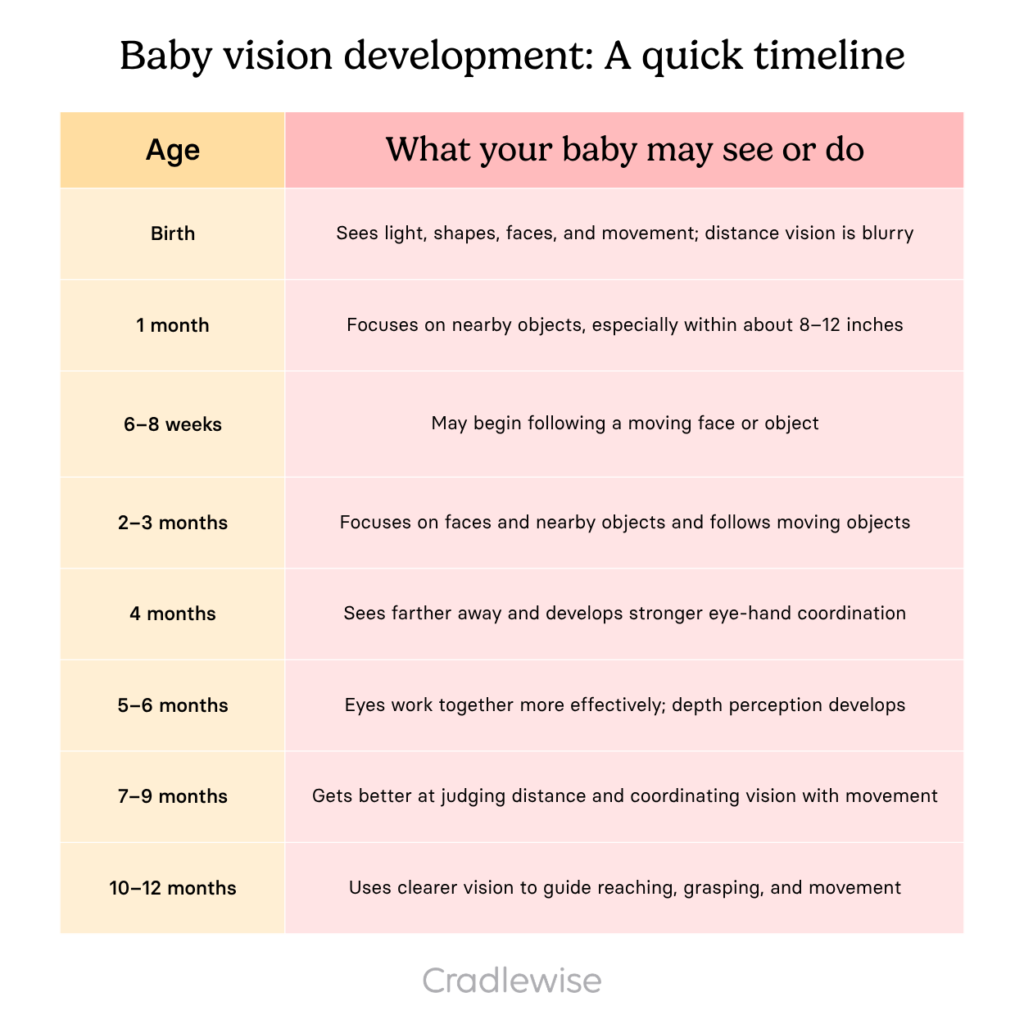
These are broad developmental milestones, not a weekly test for your baby. Visual acuity develops progressively throughout the first year, and babies can reach individual milestones at somewhat different ages.
When do babies start seeing clearly?
There isn’t one week when your baby’s blurry newborn vision suddenly becomes clear. Visual acuity improves throughout the first year as the eyes and visual system mature.
In the first weeks, your baby sees best when your face is close. By around 3 months, they can follow moving objects. Around 5–6 months, their eyes are working together more effectively, and depth perception is developing. By the end of the first year, they can use visual information much more accurately as they reach, grasp, crawl, and explore.
Those colorful toys you bought before your baby was born may look very different to them now than they did during those first sleepy weeks. As their visual system develops, their view of the world gradually becomes richer in detail, color, depth, and movement.
Conclusion
Your baby’s vision starts out blurry and close-up, then gradually becomes clearer as their eyes and brain learn to work together. From staring at your face during those early feeds to tracking toys, reaching for objects, and exploring their surroundings, each stage gives you a glimpse of how their visual world is changing.
If you notice persistent eye turning, unusual eye movements, or your baby isn’t reaching expected visual milestones, bring it up with their pediatrician. Early attention to vision concerns can help identify problems that may need further evaluation.
FAQs
Q: When can babies see?
A: Babies can see from birth, but newborn vision is blurry, especially at a distance. Newborns see best when objects are about 8–12 inches from their face.
Q: When can babies see faces?
A: Newborns can see faces from birth, particularly when a face is close to them. During the first few months, babies become better at focusing on faces and following them with their eyes.
Q: When can babies start to see clearly?
A: Vision becomes clearer gradually during the first year. By around 3 months, babies can focus on faces and nearby objects and follow moving objects with their eyes. Their visual acuity continues improving throughout infancy.
Q: When can babies see clearly enough to recognize objects?
A: As vision develops during the first year, babies become better at focusing on objects, distinguishing visual details, judging distance, and coordinating what they see with their movements.
Q: When do babies start seeing colors?
A: Color vision develops during infancy rather than appearing fully developed at birth. Research shows substantial development in color perception during the first six months, with babies becoming increasingly able to distinguish and categorize colors.
Sources:
- Infant vision development and early visual milestones. American Academy of Pediatrics (HealthyChildren.org).2024. “Infant Vision Development: What Can Babies See?”
- Infant eye and vision development. American Optometric Association. n.d. “Infant Vision.”
- How color perception develops during infancy. Child Development Perspectives. 2022. “Infant color perception: Insight into perceptual development.”
- Development of visual abilities in early infancy. Acta Ophthalmologica. 1983. “The Development of Binocular Function in Infancy.”
- Early vision milestones and activities for babies. Healthier Together / NHS. n.d. “Vision.”
- 1-month baby developmental milestones. American Academy of Pediatrics (HealthyChildren.org). 2026. “Developmental Milestones At 1 Month Old.
You may also like