Science of baby sleep
0 min read
3 month old baby sleep schedule: Your ultimate guide to naps, wake windows and sleep tips


Dr. Anoop Rao

Cradlewise Staff

Night sleep
10-12 hours

Daytime naps
3-5 hours

Total sleep
14-17 hours
The first few months with your baby can feel like a blur of feedings, diaper changes, and short stretches of sleep. Newborn babies typically sleep 14 to 17 hours in each 24-hour day, but the sleep is accumulated in small chunks.
By the time your baby reaches the 3-month mark, things may start to feel a little more predictable. While every baby is different, many parents start noticing a gentle rhythm forming. Daytime naps become slightly more structured, bedtime may get easier, and your baby may begin developing the early foundations of a sleep routine.
If you are wondering what a 3 month old baby sleep schedule looks like and how to support your baby’s rest, you are in the right place.
The importance of naps for babies
Although nighttime sleep receives a lot of attention, daytime sleep is equally important during the early months, especially since newborns consider little difference between day and nighttime sleep. Naps play a huge role in your baby’s learning, physical rest, and better moods.
Here is why naps matter:
- Behavior: Well-rested babies are generally calmer and less fussy. Regular naps can help prevent overtiredness, which often leads to crankiness and difficulty settling.
- Learning: Babies absorb a lot of information every day. Sleep gives their brains time to process new experiences and build early learning skills.
- Memory: During sleep, your baby’s brain organizes and stores what they’ve seen, heard, and practiced while awake.
- Emotional regulation: Rest helps babies manage their feelings more easily, and cope better with stimulation and changes in their environment.
- Physical growth: Important growth processes happen during sleep, including the release of growth hormones that support healthy development.
- Nighttime sleep: Good daytime naps often lead to better nighttime sleep, since babies who nap well are less likely to become overtired by bedtime.
At 3 months old, naps may still be a little unpredictable. Over time, they’ll gradually become more consistent.

Did you know?
Around this age, the early circadian rhythm starts setting in, and your baby’s body is beginning to tell day from night, producing more melatonin in the evening and less overnight waking hormone during the day.
What it means in practice: Keep your baby’s daytime naps in a bright room with normal household noise, and nighttime feeds and wake-ups in low-light and quiet.
3 month old baby developmental milestones
Around three months, most, if not all of your baby’s infant reflexes have probably disappeared. Instead, you’ll see more purposeful movements, such as opening and closing hands and kicking legs.
You may start noticing several developmental changes:
- Less colic and easier soothing: Most babies who previously had colic begin to outgrow it by the age of 3 to 4 months, which often makes evenings a little calmer and soothing easier for parents.
- Longer stretches of sleep at night: Some babies may begin sleeping longer stretches, sometimes upto 6 hours at night, although many still wake for one or two feeds, especially if they are breastfed.
- Stronger neck and upper body muscles: Tummy time starts paying off around this age. Many babies can lift their head and chest briefly when lying on their tummy as their neck and shoulder muscles strengthen.
- Early rolling attempts: By the end of the third month, a few babies may roll from tummy to back, though most will reach this milestone closer to four months.
- Improving hand-eye coordination: Around this age, babies start discovering their hands and start opening and closing them. You may see your baby bring their hands to their mouth, swiping at toys, and trying to grasp objects and briefly hold them, although they may still drop them frequently.
- More social smiles: Your baby may smile in response to your voice, face, or playful interactions, showing they are becoming more socially engaged.
- Babbling and making new sounds: Around this age, babies often start babbling, cooing, and experimenting with different sounds, which is an early step toward communication.
- Early self-soothing behaviors: Sucking on hands or fingers becomes more common and can help babies start learning early self-soothing skills.
- Circadian rhythm starts forming: Around 10 to 12 weeks, the first signs of a natural circadian (sleep-wake) rhythm begin to appear. This biological shift often helps babies settle into longer nighttime sleep periods.
- Sharper vision and growing curiosity: By three months, babies can see objects from several feet away and often become fascinated by faces, high-contrast shapes, and circular images such as bulls-eye and spirals.
Remember that every baby develops at their own pace. Some babies will show these changes earlier, while others may take a little longer.
Let your doctor know if your 3-month-old isn’t yet grasping toys, tracking moving objects, or imitating sounds and facial expressions. The AAP has published a developmental health watch with milestones for this age, worth reviewing with your pediatrician at your next well-child visit.

Crib Notes
Babies don’t have regular sleep cycles until they’re around six months old. Since they wake frequently (sometimes every hour), Cradlewise can help by soothing them back to sleep before they start crying, resulting in more rest for them and for you, which is a serious win-win.
How much should a 12 week old baby sleep?
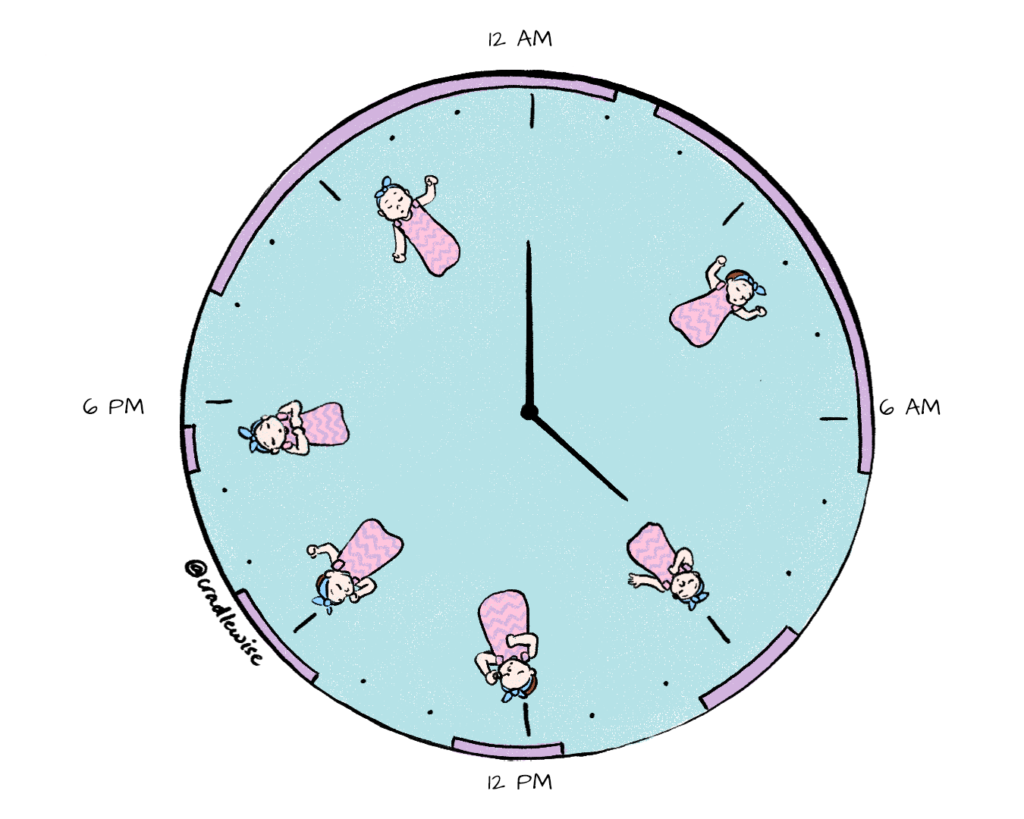
At 3 months old, most babies need about 14 to 17 hours of sleep within a 24 hour period.
This usually includes:
- Nighttime sleep: 10 to 12 hours total, with one or two feedings.
- Daytime sleep: About 3 to 5 hours spread across several shorter naps or just 2 naps (one in the morning and one in the afternoon).
Some babies may start sleeping longer stretches overnight, while others still wake every few hours to feed. Both patterns can be completely normal at this age. Instead of focusing on exact numbers, it often helps to watch your baby’s cues and support sleep when they seem tired.
What are 3 month old wake windows?
Wake windows are the amount of time your baby can comfortably stay awake between sleep periods.
For a 3 month old baby, wake windows are usually around: 60 to 90 minutes
Some babies may stretch closer to two hours, especially later in the day, but many still need sleep sooner. It’s prudent to keep it under two hours. If your baby stays awake too long, they may become overtired, which can make it harder for them to fall asleep and stay asleep.
Cradlewise tip: You should continue to soothe your child before they show signs of becoming overtired, and put them down in their Cradlewise smart crib when they’re drowsy but awake, so they can practice their own self-soothing skills.
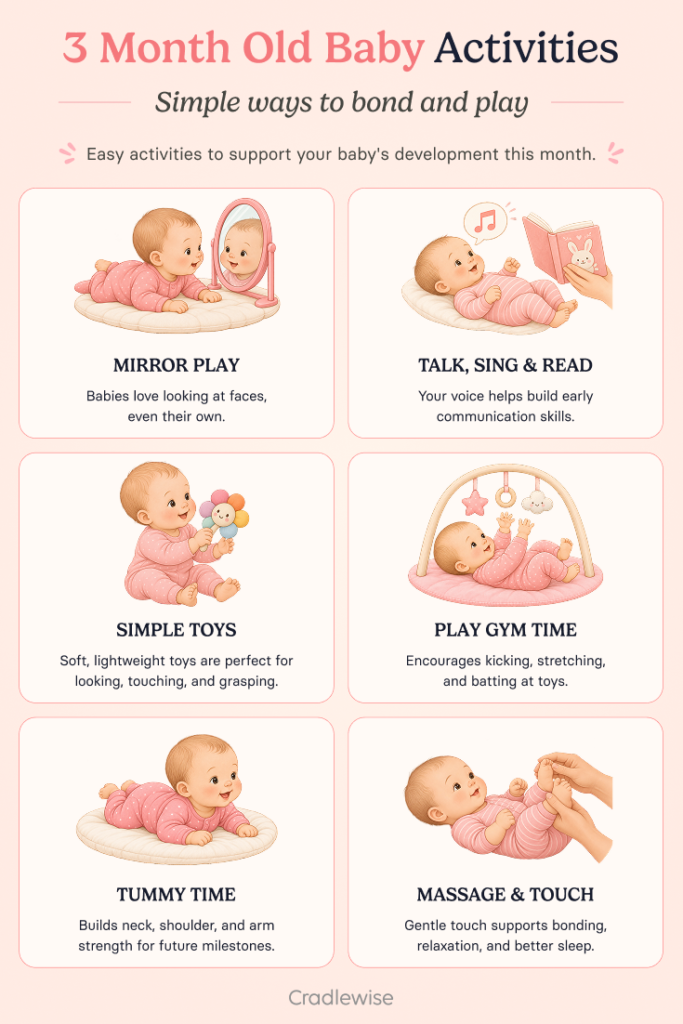
Activities for a 3 month old baby
At 3 months, playtime is about fun and also about how your baby learns about the world. Setting aside a little time each day for simple activities can help support their development while strengthening your bond.
Nap schedule for a 3 month old
Most 3 month old babies take 3 to 5 naps per day, depending on how long each nap lasts. Because sleep cycles are still developing, naps can vary quite a bit in length.
You might see:
- Short naps lasting 30 to 45 minutes
- Longer naps lasting 1 to 2 hours
- A mix of both throughout the day
At this stage, naps may not follow an exact schedule yet. Instead, many parents find it helpful to follow wake windows and their baby’s tired cues.
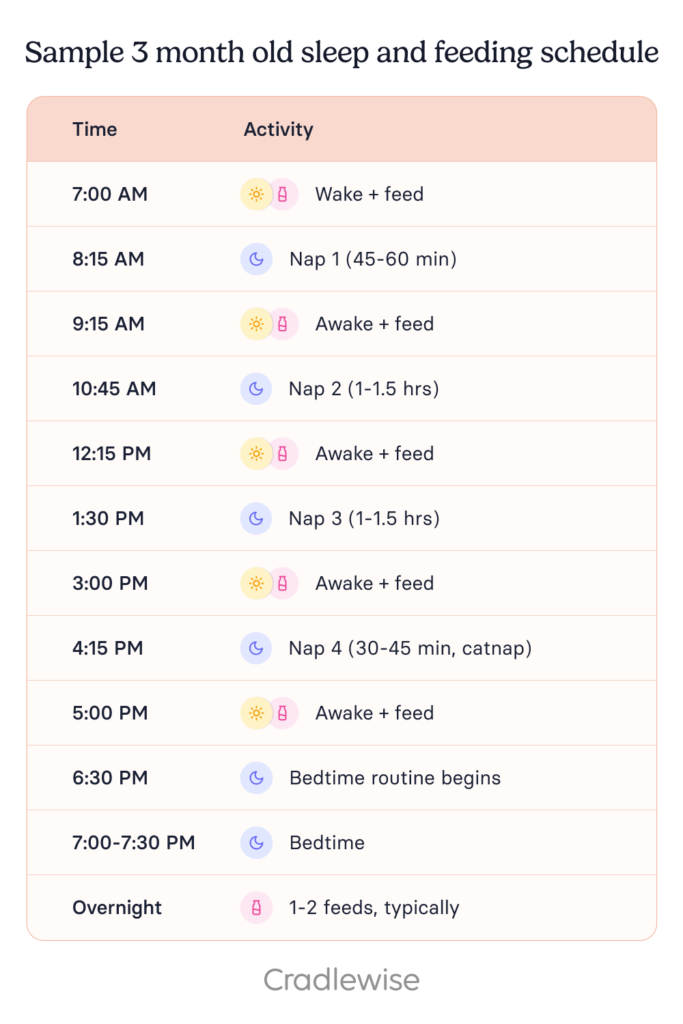
Sample 3 month old sleep and feeding schedule
This is just an example, and your baby may take fewer naps that are longer in duration. Ideally, they won’t be awake for longer than two hours at any given point during the day.
Sample schedule for a breastfed 3 month old
Breastfed babies often feed more frequently than formula-fed babies, since breast milk digests faster. The nap and wake-window pattern stays the same, but feeds typically shift closer to every 2.5 to 3 hours, with one extra feed worked in during the day.
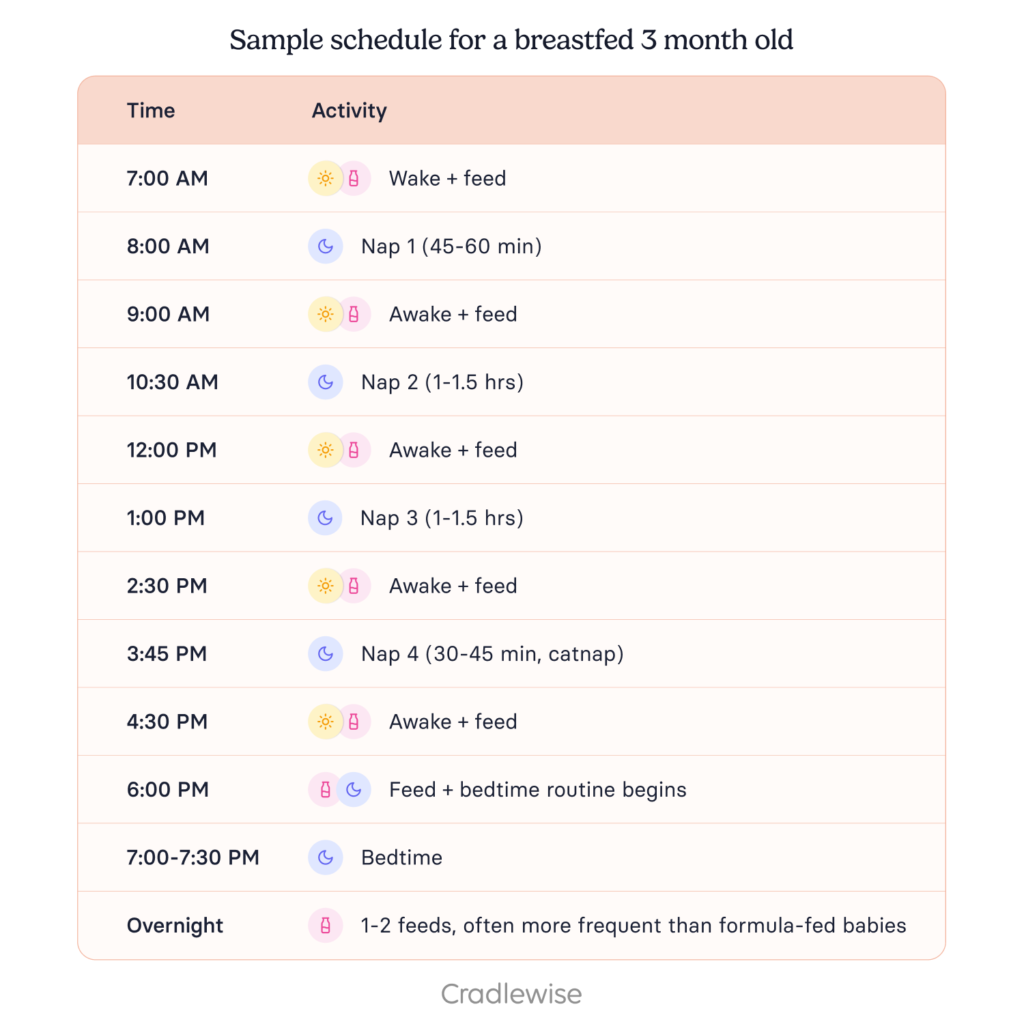
As with the general schedule above, treat this as a flexible guide, not a rulebook. Follow your baby’s hunger and sleep cues over the clock.
Signs your 3 month old is tired
Recognizing sleepy cues can make a big difference in helping your baby fall asleep more easily. If your baby becomes very fussy or difficult to settle, they may already be overtired.
Common signs include:
- Rubbing eyes
- Looking away or losing interest in toys
- Slower movements
- Fussiness
- Yawning
- Staring into space
Common sleep challenges at 3 months
Even as sleep improves, parents may still run into a few common challenges owing to developmental changes your little 3 month old is experiencing.
- Short naps: Many babies still take short naps because their sleep cycles are still maturing.
- Inconsistent schedules: It is normal for naps and bedtimes to shift from day to day.
- Growth spurts: Around three months, babies may temporarily wake more often to feed.
- Sleep regression signs: Some babies begin showing signs of 3 month sleep regression, such as lighter sleep and waking more frequently overnight.
- Teething: Most babies begin teething between 6 to 12 months, however teething signs can show up days or even weeks, possibly as early as 3 months, before your baby’s first tooth actually breaks through. Mild gum discomfort may make it harder for some babies to fall asleep or stay asleep. However, most sleep disruptions at this age tend to be temporary.
These phases are temporary and usually resolve as your baby’s sleep continues to mature.
Crib Notes
If your baby is teething, you might try using the app to adjust Cradlewise’s bounce duration or level to help soothe them back to sleep.
Feeding routine for a 3 month old baby
Feeding patterns often start to feel a little more predictable by the third month. Most babies continue gaining about 1.5 to 2 pounds and around 1 to 1.5 inches per month during early infancy. Your pediatrician will track your baby’s growth along their percentile curve to make sure everything is progressing well.
How often a 3 month old eats
Most babies feed every 3 to 4 hours, whether they are breastfed or formula-fed. Many babies take about 4 to 5 ounces per feeding, though appetite can vary from baby to baby. Breastfed babies might need more frequent feedings.
Continue breastmilk or formula only
At 3 months, your baby should still be getting only breastmilk or formula. The American Academy of Pediatrics recommends waiting until around 6 months before introducing solid foods, unless advised otherwise by your pediatrician.
Watch for growth spurts
Around the end of the third month, some babies go through a growth spurt. During this time, your baby may seem hungrier, fussier, or may wake more often at night to feed. This phase usually lasts just a few days before things settle again.
Wet diapers are a good sign
A well-fed baby typically has at least six wet diapers in 24 hours, and the urine should be pale and mild-smelling. If you notice fewer wet diapers or darker urine, it is a good idea to check with your pediatrician.
Burping may get easier
Some parents still burp their baby after every few ounces or when switching breasts. As babies grow and gain better head and trunk control, they may burp more easily on their own, though you can still help if they seem uncomfortable.
The biggest takeaway: follow your baby’s hunger cues. Some babies eat a little more, some a little less, and both are completely normal.
How to help support your baby’s sleep during the third month
During the third month, you should continue to follow your baby’s cues and not stress out too much about getting them on a specific schedule. But you will start to notice some predictable patterns, which can be comforting, especially for first-time parents.
Stop the swaddle
You might love wrapping your little one up like a burrito in a nifty blanket, but the AAP recommends discontinuing swaddling when your baby shows signs of trying to roll, which could be as early as two months of age.
The concern is that if your baby does manage to flip, they could become trapped in their blanket. You can wean from the swaddle slowly, leaving one or both arms free, or removing it completely, and try a sleep sack instead. Some babies show a bit of a sleep regression for a few nights once their swaddle goes, but Cradlewise will still be around for safe, familiar soothing.
Embrace “sleep begets sleep”
It’s a cycle: For your baby to nap well during the day, they should be well-rested overnight, and for them to fall asleep easily at bedtime, they should have napped well during the day. Being awake too long can cause babies to become overstimulated, which doesn’t mean overly excited, it means their body starts producing stimulating hormones to fight fatigue, which makes falling asleep harder, not easier.
Strengthen the bedtime routine
Three months is a great age to solidify your child’s bedtime routine. At minimum, that means a fresh outfit and diaper. You might also add a bath, a lullaby, or a short book. Many parents feed the baby earlier in the routine, so they don’t associate eating with sleep, then put them down drowsy but awake so they can practice falling asleep without help. Ideally, the routine happens in the same order each evening, takes less than 30 minutes, and can be easily replicated by other caregivers.
Lean on sleep aids
Whether your baby is teething or experiencing a three-month sleep regression, you can adjust the crib’s “Sensitivity” setting on Cradlewise if your little one seems to be having a tough time. You can also use Cradlewise’s music or white, pink, or brown noise options to help drown out distracting sounds and create a soothing atmosphere.
Favor early bedtimes
Aim for a bedtime around 7 or 8 p.m., depending on when your baby last napped. Babies who go to bed after 9 p.m. may become more overstimulated and have a harder time falling asleep.
Practice good sleep hygiene
Continue keeping your baby away from screens and blue light in the two hours before bed, encourage naps in their Cradlewise rather than the stroller, car, or carrier, and dim the lights at home when it’s time for sleep.
Conclusion
At three months old, your baby is still learning how sleep works. While the newborn sleep routine may have felt unpredictable, many families start seeing the early signs of a routine around this time.
Your baby’s sleep schedule, nap patterns, and wake windows will continue to evolve over the next few months. The most important thing is to stay flexible and follow your baby’s cues as they grow.
FAQs
Q: When do babies sleep 7 pm to 7 am?
A: Most babies begin sleeping longer overnight stretches between 4 and 6 months once they weigh around 15-16 pounds, though a consistent 7 pm to 7 am schedule varies by baby. At 3 months, many babies are still waking for one or two night feeds.
Q: How much should my 3 month old sleep?
A: A 3 month old typically needs 14-17 hours of total sleep in 24 hours, including nighttime sleep and several daytime naps.
Q: How many naps should a 3 month old take?
A: Most 3 month olds take 3 to 5 naps per day, depending on their wake windows and sleep needs.
Q: Is there a safe way to co-sleep with a 3-month-old baby?
A: The safest recommendation from pediatric experts is room-sharing without bed-sharing for at least the first 6 months, but ideally upto a year, meaning your baby sleeps in their own crib or bassinet in the same room.
Q: What is the sleep regression for a 3-month-old?
A: Around this age, babies may experience temporary sleep disruptions as their sleep patterns mature and their circadian rhythm begins to develop.
Q: How long should a 3-month-old sleep at night without eating?
A: Some 3 month olds may sleep 5-6 hour stretches at night, but many still need one or two nighttime feedings, especially breastfed babies.
Q: What is a good sleep schedule for a 3 month old breastfed baby?
A: A breastfed 3-month-old typically follows the same nap pattern as any baby this age (3-5 naps, 60-90 minute wake windows), but with feeds spaced closer to every 2.5-3 hours rather than 3-4, since breast milk digests faster than formula.
Posts you might like:
- 4-month-old baby sleep guide
- 5-month-old baby sleep guide
- 6-month-old baby sleep guide
- 7-month-old baby sleep guide
- 8-month-old baby sleep guide
- 9-month-old baby sleep guide
- 10-month-old baby sleep guide
- 11-month-old baby sleep guide
- 12-month-old baby sleep guide
More posts you may like:
- Fever after vaccines in babies: What’s normal and when to worry.
- Baby sleep while traveling: Your summer vacation guide.
- Is your baby a Velcro baby? What it means and how to make things easier.
Sources:
- Importance of naps. Sleep Foundation. 2025. How Much Sleep Do Babies and Kids Need?
- Circadian rhythms in 10- to 12-week olds. Nature of Science and Sleep. 2017. Infant sleep and its relation with cognition and growth: a narrative review.
- 14 to 17 hours of sleep. CDC. 2024. About Sleep.
- Four types of developmental milestones. HealthyChildren. 2009. Developmental milestones: 3 months.
- Well-child visit. HealthyChildren. 2026. AAP Schedule of Well-Child Care Visits.
- Teething and 3-month-olds. HealthyChildren. 2018. Baby teething pain.
- Baby feeding frequency. HealthyChildren. 2022. How often and how much should your baby eat?
- When to stop swaddling. HealthyChildren. 2020. Swaddling: Is it safe?
- Strengthen the bedtime routine. NHS. 2025. Helping your baby to sleep.
You may also like


