Parenting
0 min read
The ultimate guide to your baby’s vaccine and immunization schedule


Cradlewise Staff
Tracking baby vaccines while running on little to no sleep and holding a squirmy, wailing newborn is as exhausting and as real as it can be. And now your baby’s two-month appointment is coming up, and someone has mentioned the word “shots.”
Why so many at once? Are combination vaccines safe? What if my baby has a cold that day? Can I space them out? It’s normal to stress and also normal to have questions.
DTaP? Hib? PCV? Flu? This guide with the help of the CDC-recommended baby vaccine schedule will cut through the alphabet soup and give you a clear picture of what your baby needs, when, and why.

Did you know?
Childhood vaccines prevent an estimated 4 million deaths worldwide each year.
Why babies need vaccines so early?
Vaccines teach your baby’s immune system to recognise and fight specific diseases before they even encounter them in the real world. These vaccines contain weakened or inactivated parts of a pathogen (or just a protein from it) that trigger the immune system to build a memory without causing the illness itself.
Vaccines are given at the earliest age, so that your baby’s immune system can prepare for a strong response to the diseases. For example, whooping cough (pertussis), is most dangerous in the first few months of life, which is exactly why DTaP starts at two months.
Vaccines also protect people beyond your baby. Vaccines also help prevent outbreaks in your community, which experts call herd immunity, especially for people with weakened immune systems or newborns who aren’t old enough to get certain vaccines yet.
Did you know?
In the US, vaccines have eliminated or nearly eliminated diseases like polio, measles, and diphtheria that once hospitalized or killed tens of thousands of children annually.
Baby vaccine schedule: What to expect and when
Here’s a simple breakdown of what your baby will need, starting from the day they’re born, plus a quick explanation of why each vaccine matters.
You can download and print the CDC’s parent-friendly baby vaccine schedule. It’s a one-page version worth keeping on your fridge, diaper bag, or nursery wall.
At Birth
Hepatitis B (HepB) – Dose 1: Prevents a serious liver disease that can be passed from mother to baby at birth.
RSV immunization – Dose 2: (if baby is born during RSV season)
RSV or Respiratory syncytial virus is a common virus that can cause severe lung infections in infants. In the US, RSV season typically runs from fall through spring (roughly October to March), when cases are at their highest. If your baby is born during this period, they may be offered a single dose of monoclonal antibody shot at birth. This helps protect your baby from severe lung infections and hospitalization.
Did you know?
RSV is the leading cause of infant hospitalization in the U.S
1–2 Months
- Hepatitis B (HepB) – Dose 2
2 Months
Your baby will receive multiple vaccines, often combined into fewer shots.
- DTaP – Dose 1: Protects against diphtheria, tetanus, and whooping cough (pertussis). Whooping cough is particularly dangerous for infants.
- Hib – Dose 1: Protects against Haemophilus influenzae type b, which can cause meningitis and other life-threatening infections in young children.
- IPV (Polio) – Dose 1: Polio was eliminated in the U.S. through vaccination and continued immunisation keeps it that way.
- PCV (Pneumococcal conjugate) – Dose 1: Protects against bacteria that cause pneumonia, meningitis, and ear infections.
- RV (Rotavirus) – Dose 1: Given orally (as a liquid, not a shot). Protects against a leading cause of severe diarrhoea and dehydration in infants.
4 Months
The same five vaccines continue.
- DTaP – Dose 2
- IPV – Dose 2
- Hib – Dose 2
- PCV – Dose 2
- RV – Dose 2
6 Months
- DTaP – Dose 3
- PCV – Dose 3
- RV – Dose 3 (if needed, depending on brand)
- HepB – Dose 3 (between 6-18 months)
- IPV – Dose 3 (between 6-18 months)
- Influenza (flu shot) – Dose 1
Good to know: Babies need 2 doses of flu vaccine at least 4 weeks apart the first year they receive it.
7–11 Months
No new vaccines are typically scheduled in this window. If your baby has missed any earlier vaccines, this is a good time to catch up. Annual flu vaccination continues.
12–15 Months
- MMR (Measles, Mumps, Rubella) – Dose 1
- Varicella (Chickenpox) – Dose 1
- Hib – Final dose
- PCV – Final dose
- HepA – Dose 1: Hepatitis A can be serious; children often carry it without symptoms and pass it to unvaccinated adults.
- Flu shot – Annually before the flu season
15–18 Months
- DTaP – Dose 4
18–23 Months
- HepA – 2nd dose (at least 6 months after dose 1)
- Flu shot – annually
- Any catch-up vaccines your pediatrician recommends if earlier doses were missed.
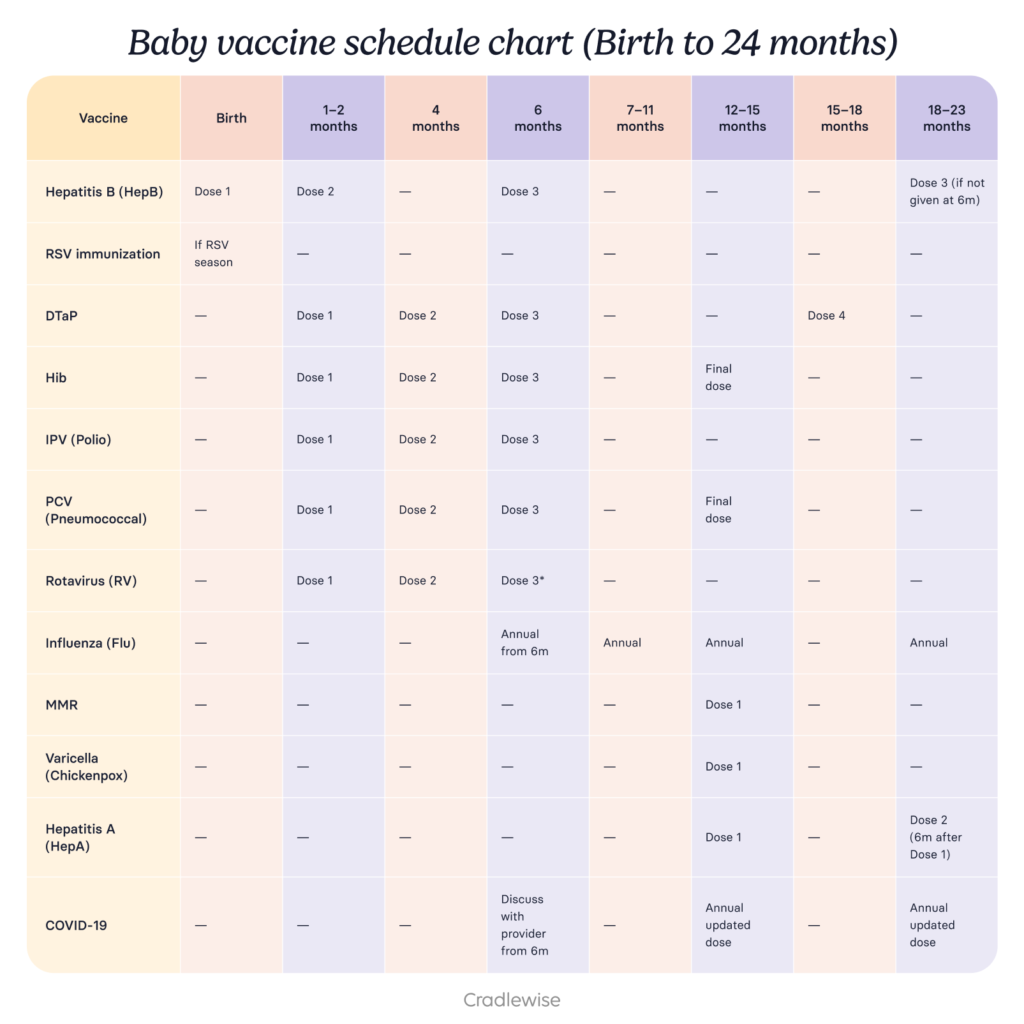
Source: CDC Child and Adolescent Immunization Schedule
What happens if vaccination is delayed for a baby?
Some parents ask about spacing out vaccines over more visits as they think getting several vaccines at once overwhelms a baby’s immune system. Let’s understand this.
Babies encounter hundreds of antigens every day just by breathing and touching surfaces; hence the small number in any vaccine visit is well within what your baby’s healthy immune system handles on a routine basis.
The AAP does not recommend an alternative or delayed schedule. The recommended schedule is designed to protect babies at the earliest age their immune system can respond effectively. Spacing vaccines out means leaving babies unprotected during the window when the diseases are most dangerous.
However, if you have concerns, talk to your pediatrician directly. They can walk you through the specific risks and benefits for your baby’s situation.
How to comfort your baby during and after vaccinations
The shot day can be hard for your baby, and you as well. Here’s what actually helps:
- Do not pre-medication your baby with paracetamol or ibuprofen to prevent fever.
- Feed your baby shortly before the visit so they’re not hungry.
- Bring the vaccination card or digital record and keep it updated.
- Hold your baby upright on your lap.
- Breastfeed during the injection if you can.
- Bring a comfort item (lovey, pacifier, blankie).
- Ask your doctor about baby-safe pain relief.
- Reward them with extra snuggles and skin-to-skin time. A slightly cooler room can help too.
Cradlewise Note: A mild fever after vaccination is actually a good sign. It means the immune system is responding. The CDC notes that most vaccine side effects are mild and short-lived. Serious allergic reactions are extremely rare, typically happening within 15 minutes of the shot, which is why clinics ask you to wait before leaving.
Conclusion
The vaccine schedule can look overwhelming on paper, but in practice it takes place across regular well-baby visits planned by your pediatrician. By the time your baby is two years old, they’ll be protected against 16 potentially serious diseases.
If you ever have questions about a specific vaccine, timing, or your baby’s reaction, your pediatrician is the right first call. For additional resources, the CDC’s parent-friendly vaccine pages are helpful.
FAQs
Q: What if my baby is sick on vaccine day?
A: A mild cold or runny nose is usually fine. However, your pediatrician may delay the shot if they have a fever over 101°F (38.3°C), vomiting, or signs of more serious illness. Your pediatrician will assess at the visit.
Q: Can I space out vaccines?
A: Technically, yes, but the AAP does not recommend this. Delaying vaccines means your baby is left vulnerable during the window when diseases are most dangerous to infants. A baby’s immune system handles multiple vaccines at once without difficulty.
Q: Are combination vaccines safe?
A: Yes. Combination vaccines are FDA-approved, clinically tested, and reduce the total number of needle sticks your baby receives in one visit. They work just as well as individual vaccines given separately.
Q: What side effects should I expect?
A: Most are mild and short lived: low-grade fever, fussiness, sleepiness, and redness or swelling at the injection site for 1-3 days.
Q: What is the COVID vaccine schedule for babies?
A: From 6 months of age, babies are eligible for the COVID-19 vaccine. An updated vaccine is recommended annually. Talk with your pediatrician who will recommend the formulation and timing.
Q: What is the hepatitis B vaccine schedule for babies?
A: Three doses total: Dose 1 within 24 hours of birth, Dose 2 at 1-2 months, and Dose 3 between 6-18 months. All three doses are needed for full protection.
Q: What if my baby missed a vaccine?
A: Don’t panic. Most missed vaccines can be given at the next visit without restarting the series. Ask your pediatrician at your baby’s next appointment.
You may also like:
- Understanding the risk factors of SIDS and how to minimize them.
- Is your baby a Velcro baby? What it means and how to make things easier.
- Toddler twitching in sleep: Is it normal?
Sources:
- CDC’s parent-friendly baby vaccine schedule. CDC. 2025. Recommended Vaccines for Young Children.
- Immunization prevents deaths worldwide. CDC. Fast Facts on Global Immunization.
- Vaccines have eliminated or nearly eliminated diseases. HealthyChildren. 2026. 14 Diseases You Almost Forgot About Thanks to Vaccines.
- Herd immunity. HHSGov. 2021. Vaccines Protect Your Community.
- RSV (Respiratory Syncytial Virus). CDC. 2026. RSV in Infants and Young Children.
- Babies need 2 doses of flu vaccine. CDC. 2025. Who Needs a Flu Vaccine.
- Delayed vaccination schedule. AAP. 2026. All About the AAP Recommended Immunization Schedule.
You may also like


