Parenting
0 min read
Breastfeeding positions: What works best for you and your baby?

Medically Reviewed Jennifer Bergman, IBCLC, CD, PMH-C, PMADs Program Assistant & Instructor at Aeroflow Breastpumps
Written by Cradlewise Staff
Breastfeeding may sound straightforward and look pretty simple in books, but when you are actually doing it, it can sometimes prove to be uncomfortable. The position you are in matters. A small adjustment in your breastfeeding position or latch-on technique can make a difference between a successful feeding session and 20 minutes of trying where you are sore and your baby is upset.
The good news is there’s no single right position. There are several breastfeeding positions that work well, each suited to different situations and stages of breastfeeding.
This guide walks you through the signs that something needs adjusting, the six most effective breastfeeding positions, discover practical tips to ease strain, improve latch, and what to do when you need more help.
Also, we spoke to Dr. David Ghozland, MD, GYN and Owner of Intimate Health Center, whose practice specializes in women’s health, cosmetic gynecology and regenerative medicine, and Jennifer Bergman, IBCLC, CD, PMH-C, PMADs Program Assistant & Instructor at Aeroflow Breastpumps, to get their expert insights on this subject.
Three cardinal rules for breastfeeding positions
These principles apply regardless of which position you use:
- Tummy to tummy: Your baby’s whole front should face your whole front. If they have to turn their head to reach the breast, swallowing becomes harder. NHS recommends, always bring your baby’s entire body not just the head toward you.
- Ear, shoulder, hip in one line: When your baby’s head is tilted or twisted, it creates tension in the jaw and throat that makes a deep latch difficult. The American Academy of Pediatrics suggests checking alignment.
- Come to you, not you to them: Leaning over your baby to bring breast to mouth causes back and shoulder strain within a feed or two. Bring your baby up to nipple height with pillows, rolled blankets, or towels instead.

Did you know?
Most nipple soreness in the early weeks comes from shallow latching. When the latch is right, your nipple should come out of your baby’s mouth round, not pinched or lipstick-shaped.
Signs the breastfeeding position is not working
If any of these are happening, you should consider changing the position, the latch, or both:
- Your nipple hurts beyond the first 30-60 seconds of a feed. Initial tenderness is normal, but you shouldn’t experience ongoing pain throughout a feed.
- Your nipple comes out pinched, flattened, or shaped like a new lipstick. This means your baby is compressing the nipple rather than drawing in a full mouthful of breast.
- You can hear clicking or smacking. This usually means your baby is losing suction mid-feed, often because the latch is shallow or slipping.
- Your baby’s chin is tucked to their chest. A flexed neck makes swallowing harder and feeding less efficient.
- Your baby seems frustrated or keeps pulling off. This can mean the milk flow is too fast, too slow, or the position isn’t letting them get a good grip. NHS suggests, pause, reposition, and try a different hold. Sometimes even switching sides or reclining slightly can make a big difference.
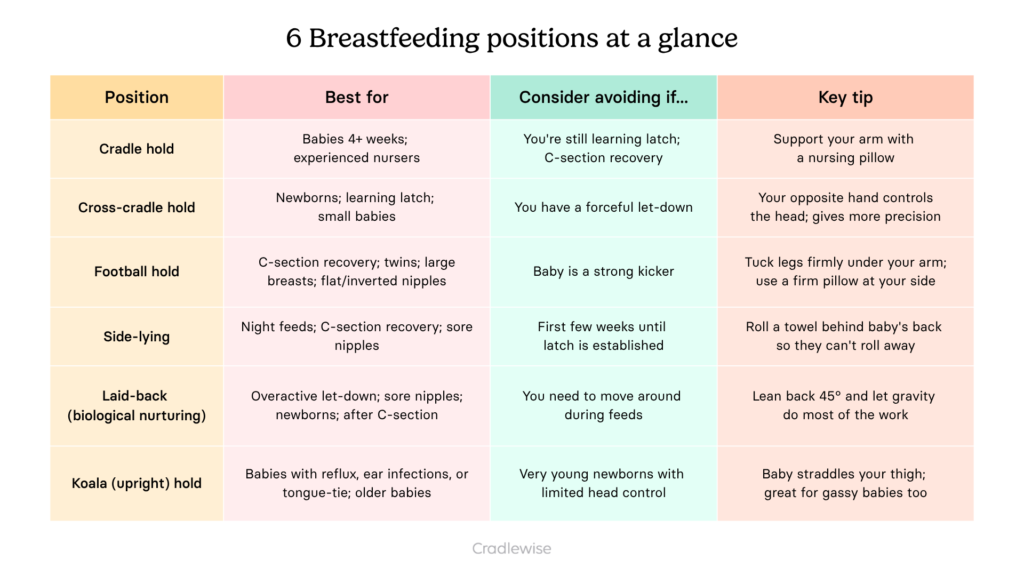
Breastfeeding positions at a glance
Use this table to find the position that suits your situation. Detailed guidance for each follows below.
6 Best breastfeeding positions and what to expect
“ In my experience, the ‘best’ breastfeeding position is the one where both you and your baby feel comfortable, supported, and connected, and that will likely change over time. In the early days, some parents feel most bonded with eye contact in the cradle or laid-back hold, while others appreciate the control and visibility of the football hold, especially after a cesarean birth.”
Here are six different breastfeeding positions and how to do each one of them:
1. Cradle hold breastfeeding position
The most commonly seen position, and often the first position parents try, especially as their baby starts to gain head and neck strength.
Your baby lies across your body, their head resting in the crook of your elbow, their body along your forearm. Their mouth is at nipple height, the full front of their body facing yours. It creates closeness and eye contact, which many moms find comforting and grounding.
- While sitting, use a nursing pillow to bring the baby up to your level; your arms shouldn’t be carrying the weight alone.
- Support your breast in a C-hold: thumb on top, fingers underneath, well back from the areola.
- As this position gives you less control over head positioning than the cross-cradle, most parents find it works better after the first few weeks when latch is established.
- If you have had a C-section, you may find this position puts pressure on your abdomen.
2. Cross-cradle hold breastfeeding position
The cross-cradle hold is perfect when you’re still mastering the latch. It’s especially helpful for newborns or smaller babies who need more guidance.
Similar in appearance to the cradle hold, but your opposite hand supports your baby’s head, giving you more control over positioning.
- Your supporting hand forms a ‘second neck’ for your baby. Thumb behind one ear, fingers behind the other, palm between the shoulder blades.
- If you’re nursing on the right breast, your left hand supports your baby’s head at the base of the skull and not the back of the head, which causes them to push back against you.
- Your other hand supports your breast, helping you guide the nipple into their mouth.
- Once your baby latches well, you can shift to the cradle hold for comfort.
Cradlewise Tip: If you’ve tried latching several times without success, pause and try skin-to-skin for a few minutes first. Skin-to-skin contact activates your baby’s feeding instincts and often makes the next latch attempt much easier.
3. Football breastfeeding position (clutch hold)
Your baby is tucked under your arm like a rugby ball, their legs pointing behind you, their head in your palm at the level of your breast, supporting their neck and upper back, and allowing their head to tilt back slightly.
- Use a firm pillow at your side to support your arm and bring your baby to nipple height.
- Support your breast in a C-hold. Your baby faces up, mouth to nipple.
- It gives you a clear view of the latch and helps avoid pressure on your tummy, especially after a C-section.
- Especially useful for parents with larger breasts, flat or inverted nipples, or twins nursing simultaneously.
4. Side lying breastfeeding position
Both you and your baby lie on your sides facing each other. Your baby’s mouth is level with your lower breast. It’s relaxed, hands-free, and great for keeping skin-to-skin contact.
- Place a pillow between your knees and another behind your back for your own comfort.
- Once latched, you can rest your arm rather than supporting your baby’s weight.
- A rolled towel or small blanket tucked behind your baby’s back keeps them in position.
- Most comfortable for night feeds and C-section recovery. Practice during daytime first to get confident with the latch before using at night.
Cradlewise Tip: Side-lying is the position most associated with feeding in bed. The AAP advises against falling asleep while nursing in an adult bed. If you’re using this position at night, have a plan to transfer your baby back to their own sleep surface once the feed is complete.
“ Alignment of the body in the process of feeding has a direct influence on muscle tension, hormonal reaction, and session length. The side-lying position takes the weight off the mother so she can continue feeding 10 to 15 minutes longer without discomfort. This additional time tends to reinforce the discharge of oxytocin which facilitates bonding and milk flow.”
5. Laid back breastfeeding position (biological nurturing)
You recline at roughly 45 degrees, well-supported by pillows, not flat on your back, and your baby lies face-down on your chest, belly to belly with you.
Gravity keeps them in place while their natural feeding reflexes allow your baby to lead the way with minimal guidance from you. It’s especially great for first feeds, skin-to-skin bonding, and easing into a more natural latch.
- This position is particularly effective for parents with a forceful let-down, as the uphill flow slows milk delivery.
- Use pillows behind your neck and under your arms for extra comfort.
- Newborns often latch most easily in this position because it activates primitive rooting reflexes.
- Works after C-section because your baby’s weight is on your chest, not your abdomen.
6. Koala breastfeeding position (upright hold)
Your baby sits straddling your thigh or hip, upright with their spine and head straight. They face the breast, latching while sitting rather than lying down.
- The upright position keeps milk flowing downward and reduces reflux and ear pressure during feeds.
- Particularly useful for babies with tongue-tie, ear infections, or any condition where lying flat makes feeding uncomfortable.
- Older babies who want to look around while feeding often settle better in this hold because they can still see you and the room.
When to call a lactation consultant
While most breastfeeding challenges can be improved with simple adjustments to positioning, there are times when you should seek expert help. Reach out to a lactation consultant or healthcare provider if you notice any of the following:
- Severe nipple pain that doesn’t improve after correcting your baby’s latch.
- Cracked, bleeding, swelling, or blistered nipples.
- White spots on the nipples or areola.
- Signs of mastitis such as fever, chills, breast redness, or a hard, painful lump.
- Persistent engorgement that makes latching difficult even after feeding or pumping.
- Sharp, burning breast pain during or between feeds.
- Your baby is not gaining weight or having fewer than 6 wet diapers per day after the first week.
- Frequent coughing, choking, or gagging during feeds despite trying different breastfeeding positions to prevent choking.
- You suspect tongue-tie (your baby can’t stick their tongue past their lower lip, or makes a clicking sound at every feed).
Cradlewise Note: The National Women’s Health and Breastfeeding Helpline is available at 1-800-994-9662, and the International Lactation Consultant Association (ILCA) has a searchable directory to find a certified lactation consultant near you.
Conclusion
If something feels off like pain, shallow latch, or stress during feeds, don’t be afraid to try different positions. And, remember, you’re not alone. A certified lactation consultant can offer hands-on support, check the latch, and help you find what works best for your body and your baby’s needs.
This journey is full of trial and tenderness. You are learning from each other, feed by feed, hold by hold.
FAQs
Q: What is the best position to breastfeed after C-section?
A: The football hold, side-lying and laid-back nursing positions are recommended after a C-section because they don’t put pressure on the abdominal incision. Using a pillow between your baby and your stomach can add extra comfort.
Q: What is the best position for latching breastfeeding?
A: Cross-cradle hold and side lying position give you better control to guide your baby for a deeper latch.
Q: What is the best position to breastfeed to avoid choking?
A: The laid-back position or side-lying position allows better control of milk flow and helps avoid gagging. Keep your baby’s head slightly elevated to prevent choking.
Q: What are the best breastfeeding positions to reduce air intake?
A: Cross-cradle hold or laid-back position promotes a deep latch leading to your baby swallowing less air, reducing gas and fussiness.
Q: How to keep baby awake while breastfeeding?
A: Gently tickling your baby’s feet, talking to them, unwrapping the swaddle or taking them out of their sleep sack, or switching breasts can keep your baby awake while breastfeeding. Football hold and upright sitting positions can also help keep your baby awake.
Q: What are the best breastfeeding positions for reflux?
A: Laid back position or holding your baby in a cradle hold are best breastfeeding positions for reflux as they keep your baby’s head higher than their tummy. Keeping them upright for 20–30 minutes after feeding also helps reduce spit-up.
Q: Is it normal for breastfeeding to hurt?
A: A brief sting in the first 30-60 seconds as baby latches is common, especially in the first week. Pain that continues through a full feed, causes you to dread nursing, or leaves your nipples cracked or blistered is not normal. Adjust the latch or try a different position.
You may also like:
- Next-level baby gear that’ll make you say, “Why didn’t I have this sooner?”
- Why can’t babies have honey (even in baked goods)
- 15 sweet things to put in your baby’s time capsule
Sources:
- Tummy to tummy. NHS. 2026. Breastfeeding: positioning and attachment.
- Check alignment. AAP. 2022. Ensuring Proper Latch On While Breastfeeding.
- Nipple soreness. Did you know? La Leche League International. 2026. Positioning and Latch.
- Your baby seems frustrated or keeps pulling off. NHS. 2026. Positioning and latching.
You may also like