Pregnancy
0 min read
15 Weird signs labor is near

Medically Reviewed Juliana Parker, Founder/Registered Nurse at Nurse Core Triage, Inc
Written by Cradlewise Staff
As your due date gets closer, every little change in your body can make you wonder ‘is this it?’
While most of us know the classic signs of labor like contractions and water breaking, there are also weird signs labor is near that can feel confusing, surprising, and sometimes even a little funny. From sudden bursts of energy to unexpected nausea, your body has its own way of preparing for birth.
We will walk you through the most common and unusual signs of labor, so you can feel more prepared, less anxious, and ready to recognize when your baby is truly on the way.
We also talked to Juliana Parker, Founder/Registered Nurse at Nurse Core Triage, Inc, and Kathleen Dowd, CNM, NP, MSN, Founder and Women’s Health/Mental Health Clinician at Gentle Touch Wellness. Kathleen has over 30 years of experience in physiologic birth/reducing C/S at one of the main KP campuses in the Bay Area (SF).
Kathleen says, “It does not serve them (expecting moms) to go to the hospital before they need to be there. Their bodies will progress the best in their own environment, where they feel safe and supported, they are in a familiar space. Fear and anxiety can really disrupt the hormonal regulation of labor and birth.”
Read on to know more such nuggets of wisdom on perinatal health during labor.
Weird signs labor is near: What your body is telling you
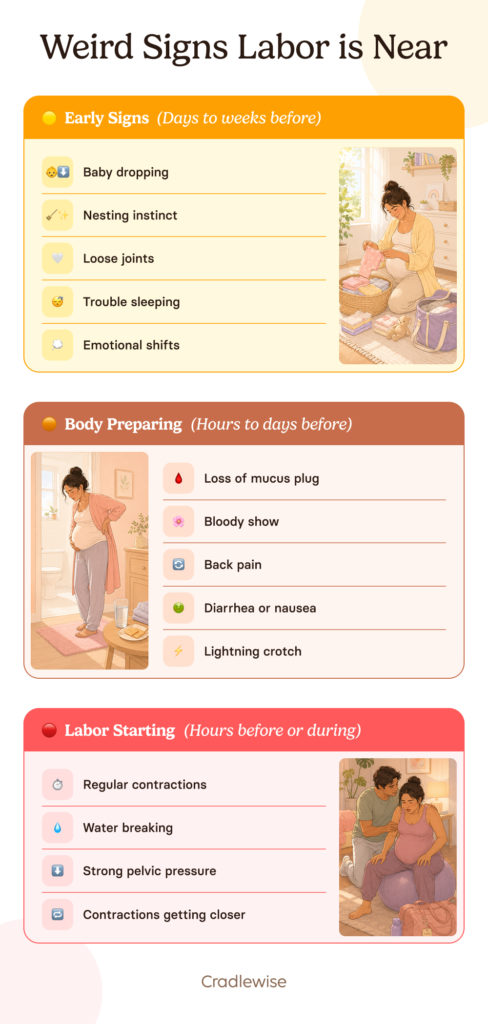
15 weird signs labor is near
1. Lightening or baby dropping
This is when your baby moves lower into your pelvis in preparation for birth. You might feel like you can breathe more easily, but at the same time, there’s increased pressure on your bladder. This can happen weeks or even hours before labor begins.
2. Increased pelvic pressure
As your baby settles deeper, you may feel heaviness or pressure in your lower abdomen and pelvis. You might feel uncomfortable while walking. It’s your body’s way of getting ready for delivery.
3. Loss of mucus plug
During pregnancy, a glob of mucus sits in the cervix to help prevent bacteria from moving from the vagina to the uterus. As your cervix softens in preparation for labor, that glob can fall out, and you might notice a thick, jelly-like discharge.
This is often one of the more obvious signs labor is coming soon.

Cradlewise Smart Crib
Smarter Sleep for Your Baby
An award-winning crib—loved by parents, approved by experts.
0 to 24 months of use
Automatic soothing
Built-in video & sound machine
AI-powered sleep insights
Customizable soundtracks
Get 2 extra hours of sleep nightly
4. Bloody show
You might notice a pink or slightly bloody discharge as the cervix begins to open. It may happen gradually or all at once.
Kathleen Dowd assures, “It is normal to have a little bit of spotting and bleeding as your cervix starts to shorten and dilate. Do not be afraid if you see a little bit of mucousy blood. That does not mean you have to go to the hospital/birth center. It means that things are falling into place as they should.”
5. Regular contractions
Braxton Hicks are often called ‘practice contractions’ and are usually felt after 16 weeks. They help to tone the uterus and prepare it (and you) for birth. The frequency of Braxton Hicks increases closer to labor as your body prepares itself.
However, unlike Braxton Hicks, true labor contractions become consistent, stronger, and closer together. They don’t ease with rest or movement. This is one of the clearest signs that labor is starting.

Did you know?
Braxton Hicks contractions (or false labor or practice contractions) have been named after John Braxton Hicks, an English doctor who first described these pre-labor contractions in 1872.
6. Water breaking
Your water may break before or during labor. This happens when the amniotic sac ruptures, releasing fluid. It might feel like a gush or a slow trickle (you’ll probably think you leaked). However, at the end of pregnancy, it’s very normal to have a lot of vaginal discharge and moisture, so it can be hard to tell if your water broke or if it’s just normal discharge.
Try this: Put a pad in your underwear. If you experience continual fluid leaking, chances are good that it’s your water breaking.
Once your water breaks, labor is usually not far off, and it’s time to contact your healthcare provider.
7. Diarrhea or loose stools
This is one of those “no one warned me” signs.
This happens due to hormonal changes, especially prostaglandins, which work to soften and relax your cervix in labor, but can also relax your GI tract. In the days or hours leading up to labor (as well as during labor), you may find that you have loose stools or diarrhea.
Crib note: Hydration is really important in labor, so if you have diarrhea, replenish the lost fluids by frequently sipping water.
8. Nausea or vomiting
You might feel slightly nauseous right before labor begins. It can feel similar to early pregnancy symptoms, but it’s actually your body preparing for the intensity ahead.
9. Nesting instinct or sudden burst of energy
You might suddenly feel the urge to clean, organize, or “get everything ready right now.” This burst of energy is commonly reported just before labor and is completely normal.
If you find yourself cleaning the kitchen, organizing the pantry, or arranging the nursery for your baby’s arrival, it might be a good sign.
Cradlewsie Note: Try not to overdo things, as you will need your energy during labor.
10. Persistent lower back pain
Back pain that feels deeper, more persistent, or rhythmic can be a sign of labor, especially if it doesn’t go away with rest. This pain is usually due to your baby settling into your pelvis, preparing for birth. If you experience dull and constant pain in the back towards the end of your pregnancy, it might be considered as one of the many weird signs that labor is near.
11. Lightning crotch
Sharp, sudden pains in the pelvic area are called the lightning crotch and can take you by surprise. These quick, shooting sensations happen as your baby presses on nerves in the pelvis. While they can be uncomfortable, they’re usually harmless and tell you that your labor is near.
12. Trouble sleeping or sudden exhaustion
Your body can play tricks with you. Some parents feel a surge of insomnia right before labor, while others feel unusually tired. Your body is either conserving energy or reacting to hormonal shifts.
13. Emotional shifts or mood swings
You might feel unusually emotional, anxious, or even quiet and withdrawn. You might find yourself tearing up watching a cute baby video or even your favorite sitcom. Hormonal changes and anticipation can bring on strong feelings as your body prepares for birth.
14. Joint looseness
Thanks to hormones like relaxin, your joints may feel looser, especially in the hips and pelvis, allowing for greater flexibility as your body prepares for labor. It also helps make childbirth easier as your baby can move through the birth canal due to expanding pelvis.
On the other hand, loose joints can leave you feeling slightly unbalanced or achy.
15. Vivid dreams or strong intuition
Many parents report intense dreams or a gut feeling that labor is near. While not medical signs, these emotional and mental cues often surface as your mind prepares for the big transition – to meet your baby.
Signs you are in active labor
You may notice:
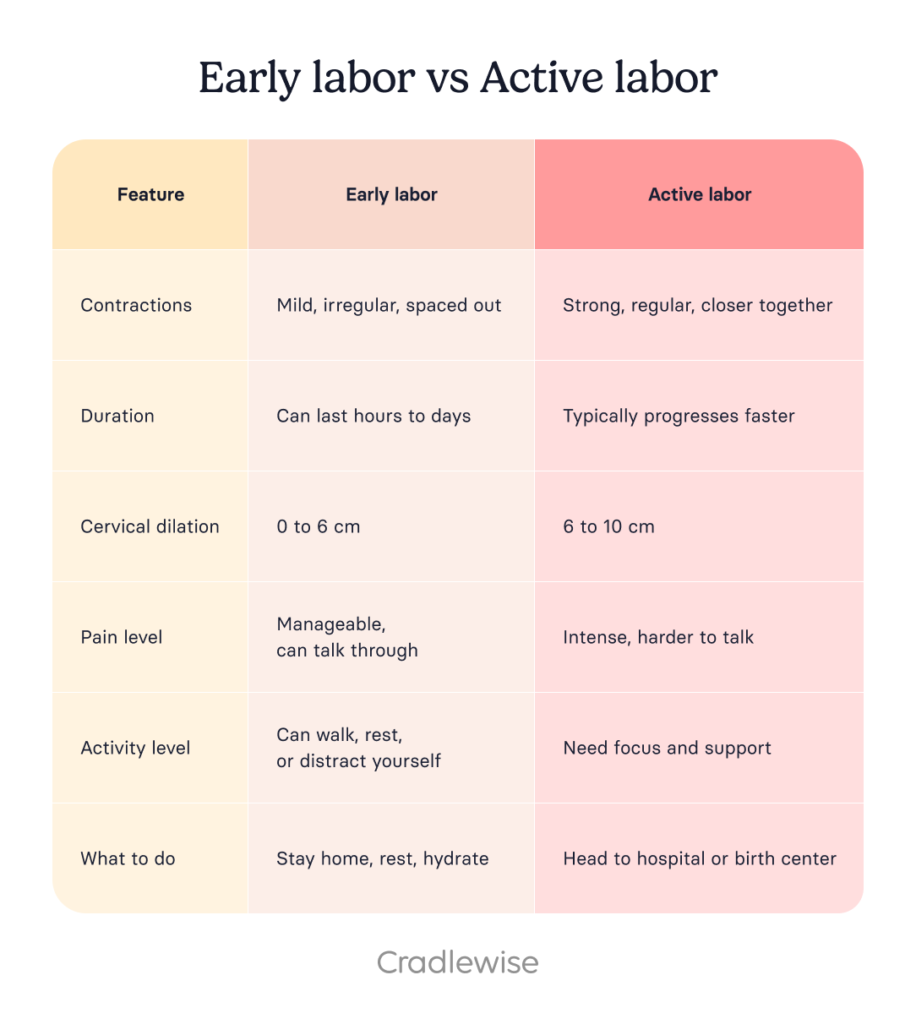
- Strong, regular contractions that come every 5 minutes consistently for an hour
- Contractions lasting about 45 to 60 seconds
- Pain that makes it hard to talk or walk through contractions
- Increasing pressure in your pelvis or lower back
- Cervix dilating beyond 6 cm
- Some bleeding
Juliana Parker says, “A common guideline is the 5-1-1 rule for first-time moms (contractions every 5 minutes, lasting 1 minute, for 1 hour) and the 7-1-1 rule for second or subsequent births (since labor can move faster).”
At this stage, your body is fully preparing to meet your baby, and it is usually time to head to your hospital or birth center.
Difference between early labor and active labor
Early labor might have more or less the same symptoms but on a lesser intensity, while active labor is when things become more intense, consistent, and persistent.
Signs of labor that warrant a call to the doctor
While some signs can seem normal and some confusing, there are some that require immediate medical attention. Call your doctor if you notice:
- Your bag of water breaking, especially if fluid is green or brown
- Heavy bleeding like a period
- Decreased baby movement
- Severe or constant abdominal pain
- High fever or chills
- Contractions that are very intense, every 3 to 5 minutes
Conclusion
Labor does not always begin with a dramatic moment. Sometimes, it starts quietly, with subtle and even strange signals from your body.
Understanding these weird signs labor is near can help you feel more in control and less surprised as the big day approaches. Every pregnancy is different, and your experience will be uniquely yours.
Trust your instincts, stay connected with your care team, and have faith in your body as it knows what to do.
FAQs
Q: Is diarrhea a sign of labor?
A: Yes, diarrhea can be a sign that labor is near. Hormonal changes, especially the release of prostaglandins, help relax your body in preparation for birth, and that can also affect your digestive system. Many people notice loose stools in the 24-48 hours before labor begins.
Q: Is nausea a sign of labor?
A: It can be. Some parents experience nausea or even vomiting as labor approaches due to hormonal shifts and the physical intensity building in the body.
Q: What are the stages of labor?
A: Labor is typically divided into three stages. The first stage includes early and active labor, where contractions begin and the cervix dilates. The second stage is when you push and deliver your baby, and the third stage is the delivery of the placenta.
Q: Can I be in labor and not know it?
A: Yes, especially during early labor. Early contractions can feel mild, irregular, and easy to miss or mistake for cramps or back pain. Some parents only realize they are in labor once contractions become more consistent and intense.
Q: Are there ways to induce labor naturally?
A: Some gentle methods like walking, staying upright, or relaxation techniques may help encourage labor if your body is already close. However, it’s important to talk to your healthcare provider before trying anything, as not all methods are safe for every pregnancy.
Q: What is active labor?
A: Active labor is the stage when contractions become intense, regular, and closer together (they come every 5 minutes consistently for an hour and last about 45-60 seconds) while the cervix dilates more quickly. This is usually when it is time to head to the hospital or birthing center.
Q: What are the signs labor is 24-48 hours away?
A: Some common signs include diarrhea, nausea, back pain, loss of the mucus plug, and a sudden burst of energy or nesting. You might also notice stronger Braxton Hicks contractions or increased pelvic pressure. These signs don’t guarantee exact timing, but they often mean your body is getting close.
Q: If I see bloody discharge, should I leave for the hospital?
A: Kathleen says, “It is normal to have a little bit of spotting and bleeding as your cervix starts to shorten and dilate. Do not be afraid if you see a little bit of mucousy blood. That does not mean you have to go to the hospital/birth center. If the bleeding is heavy like a period, you do need to go to the hospital to get checked out.”
Q: What are regular contractions?
A: Regular contractions come at predictable intervals, gradually get closer together, last longer, and become more intense over time. Unlike false labor contractions, they don’t go away with rest or changes in position.
More posts you might like:
More posts you might like:
- Perineal massage during pregnancy: what it is, when to start, and does it really help?
- Why a pregnancy body pillow is a pregnant person’s best friend
- Tips on baby proofing home before baby arrives
- Moms share their experiences of using a breast pump


You may also like


