Science of baby sleep
8-month-old baby sleep guide
By Cradlewise Staff

Science of baby sleep
8-month-old baby sleep guide
By Cradlewise Staff
Night sleep
Daytime naps
Total sleep
10-12.5 hours
2-3.5 hours
12-16 hours

Night sleep
10-12.5 hours

Daytime naps
2-3.5 hours

Total sleep
12-16 hours
At eight months, your baby is getting bigger and more active. Your baby is likely crawling, maybe pulling to stand, babbling more, and suddenly much more aware that you exist as a separate person who can leave the room. All of that developmental momentum is wonderful to watch, but it can also throw your baby’s sleep into a temporary tailspin.
You may be feeling the nights are less predictable than they did a month ago. We spoke with Dr. Hormuz Nicolwala, Director of the Infant Apnea Program at Stony Brook Children’s Hospital, NY, to understand what’s actually happening at this age, how your baby’s sleep and feeding patterns are changing, and what you can do to help promote more restful nights.
How much sleep does an 8 month old need?
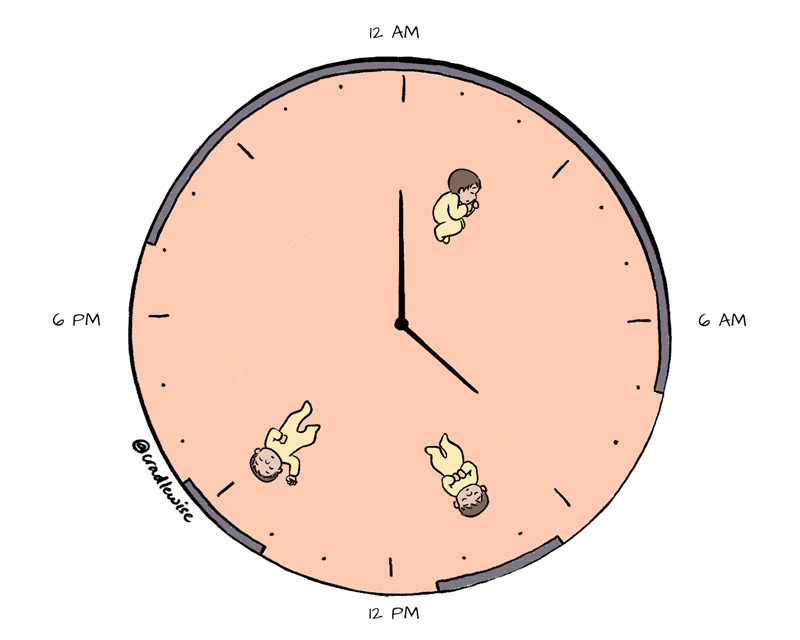
Most 8-month-olds need 12 to 16 hours of sleep across a 24-hour day, with many able to achieve closer to 13 to 14 hours of sleep. That typically breaks down to 10 to 12.5 hours overnight and 2 to 3.5 hours of daytime naps.
Wake windows at this age vary more than at almost any other stage, mainly because your baby is somewhere in the middle of dropping their third nap. On average, expect wake windows between 2 and 3.5 hours, but don’t be surprised if your baby’s actual pattern changes week to week.
Transitioning from 3 naps to 2
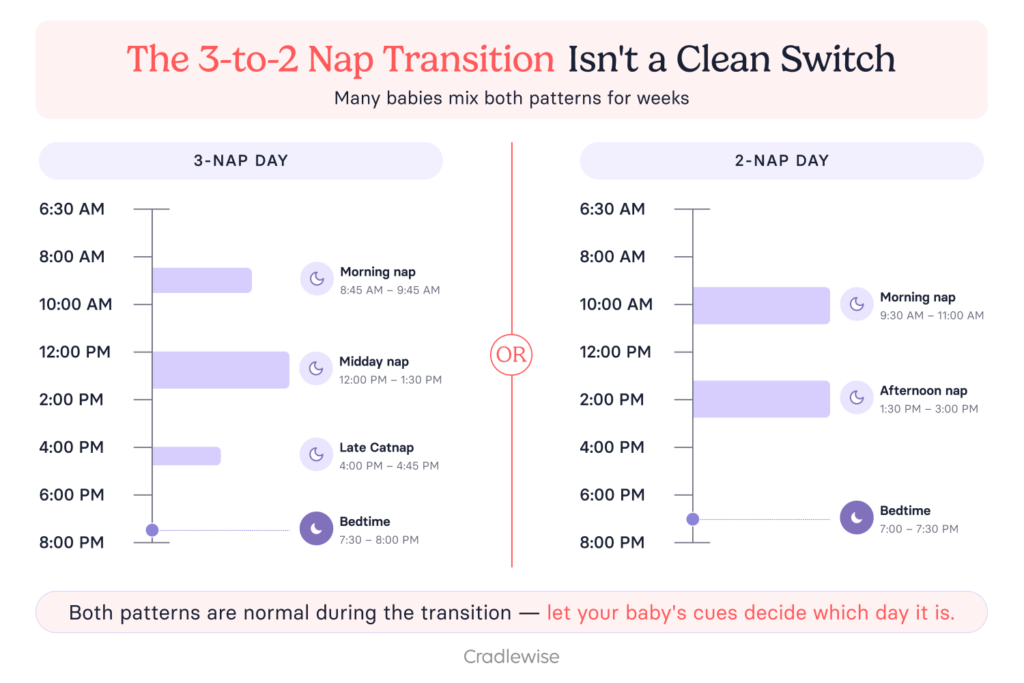
This is the defining sleep event of month 8 for a lot of families, but it rarely happens all at once.
Dr. Hormuz Nicolwala says, “Around 8 months, many babies are beginning the transition from three naps to two.”
Signs that your baby may be ready include consistently:
- fighting or refusing that third nap,
- taking much longer to fall asleep for it, or
- having the late nap interfere with bedtime.
- You may also notice that your baby can comfortably stay awake longer between naps and still seem happy and well-rested with two naps.
The key word here is “consistently.” A single rough nap doesn’t mean it’s time to drop one. If a baby normally takes that third nap without a problem and suddenly refuses it for a day or two, it is not a strong enough indication to change the schedule.
Cradlewise note: It’s genuinely normal for your baby to have 3-nap days and 2-nap days mixed together for weeks. If your baby skips the third nap, an earlier bedtime that evening can help make up the difference.
The next nap drop for your baby will be somewhere between 18 and 24 months. That is when most babies transition to one nap.
Sample 8-month-old sleep and feeding schedule
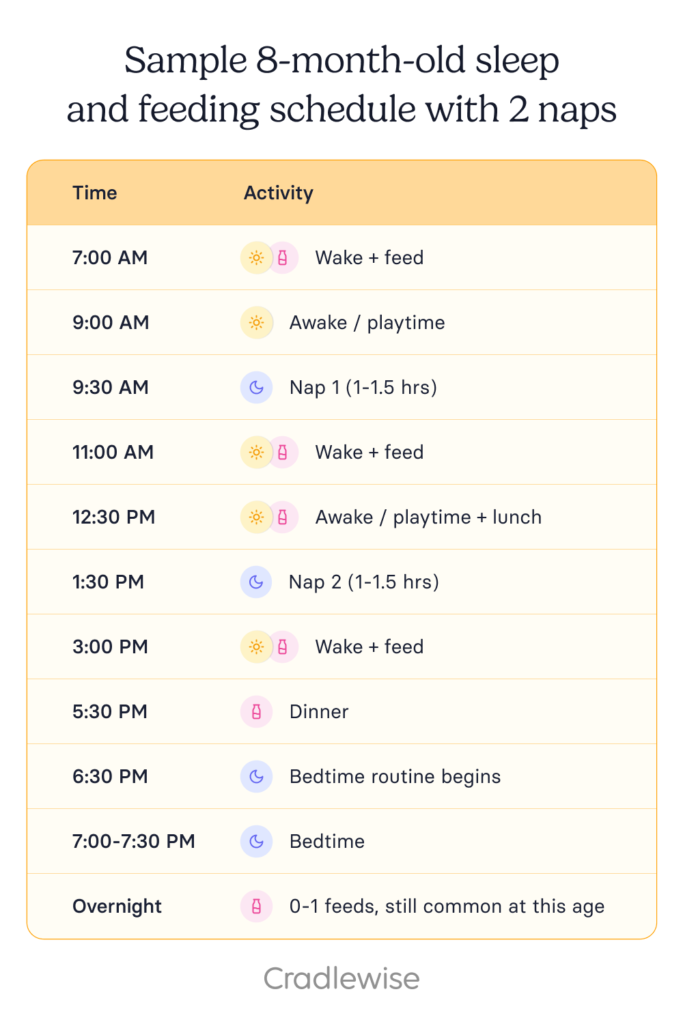
Every baby is different, but here’s a sample schedule for an 8-month-old baby who has settled into two naps.
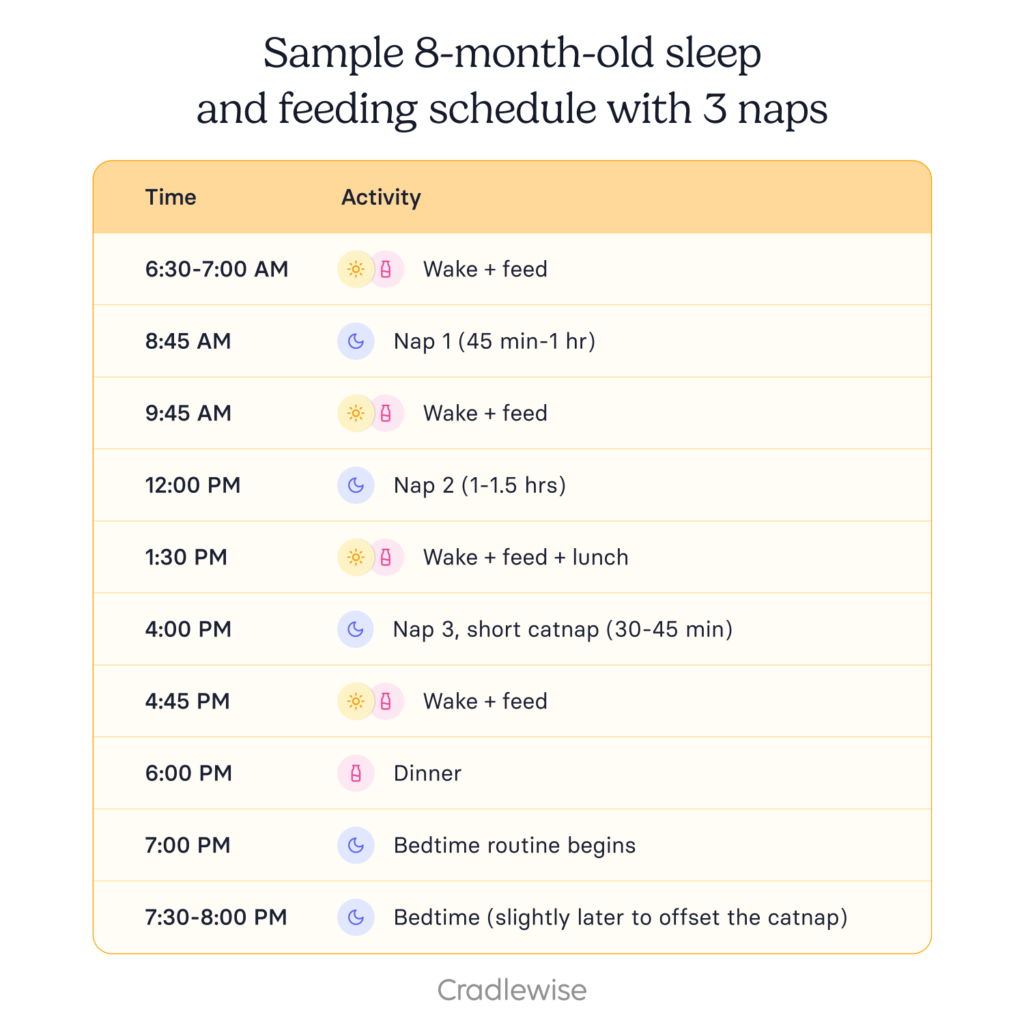
If your baby hasn’t fully transitioned from three naps yet, here’s what a 3-nap day often looks like with a catnap towards the end of the day (around 4 PM) with a slightly later bedtime.
8-month-old baby sleep milestones (the ‘regression’)
You may have heard the term “8-month sleep regression.”
Sleep regressions tend to happen anytime your baby goes through a significant developmental leap, whether physical, emotional, or neurological, and 8 months is a genuinely busy month on all three fronts.
Dr. Nicolwala adds, “What tends to help most is consistency: keep a predictable bedtime routine, maintain an appropriate sleep schedule, and give the baby plenty of opportunities to practice new motor skills during the day.”
If disrupted sleep is prolonged, worsening, or accompanied by feeding, growth concerns, or abnormal breathing during sleep that’s the point to loop in your pediatrician.
What’s going on in your baby’s brain?
A few months ago, your baby couldn’t sit up unassisted. Now they may be crawling, and possibly pulling to stand. That’s a huge developmental leap in a short window.
One of the bigger, less visible transformations happening right now is your baby learning to distinguish themselves from you. For a long time, your baby has been experiencing you and them as one unit, which is part of why separation anxiety often intensifies around this age. The brain is also getting better at processing emotions like sadness or fear, which can feel overwhelming for your baby who doesn’t yet have the tools to manage it.
Dr. Nicolwala explains, “When a baby learns to pull to stand, they suddenly have a brand-new skill they want to practice everywhere, including the crib. At the same time, separation anxiety can make them much more aware that their parent has left the room. So you can end up with a baby who pulls up in the crib, realizes Mom or Dad isn’t there, and then becomes upset. The parent comes back in, the baby settles, and then they stand up again. It can become a bit of a cycle.”
This is a normal developmental phase, and not something to worry about.
According to Dr. Nicolwala, the following can help you and your baby:
- Practice standing, sitting, and getting back down during the day.
- A predictable bedtime routine and a consistent response.
- Acknowledge the separation anxiety rather than treating it like a behavioral problem.
- Give your baby plenty of connection and reassurance before bedtime, while still keeping the bedtime routine consistent.
Cradlewise Note: The CDC doesn’t publish milestones specific to exactly 8 months; instead it groups guidance for 6 to 9 months. By 9 months, most babies show early signs of stranger anxiety, respond to their name, babble, sit without support, and crawl. Bring any concerns to your pediatrician rather than comparing week to week.
Standing in the crib
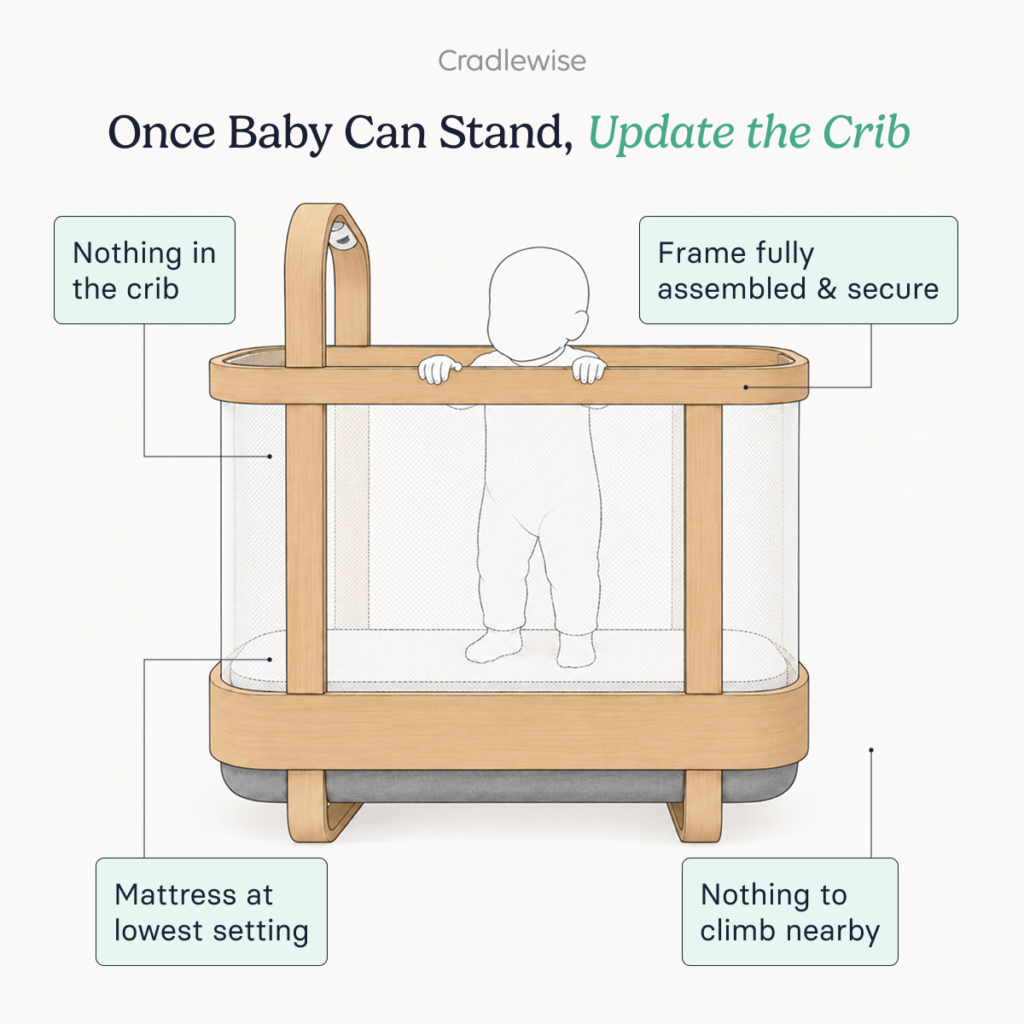
Pulling to stand is an exciting milestone for your baby, that usually happens between 8 and 10 months. Some babies get so excited about standing that they do it repeatedly, then get stuck and frustrated because they haven’t figured out how to sit back down yet.
“ Practicing standing, sitting, and getting back down during the day can be very helpful. If the baby stands up at bedtime, I don’t think parents need to immediately lay them down every single time. If they’re safe and otherwise calm, giving them a little opportunity to figure out how to get themselves back down is reasonable.”
Keeping safe sleep
While you and your baby are excited about this new developmental milestone, keep in mind it also changes what a safe crib setup looks like.
Dr. Nicolwala says, “The biggest change is really about safety, not the sleep schedule.”
He suggests a few measures to keep your baby’s sleep area safe:
- Once a baby can pull to stand, the crib mattress should be at its lowest setting.
- The crib should remain completely bare, no bumpers, pillows, blankets, stuffed animals, or anything else the baby could use to climb.
- Parents should also make sure the crib is properly assembled and that furniture, cords, monitors, or other objects nearby aren’t within the baby’s reach.
For a full safe sleep refresher now that your baby is more mobile, see our safe sleep checklist.
Why is my 8-month-old waking up so early?
“ It can be a schedule issue, but early waking isn’t always a sign that the schedule needs to be changed. If an 8-month-old is consistently waking very early, particularly if they’re happy and ready to start their day, I would look at the entire 24-hour sleep pattern— daytime naps, wake periods, bedtime, and total sleep.”
Dr. Nicolwala adds: There are plenty of other possibilities. Hunger, teething, illness, developmental changes, light coming into the room, temperature, and environmental noise can all contribute. At this age, babies are also learning new skills like crawling and pulling to stand, and sometimes they’re simply too excited about those skills to sleep as well as they previously did.
Cradlewise tip: A common assumption is that a later bedtime automatically leads to a later wake-up. Dr. Nicolwala notes that’s often not the case for babies this age, so if early waking is new, look at the whole day’s sleep pattern before shifting bedtime later.
Activities for an 8-month-old
Just like with younger babies, one of the most important activities you can do with your baby at 8 months old is to play and interact with them. Playing encourages brain development and helps babies learn and grow. It also helps establish sleep-wake cycles to teach their brains when it’s time to be active and when it’s time to sleep.
There is no right or wrong way to play, but if you need some ideas, here are some CDC-approved activities for 8-month-olds:
- Repeat words your baby babbles or give them easy words to say after you, such as “babababa.”
- Set toys just out of reach so your baby has to scoot, crawl, or move to reach them.
- Teach your baby some sign language.
- Read together daily.
- Practice waving “bye-bye” or shaking your head and let them imitate you.
Toys for 8-month-olds
You might have noticed that even with a nursery full of toys, your baby loves things like cardboard boxes and the remote control. But if you want things that can help your 8-month-old’s development, here are some ideas:
- Wooden building blocks: Your baby will be learning to stack blocks and knock them over. Not only does it build fine motor skills, but it also teaches cause and effect.
- Books: Peek-a-boo flaps and touch-and-feel features are always a great idea.
- Sensory toys: Touching and feeling different textures is great for brain development.
- A basic ball: Sometimes simple is best with babies, and a classic, large ball is perfect for rolling back and forth. This game will help your baby practice their new skill of sitting up, and they will absolutely delight in “catching” it when it gets to them.
8-month-old feeding tips
According to the American Academy of Pediatrics (AAP), you can introduce more textured foods such as yogurt, oatmeal, mashed banana, mashed potatoes, scrambled eggs, cottage cheese, or even thicker or lumpy pureed vegetables.
To check out the sample menu for your baby, you can visit the AAP site.
How much should an 8-month-old eat?
Most babies need between 750 and 900 calories a day at this age, with roughly half coming from breast milk or formula, per the AAP. For bottle-fed babies, that’s roughly 24 ounces of milk or formula daily. If you’re breastfeeding, continue nursing on demand; your baby may nurse more during teething, growth spurts, or disrupted sleep for extra calories and comfort.
How much should an 8-month-old weigh?
Average weight is around 22 pounds for boys and 19.5 pounds for girls, per WHO growth standards. Weight varies a lot from baby to baby, so following your own baby’s growth curve at well-child visits helps more than comparing it to the average.
How often should an 8-month-old eat?
Breast milk or formula should still make up more than half of your baby’s daily calories, so offer that first at meals and snacks. After that, give 1 to 2 tablespoons of food and see if they ask for more. As per the CDC, you should give your child something to eat or drink every 2-3 hours, or 5-6 times a day, that is roughly 3 meals and 2-3 snacks daily.

Cradlewise Smart Crib
Smarter Sleep for Your Baby
An award-winning crib—loved by parents, approved by experts.
0 to 24 months of use
Automatic soothing
Built-in video & sound machine
AI-powered sleep insights
Customizable soundtracks
Get 2 extra hours of sleep nightly
How to support your 8 month old’s sleep
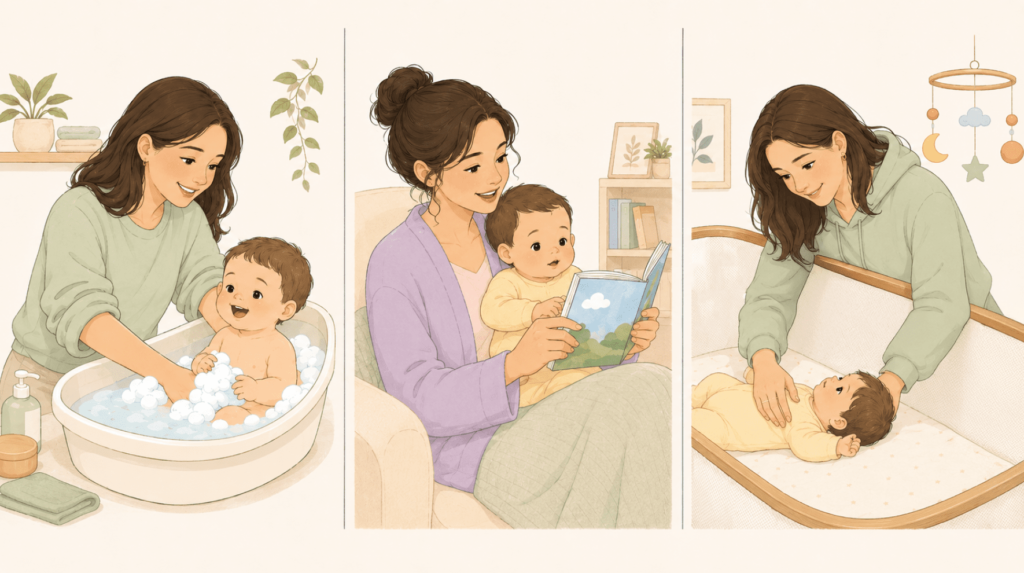
During your baby’s eighth month, it can be helpful to keep the following sleep tips in mind:
Stay flexible with naps
Eight months can be an odd stretch for sleep, especially if your baby is in daycare on a 2-nap schedule but genuinely still needs three at home.
Don’t force the transition; let your baby’s cues lead, allow your baby the extra sleep when they need it and offer an earlier bedtime on days the third nap gets dropped.
Aim for a bedtime around 7 to 8 PM
An earlier bedtime tends to reduce nighttime awakenings and bedtime struggles. If evenings feel rushed, trim the routine rather than cutting it: one book instead of three, a shorter bath, same order every night.
Stash an extra pacifier
If your baby uses a pacifier and has the fine motor skills to find it themselves, placing one or two extras in the crib at bedtime improves the odds they can self-soothe back to sleep without calling for you.
Practice standing and sitting during the day
As covered above, giving your baby chances to practice getting from standing back to sitting outside of the crib can reduce how often they get stuck and frustrated at bedtime.
Keep the response consistent
We have mentioned earlier too that consistency is really the key.
Whether it’s separation anxiety, standing, or general overtiredness driving the wake-ups, a predictable, calm response from you, rather than a different approach each night, tends to help your baby settle into the new normal faster.
Conclusion
Eight months brings a lot of active development, all at once: a nap transition, a new physical skill, and a stronger awareness of separation from you. None of that means your baby’s sleep schedule is broken.
As Dr. Nicolwala put it, these periods of disrupted sleep are usually temporary and there isn’t a single perfect schedule that works for every 8-month-old, just a safe sleep environment, a predictable routine, and an approach that fits your baby. Give it consistency and a little time, and most of this evens out on its own.
FAQs
Q: Can an 8-month-old sleep through the night?
A: Many can, but plenty still wake for a feed. There isn’t a universal age when every baby should sleep 10-12 hours without waking, and a night feed at 8 months doesn’t need to be eliminated if your baby is growing well.
Q: How many naps should an 8-month-old take?
A: Most babies at this age are either still on 3 naps or transitioning to 2, with the two-nap pattern usually landing around 1 to 1.5 hours per nap. Expect some overlap between both patterns for a few weeks during the transition.
Q: What are normal wake windows for an 8-month-old?
A: Typically 2 to 3.5 hours, though this varies more at 8 months than at most ages, since your baby is somewhere in the middle of dropping a nap.
Q: How long does the 8-month sleep regression last?
A: There’s no fixed timeline. For some babies it resolves in several days; for others it takes a few weeks. Consistency in routine tends to help.
Q: Does an 8-month-old still need night feeds?
A: Many do, and that’s within the range of normal. What matters more than a fixed age cutoff is your baby’s overall growth, daytime intake, and whether the feed still seems nutritionally driven.
Q: Why is my 8-month-old waking up so early?
A: It could be a schedule issue, but it isn’t always. Hunger, teething, illness, light, temperature, noise, or excitement about new skills like standing can all play a role. Look at the full 24-hour pattern before assuming bedtime needs to shift.
You may also like:
- How to wean off pumping: A step-by-step guide.
- 10 thoughts every parent has during a sleep regression―and how to deal.
- Rediscovering intimacy and sex after birth: A guide for new parents.
Sources:
- 8-month sleep regression. SleepFoundation. 2025. 8-Month Sleep Regression.
- Guidance for 6 to 9 months. CDC. 2026. Important Milestones: Your Baby by Nine Months
- Most babies need between 750 and 900 calories a day. HealthyChildren. 2025. Sample Menu for a Baby 8 to 12 Months Old
- WHO growth standards. CDC. 2024. WHO growth standards for use in US infants and children birth to 2 years.
- How often should an 8-month-old eat. CDC. 2025. How Much and How Often To Feed.
Sources:
- 8-month sleep regression. SleepFoundation. 2025. 8-Month Sleep Regression.
- Activities for an 8-month-old. CDC. 2026. Milestones by 9 Months.
- Guidance for 6 to 9 months. CDC. 2026. Milestones by 9 Months.
- Most babies need between 750 and 900 calories a day. HealthyChildren. 2025. Sample Menu for a Baby 8 to 12 Months Old.
- WHO growth standards. CDC. 2024. WHO growth standards for use in US infants and children birth to 2 years.
- How often should an 8-month-old eat. CDC. 2025. How Much and How Often To Feed.